UCF Team Finds Experimental Evidence of Altermagnetism in a Layered Cobalt Material
The signature of a recently recognized form of magnetism in Co₁/₄TaSe₂ could point toward faster, more efficient spintronic electronics.
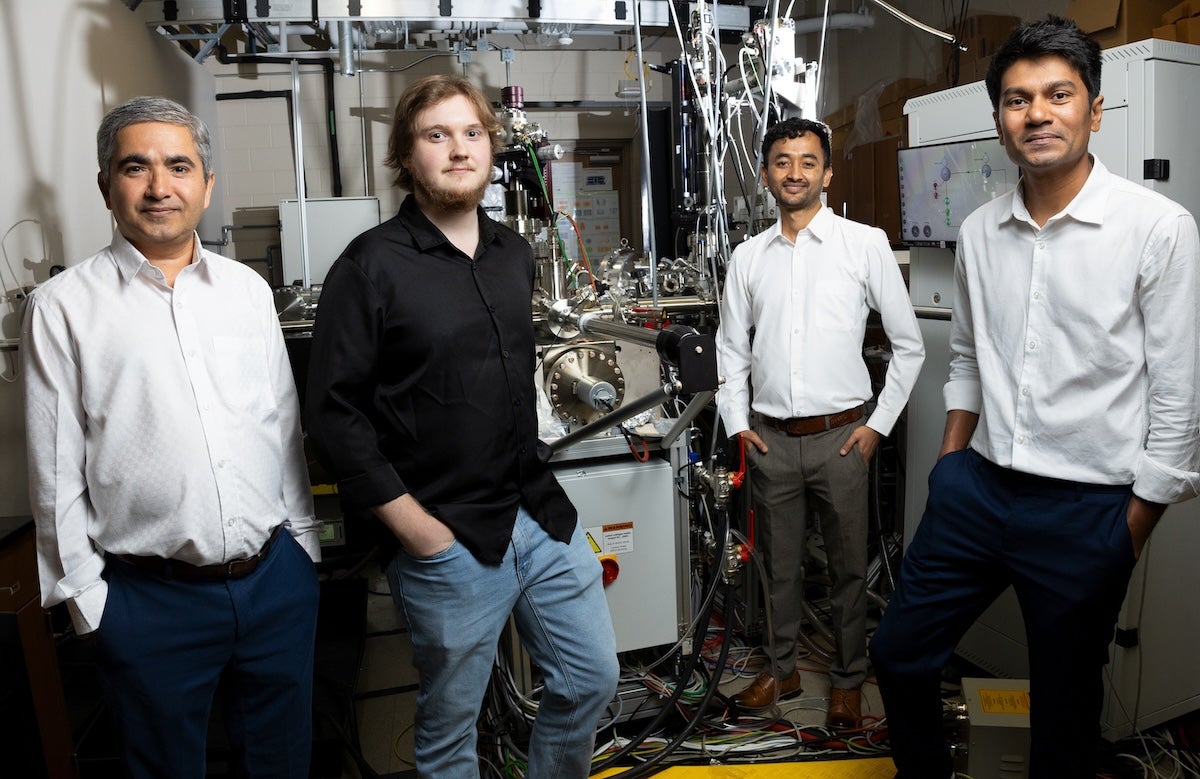
Physicists at the University of Central Florida say they have found experimental evidence of altermagnetism in a thin, layered material, a result that could help electronics use the spin of electrons rather than relying only on their electric charge.
The team, led by physics professor Madhab Neupane, reported signatures of altermagnetism in Co₁/₄TaSe₂, a layered compound containing magnetic cobalt atoms. The work appears in the journal Nature Communications and was funded by the U.S. Department of Energy's Office of Science.
Altermagnetism is a recently recognized third kind of magnetic order. It combines useful features of the two familiar types. Like an antiferromagnet, an altermagnet produces no stray magnetic field, so components built from it could be packed tightly without interfering with each other. Unlike a standard antiferromagnet, though, it can generate and detect spin currents, which are flows of electron spin through a material.
"These materials are distinguished from conventional antiferromagnets by their ability to generate and detect spin currents," Neupane said.
To find the effect, the researchers used angle-resolved photoemission spectroscopy, known as ARPES, which maps the energy levels of electrons in a crystal. They first used high-resolution measurements that are insensitive to electron spin to see splitting in the energy levels. They then added spin-resolved ARPES, which showed that the split levels carried opposite spin polarizations. That pairing is the characteristic fingerprint of an altermagnet.
The material's layered structure matters. Layers can be modified relatively easily, which gives scientists a way to study how altermagnetism interacts with other quantum phenomena and to tune it.
The potential applications are the draw. The researchers point to spintronic devices, ultrafast memory, terahertz communication networks and energy-efficient electronics, all technologies that need compact parts free of magnetic interference.
The result is early. Confirming a new magnetic state in one material is a step toward devices, not a device itself, and other groups will want to reproduce and extend the measurements. Still, altermagnets have drawn intense interest since being identified, because they offer a path that neither ferromagnets nor antiferromagnets provide: fast, low-power operation with no stray fields.
The paper's authors stress that the layered structure is the practical advantage, since it lets researchers adjust the material and watch how the magnetic state responds.
Altermagnetism itself is young. It was only recently recognized as a distinct class, which is why each experimental confirmation in a real material draws attention from groups working on spintronics and quantum materials.