Cornell Physicists Stopped Part of a Light Wave and Left a Magnet Behind for 300 Femtoseconds
No external magnets, no magnetic materials — just a germanium metasurface and a well-timed laser pulse that changes the rules while the light is still inside.

Light carries a magnetic field, but it is an oscillating one — it flips billions of times a second and averages to nothing. Cornell researchers have now shown, in work published in Advanced Science, that you can freeze part of that field in place and leave behind a static magnet, using no external magnets and no magnetic materials at all.
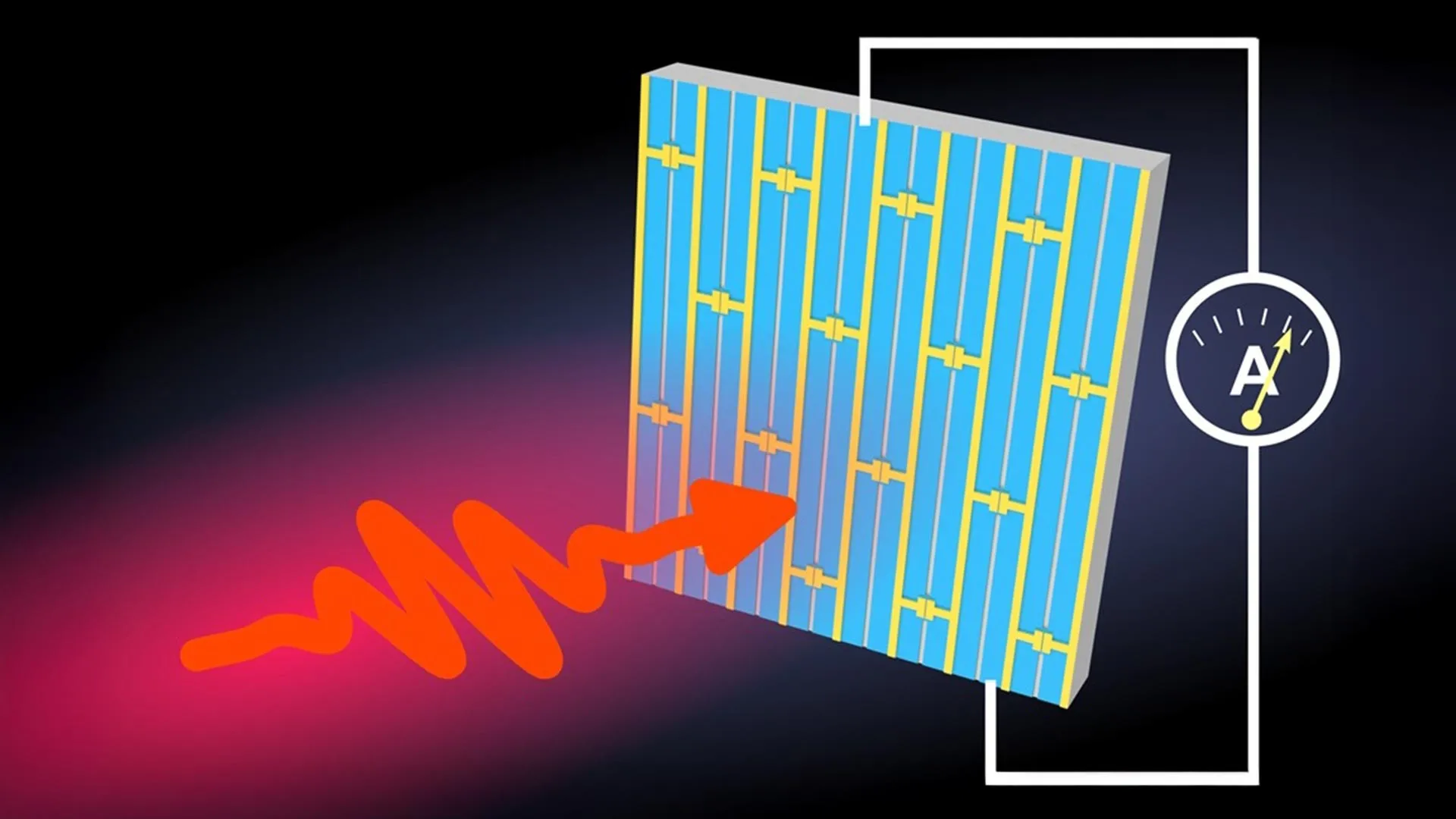
The trick is what physicists call a time interface. When light crosses from air into water it hits a spatial interface, and some of the wave reflects while the rest transmits. A time interface is the same idea rotated ninety degrees: instead of the light moving into a new medium, the medium itself changes abruptly around the light — its refractive index jumps while the wave is still inside. That also produces reflected and transmitted waves. What the Cornell group showed is that it can do something else as well: excite a static, zero-frequency mode, converting part of the light's rapidly varying magnetic field into a stationary pattern that simply stays put.
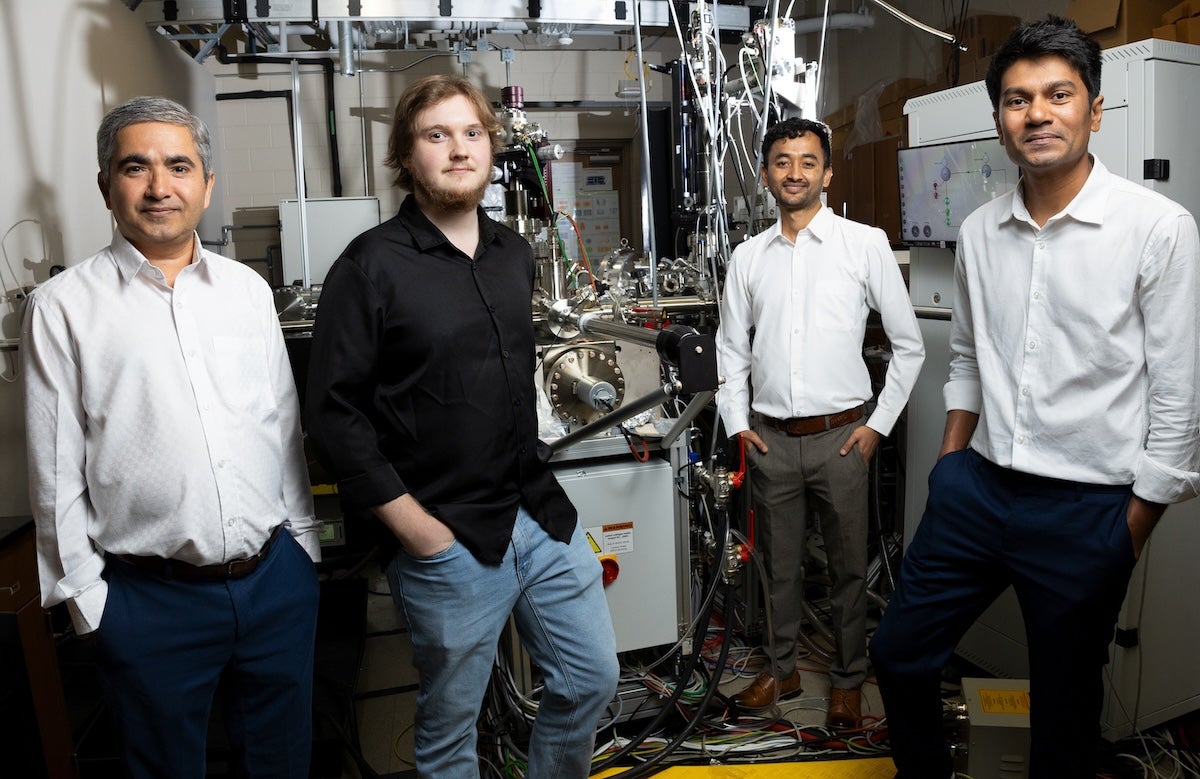
To build the interface, Shivaksh Rawat, a Ph.D. candidate in the group of Gennady Shvets, the J. Preston Levis Professor of Engineering in Cornell's School of Applied and Engineering Physics, together with postdoctoral researcher Samyobrata Mukherjee, used a two-dimensional metasurface — a rectangular array of germanium nanostructures engineered to trap mid-infrared light. While that light was still circulating inside the array, they hit the surface with a short, intense burst of higher-energy near-infrared photons. The pulse knocked electrons out of the germanium atoms, flooding the material with free electrons and holes and changing its refractive index almost instantaneously.
Some of the trapped light's energy shifted into new, red-shifted waves. The rest went into the kinetic energy of circulating free electrons, which formed current loops in the metasurface's hot spots and sustained a magnetic field there. Without losses that magnetization would persist indefinitely. In practice it lasted about 300 femtoseconds — three ten-trillionths of a second, which sounds like nothing until you note it is roughly 20 full cycles of the mid-infrared wave that created it.
"We used an approach known as localized free carrier generation, which has advantages over other methods of nanoscale magnetization," Rawat said. "One of the important contributions of our work is that our approach is material agnostic. Any nonmetallic surface will work." That last point is what makes the result more than a curiosity: the effect does not depend on exotic magnetic compounds, so it could in principle be engineered into ordinary dielectric platforms.
"By rapidly changing the optical properties of an engineered metasurface, we were able to convert part of a passing light wave into a localized magnetic field that remained after the light had passed," Rawat said. The group argues the work also clarifies how energy gets redistributed inside rapidly changing optical materials — a question at the center of the fast-growing field of time-varying photonics. The obvious applications sit where light and magnetism already meet: spintronics, magnetic data storage, photonic and quantum computing, and any technique that needs a strong magnetic field confined to a spot a few hundred nanometers across.