Quantum Metasurface Breakthrough Could Finally Close the Terahertz Gap
New compact detector increases terahertz radiation detection efficiency by 20 times, promising advances in healthcare and communications.
Researchers have developed a revolutionary compact quantum detector that dramatically improves the detection of terahertz radiation, a long-standing challenge in the electromagnetic spectrum. The new device combines quantum physics with a specially engineered metasurface to increase detection efficiency by approximately 20 times compared to earlier designs, potentially transforming applications in healthcare, communications, and scientific research.
The terahertz range, which sits between microwaves and infrared light, has historically been one of the most difficult portions of the electromagnetic spectrum to work with effectively. Existing detectors for these frequencies are often slow, lack sensitivity, or require large, costly equipment that frequently needs cryogenic cooling. These limitations have prevented terahertz technology from reaching its full potential in practical applications.
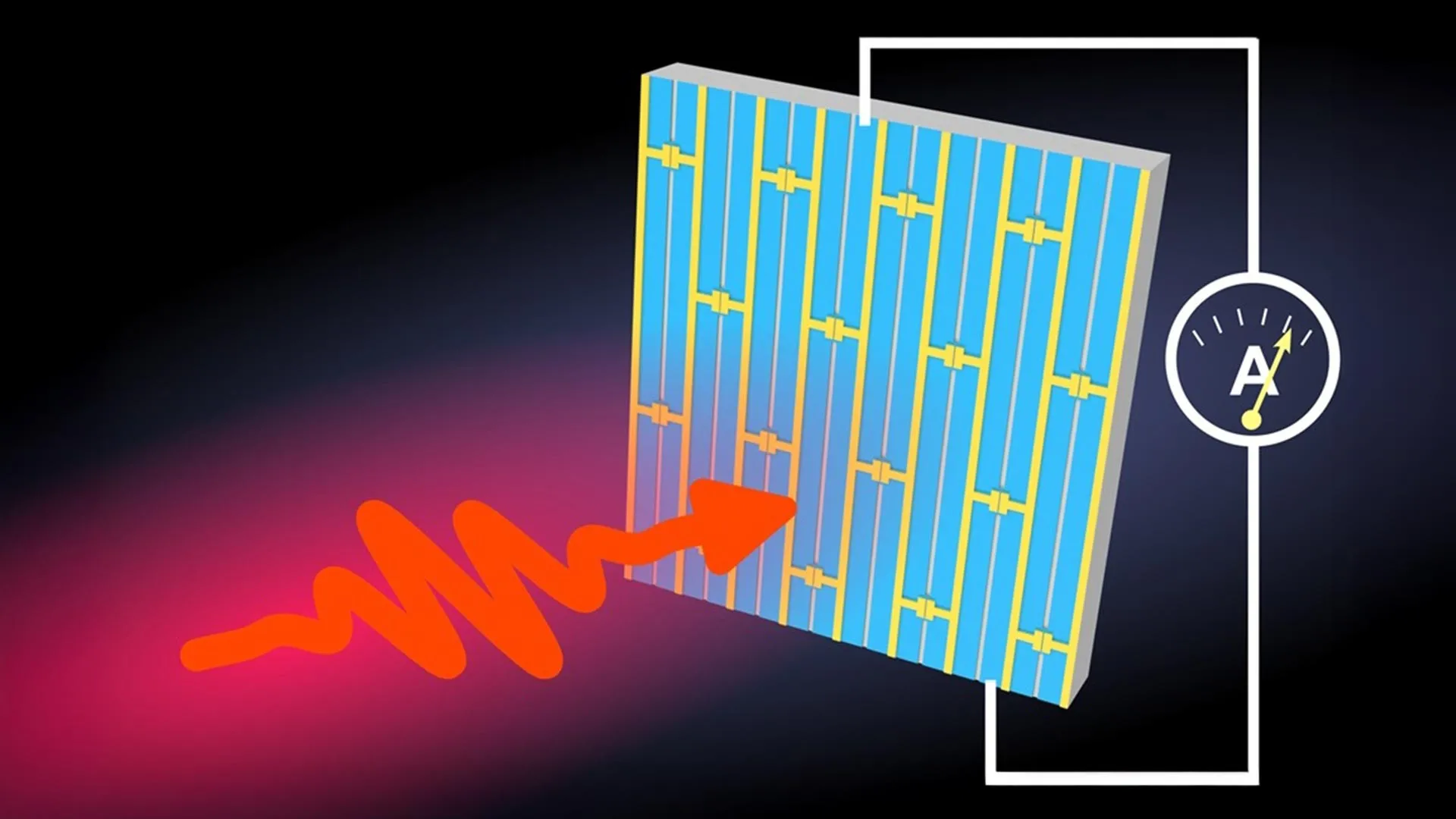
The breakthrough device relies on the in-plane photoelectric effect, where incoming terahertz photons transfer energy to electrons confined within a two-dimensional electron gas. These energized electrons then cross a carefully designed potential step, producing an electrical current that can be measured. Unlike conventional photoelectric detectors, this mechanism does not require photons to exceed a minimum energy threshold, avoiding several efficiency limitations that have constrained earlier detector designs.
A key innovation lies in the metasurface design, which uses a repeating "brickwork" pattern that serves dual purposes. The structure collects incoming terahertz radiation and channels it into narrow gaps where the detection process takes place. Each gap functions as an individual detector, and by distributing many detection elements across the surface and electronically linking them together, researchers can combine their outputs into a stronger overall signal without requiring external optics or complicated detector arrays.
The integration of light collection and detection into a single device represents a significant advancement over previous approaches. Rather than designing these systems separately, the team built detection elements directly into regions where the electric field is strongest within the metasurface. This ensures optimal coupling between the metasurface and detection elements while eliminating the need for additional optical components. The success of this quantum metasurface approach could finally make terahertz technologies practical for widespread use in medical imaging, wireless communications, and security applications.