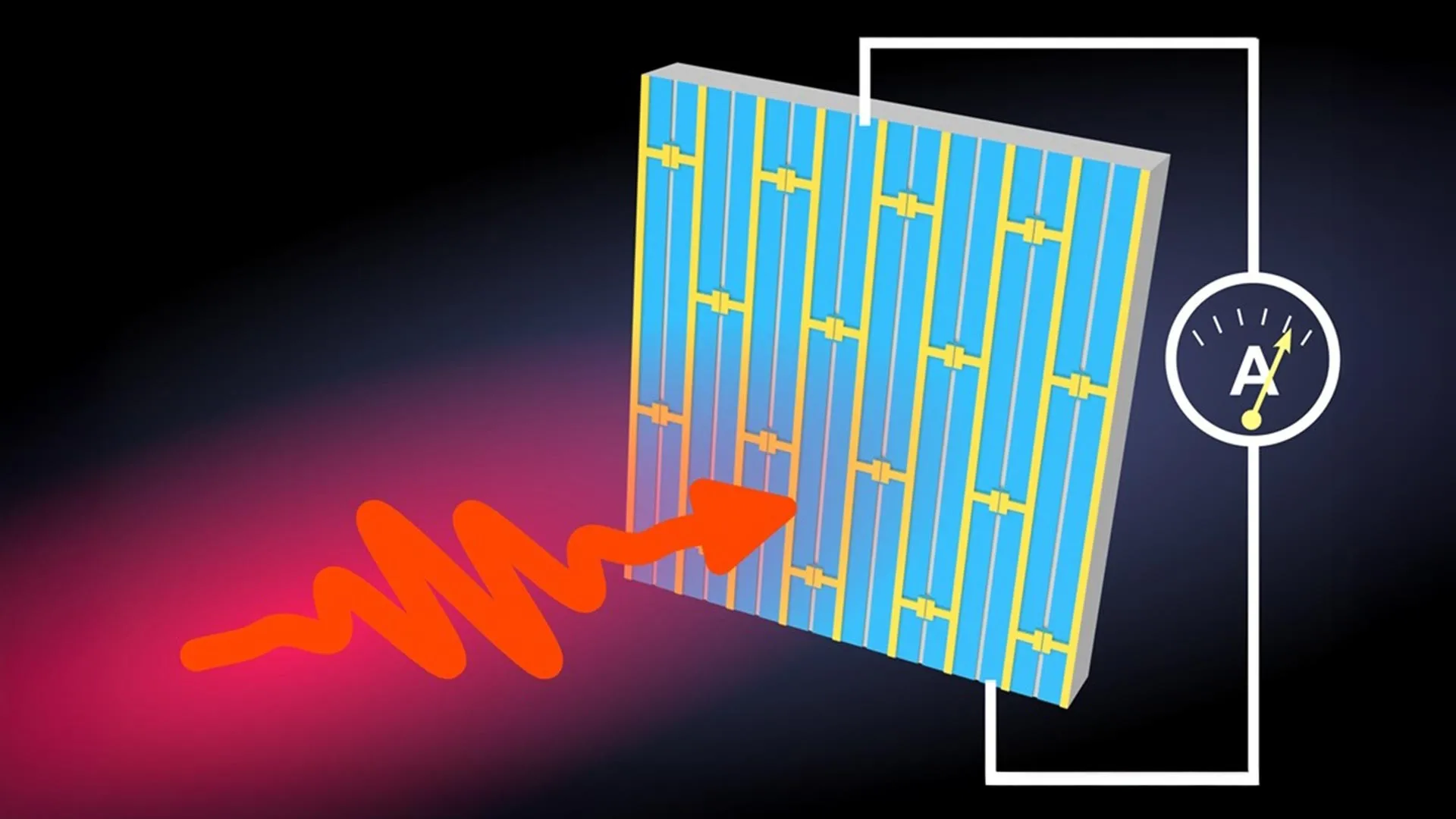
Etched Microscopic Springs Make Brittle Silicon Stretch and Tune Terahertz Waves
Osaka researchers carved spiral springs into a silicon wafer, producing a self-supporting material whose response to terahertz light changes as it is pulled.
Topic
19 stories from Planck Standard. Latest: October 29, 2026.

Osaka researchers carved spiral springs into a silicon wafer, producing a self-supporting material whose response to terahertz light changes as it is pulled.

The ACS Nano prediction for MnBi₂Te₄ points to ultrafast switching without the heat of electrical circuits, but no experiment has tested it yet.

The National University of Singapore team used 0.14-terahertz radiation, whose photons carry just 0.6 millielectronvolts, to warm the charge carriers and nothing else. The trick separates two effects that every conventional measurement blurs together.

A French-German team modulated a gold-and-semiconductor metamaterial so fast that its optical properties change on the same timescale as light's own oscillations — cutting photon losses roughly in half. The result ran in Nature on July 30.
Using terahertz laser pulses on bismuth selenide, German researchers watched angular momentum flip direction as it passed between a crystal's own vibrations — a first that could help control quantum bits.

New compact detector increases terahertz radiation detection efficiency by 20 times, promising advances in healthcare and communications.
Using terahertz laser pulses, a German-led team caught angular momentum reversing direction as it moved through a crystal — a quantum effect they say could sharpen control of next-generation memory and quantum materials.

Compact room-temperature detector could revolutionize terahertz technology for healthcare, communications and scientific research.

MIT physicists have directly imaged, for the first time, the collective oscillations of superconducting electrons using a terahertz-light microscope — an observation that could unlock the physics behind high-temperature superconductivity.
Experiments using terahertz spectroscopy on skyrmions — nanoscale magnetic whirlpools viewed as candidates for next-generation data storage — revealed multiple internal oscillation modes that existing theoretical models had not predicted.

By squeezing terahertz light smaller than its own wavelength, MIT physicists captured the synchronized quantum oscillations of Cooper pairs in BSCCO — a step toward understanding room-temperature superconductivity.

Researchers at the University of Geneva have made the first experimental measurement of the 'quantum metric' — a geometric property of quantum materials theorized since the early 2000s — with profound implications for superconductors, topological devices, and ultrafast electronics.

Using a metasurface of precisely tailored silver nanocubes, Duke University researchers created a pyroelectric detector operating at 2.8 gigahertz — hundreds of times faster than any previous thermal photodetector — with potential applications from medical imaging to deep-space sensing.
Physicists at MIT have directly observed the quantum oscillations of electrons inside a superconductor for the first time in history, publishing results in Nature that could accelerate the search for room-temperature superconductors and next-generation wireless technology.
Using spintronic terahertz emitters to circumvent the diffraction limit, physicists led by Alexander von Hoegen observed for the first time the collective oscillation of Cooper pairs inside a superconducting copper-oxide material — a breakthrough that could accelerate the development of room-temperature superconductors.
Professor Nuh Gedik's team used their new spintronic terahertz emitter and Bragg-mirror system to directly image the Higgs amplitude mode of a superconductor for the first time — a collective electron oscillation predicted for decades but never seen — with major implications for room-temperature superconductors and 6G wireless.
Ryo Shimano's team at the University of Tokyo used ultrafast laser pulses to capture the fastest magnetic movie ever recorded inside manganese-tin, revealing a non-thermal spin-switching mechanism that is far more energy efficient than previously known and could enable terahertz-speed spintronic computers.

A revolutionary terahertz microscope has captured quantum oscillations inside superconducting electrons for the first time, opening a new window on one of physics' greatest puzzles.
The quantum metric warps electron motion the same way spacetime curves around massive objects.