Scientists Discover Hidden Geometry Inside Materials That Bends Electrons Like Gravity Bends Light
The quantum metric warps electron motion the same way spacetime curves around massive objects.

A team of physicists at the University of Geneva has experimentally confirmed something theorists predicted but no one had ever directly observed: a hidden geometric property lurking inside solid materials that warps the movement of electrons in the same way Einstein's curved spacetime bends starlight around a massive star. The discovery, published this week in Nature Physics, marks a turning point for condensed matter research and could unlock an entirely new generation of ultra-fast electronics.
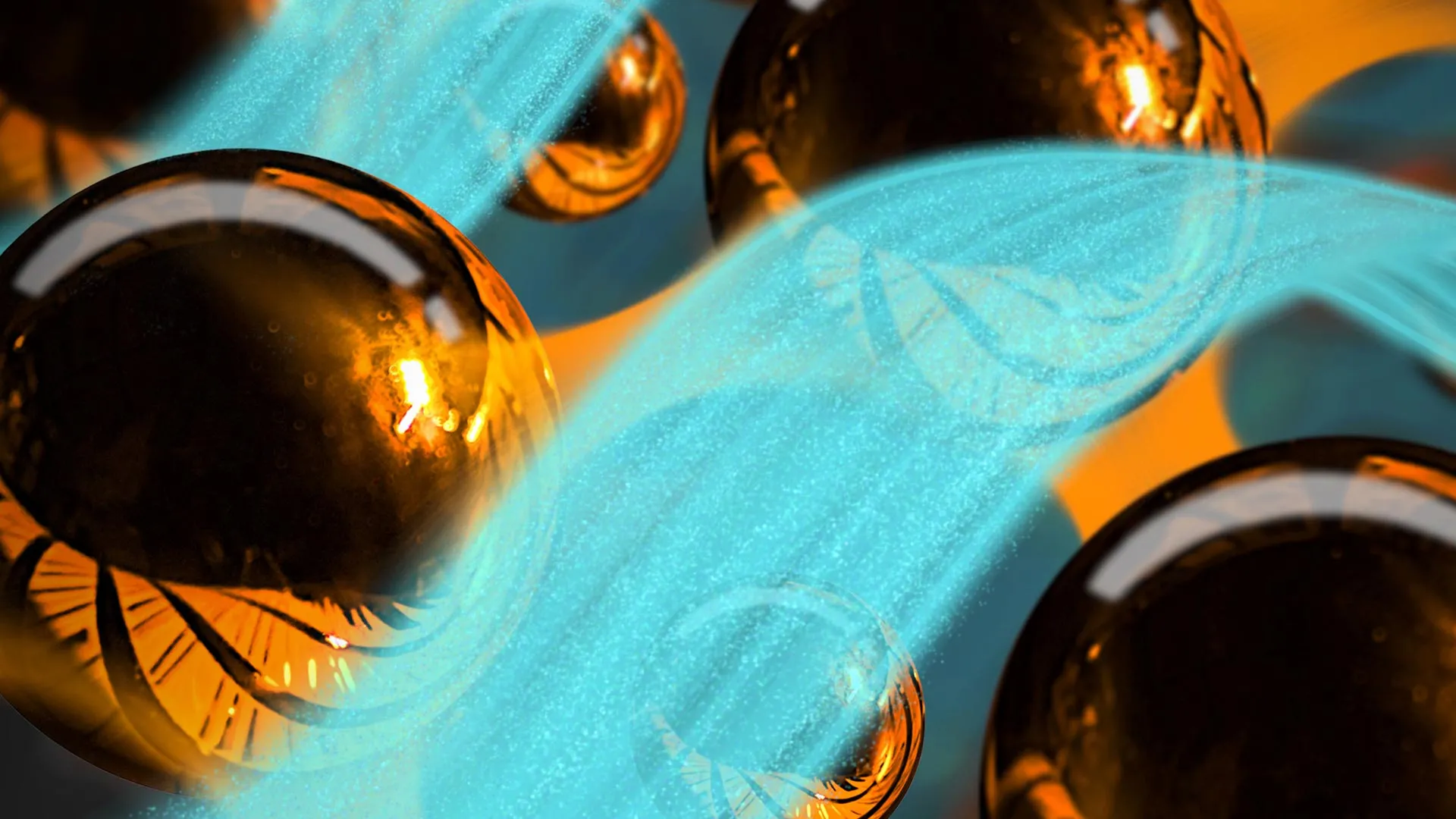
The property is called the quantum metric, a mathematical quantity that describes the intrinsic curvature of electron wave functions inside a crystal lattice. In general relativity, mass curves the fabric of spacetime, forcing light and matter to follow bent paths. The quantum metric does something eerily similar at the atomic scale — it warps the internal geometry of a material's electronic states, forcing electrons to accelerate and change direction even without an external electric field pushing them.
To detect it, the Geneva team built an extraordinarily clean interface between two oxide materials — strontium titanate and lanthanum aluminate — cooled to near absolute zero. By firing terahertz-frequency light pulses at the interface and measuring how electrons responded, they were able to isolate the quantum metric's contribution from all other effects. The electrons moved in ways that classical physics and even standard quantum mechanics without geometric corrections could not explain.
"What we measured is essentially the shape of the space that electrons live in," said lead researcher Dr. Jean-Marc Triscone. "It's not physical space — it's an abstract mathematical space defined by the quantum states themselves. But its curvature has real, measurable consequences for how electrons behave."
The implications extend far beyond the laboratory. Materials with large quantum metric effects could serve as the basis for terahertz electronics — devices operating at frequencies between microwaves and infrared light that would be orders of magnitude faster than today's silicon chips. The U.S. Department of Defense and several semiconductor companies have already expressed interest in funding follow-up research, viewing terahertz technology as critical for next-generation communications, imaging, and radar systems.
Physicists say the discovery also deepens a fascinating bridge between Einstein's theory of gravity and quantum mechanics. While the two frameworks famously refuse to merge at the mathematical level, the quantum metric shows that nature uses the same geometric language — curvature, geodesics, and metric tensors — to govern phenomena at radically different scales, from galaxy clusters to individual electrons inside a chip.