Physicists Catch a Crystal's Atoms Spinning Backward, Where 1 + 1 = -1
Using terahertz laser pulses on bismuth selenide, German researchers watched angular momentum flip direction as it passed between a crystal's own vibrations — a first that could help control quantum bits.

Physicists have directly observed, for the first time, how angular momentum moves between atomic vibrations inside a crystal — and discovered that the rotation can flip direction along the way. The result, described with deliberately odd arithmetic as "1 + 1 = -1," gives scientists a new handle on the physics that governs magnetism in quantum materials.
The research was led by the Helmholtz-Zentrum Dresden-Rossendorf (HZDR) and the Fritz Haber Institute of the Max Planck Society, with collaborators at TU Dresden, Forschungszentrum Jülich and Eindhoven University of Technology. The findings were published May 24 in Nature Physics.
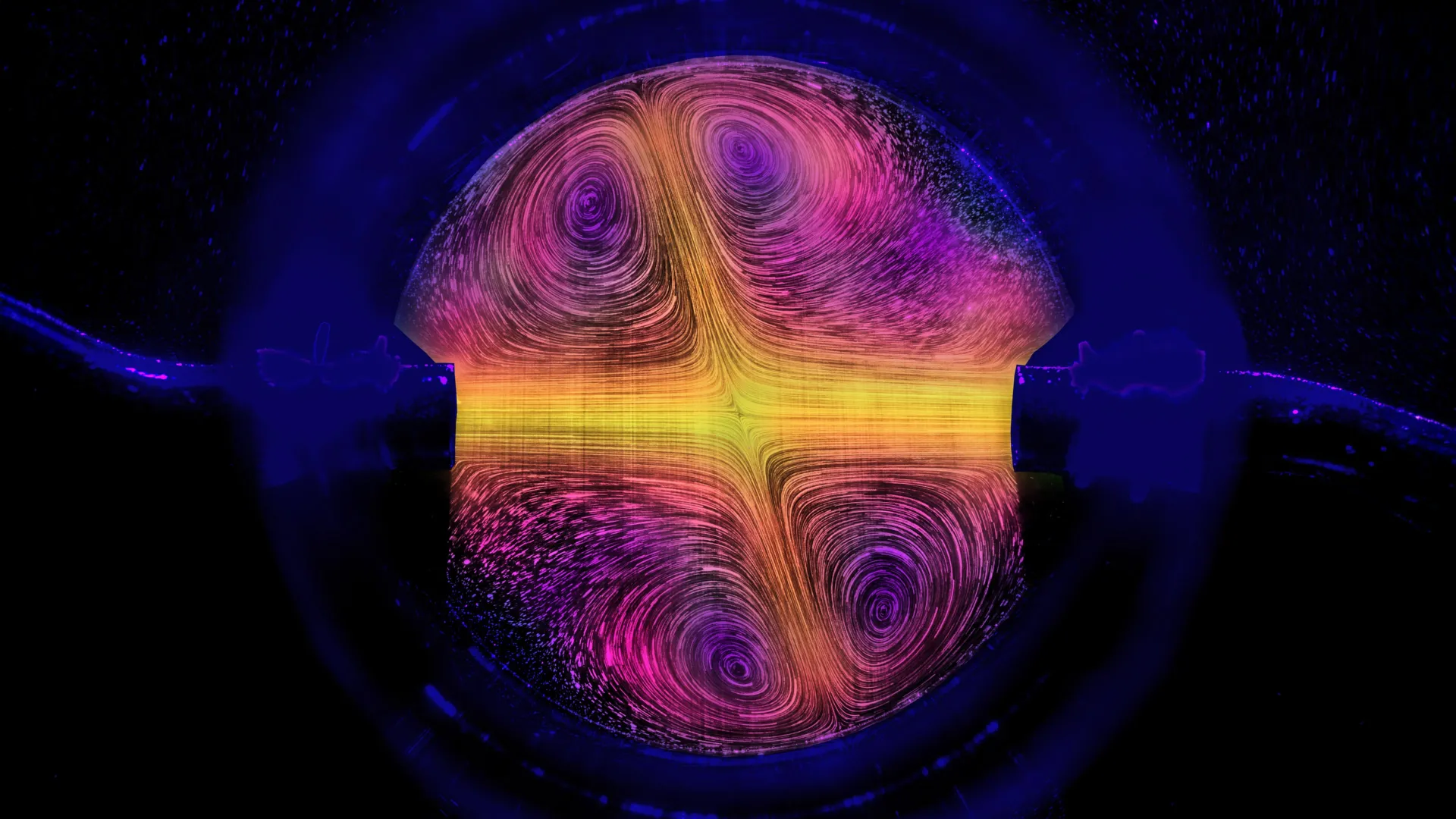
The material at the center of the experiment was bismuth selenide, a so-called topological insulator prized for its unusual electronic and magnetic behavior. The team used ultra-strong terahertz laser pulses to set the crystal's atoms spinning in tiny circular paths, then employed a second, ultrafast laser to track how that rotational motion — the angular momentum — was handed off between two of the crystal's internal vibrations.
What they caught was a reversal. When two rotations pointing the same way combined, the result was a single vibration spinning in the opposite direction, at twice the frequency. The effect, an Umklapp process, arises from the symmetry of the crystal lattice itself — the way the atoms are arranged dictates how their motions can add up. "I find it extraordinarily elegant how the laws of physics are directly dictated by the symmetries of nature," said lead author Olga Minakova of the Fritz Haber Institute.
That seemingly abstract bookkeeping carries practical weight. Angular momentum in a crystal is intimately tied to its magnetic state, and being able to steer it on ultrafast timescales offers a potential new lever for manipulating quantum systems — including the qubits that lie at the heart of quantum computers.
The work also sharpens scientists' picture of how energy and motion flow through solids at the atomic scale, knowledge that underpins efforts to design next-generation memory and information technologies. By showing that a crystal's own vibrations can flip the direction of their spin, the researchers have revealed a control knob that physicists did not previously know existed.