Scientists Film a Magnetic Flip in 140 Trillionths of a Second — And Find Two Ways It Happens
Ryo Shimano's team at the University of Tokyo used ultrafast laser pulses to capture the fastest magnetic movie ever recorded inside manganese-tin, revealing a non-thermal spin-switching mechanism that is far more energy efficient than previously known and could enable terahertz-speed spintronic computers.

Scientists at the University of Tokyo have captured the fastest magnetic movie ever recorded — a frame-by-frame account of how electron spins flip inside an antiferromagnetic material in just 140 trillionths of a second, a feat that resolves a decades-old mystery about how certain materials switch their magnetic orientation and that points toward a new generation of computing hardware that could operate at speeds far beyond anything silicon can achieve.
The research, led by Ryo Shimano of the University of Tokyo's School of Science and his collaborator Kazuma Ogawa, was published in Nature Materials in early 2026. The team worked with a material called manganese-tin, chemically written as Mn₃Sn, which belongs to the class of antiferromagnets — materials whose atoms have magnetic moments, but where neighboring moments point in opposite directions and cancel each other out, making the material appear magnetically neutral from the outside. Despite this apparent invisibility, antiferromagnets are of immense interest to physicists and engineers because their internal magnetic structure can be switched extremely rapidly, potentially enabling data storage and logic devices that operate at terahertz speeds.
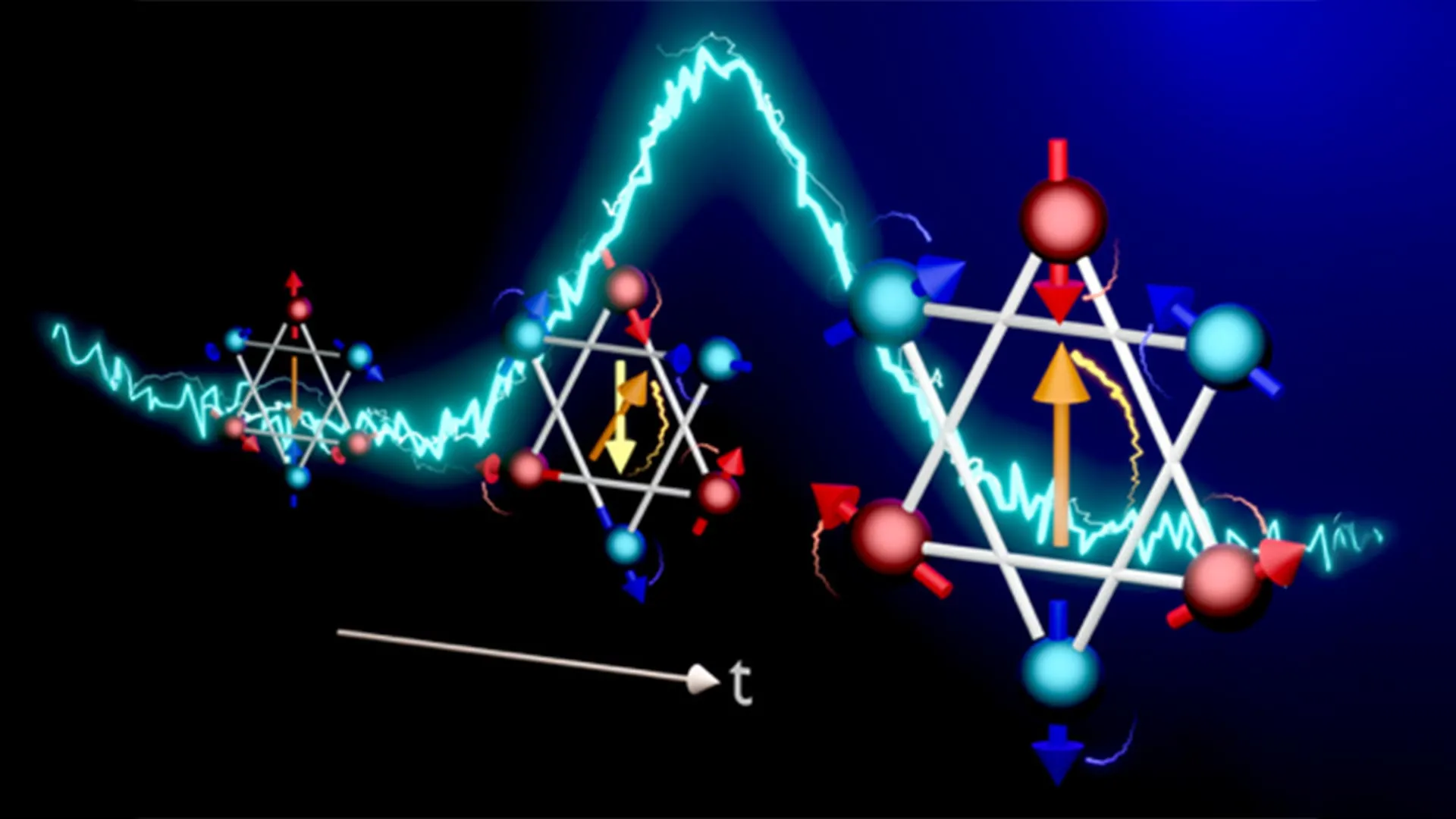
The challenge has always been observing what actually happens during the switching process. "For many years, scientists believed that antiferromagnets like Mn₃Sn could switch their magnetization extremely quickly," Shimano said. "But the actual moment-by-moment process remained completely unknown. We had no direct picture of what was happening." To build that picture, Shimano's team fired ultrafast electrical pulses into a thin film of manganese-tin and then illuminated the sample with precisely timed flashes of laser light at varying delays — from just a few picoseconds after the electrical pulse to hundreds of picoseconds later. By assembling the time-stamped optical snapshots into a sequence, the researchers reconstructed a movie of the magnetization evolving in real time.
The resulting footage revealed something unexpected: manganese-tin does not switch its magnetization through a single mechanism. The researchers identified two distinct pathways. In the first, strong electrical currents generate enough heat to demagnetize the material and allow its spins to relax into a new configuration — a thermal process that is energetically expensive and relatively slow. In the second, weaker currents flip the spins directly through a purely electronic interaction, with minimal heat generated — a non-thermal process that is significantly more energy efficient and potentially faster than the researchers' instruments could fully resolve.
The existence of the non-thermal switching mechanism is the finding that has generated the most excitement among the spintronics research community. Spintronic devices — which store and process information using the spin states of electrons rather than their charge — promise to consume far less power than conventional charge-based electronics and to retain their state without power (non-volatile memory) in a way that current DRAM chips cannot. But the energy barrier to switching spins has historically been a practical obstacle to making these devices competitive with silicon at real computing speeds.
The non-thermal pathway Shimano's team discovered bypasses that energy barrier. If the mechanism can be reliably engineered into device architectures, it could enable magnetic memory cells that switch in under 140 picoseconds — potentially as fast as a few picoseconds in optimized materials — at a fraction of the power cost of thermal switching. For comparison, the fastest commercial DRAM memory today has access times measured in tens of nanoseconds, roughly 100 times slower than the timescale Shimano's team observed.
The measurement itself represents a technical tour de force. Tracking magnetic dynamics on a 140-picosecond timescale requires synchronizing optical and electrical pulses with femtosecond precision across an experimental apparatus built to minimize timing jitter from every possible source — vibrations, temperature fluctuations, electrical noise. The team used a custom ultrafast optical spectrometer operating at cryogenic temperatures to achieve the necessary sensitivity.
Beyond data storage, the non-thermal switching mechanism has implications for antiferromagnetic logic devices — circuits that perform computation by manipulating spin orientations rather than voltage levels. The authors note that the two mechanisms they discovered could be separately addressed in device design: the thermal pathway provides a high-power "erase" function while the non-thermal pathway enables fine-grained, energy-efficient writing. Combining them in a single device architecture could yield a new class of non-volatile processors that simultaneously match silicon's logic performance and flash memory's data retention without the fundamental power and speed tradeoffs that constrain current designs.