Duke Engineers Build World's Fastest Photodetector, Sensing Light Across the Entire Spectrum in 125 Trillionths of a Second
Using a metasurface of precisely tailored silver nanocubes, Duke University researchers created a pyroelectric detector operating at 2.8 gigahertz — hundreds of times faster than any previous thermal photodetector — with potential applications from medical imaging to deep-space sensing.
Electrical engineers at Duke University have built the fastest pyroelectric photodetector ever demonstrated, a device that can sense light across the entire electromagnetic spectrum — from X-rays to terahertz waves — and generate an electrical signal in just 125 picoseconds, or 125 trillionths of a second. The breakthrough, published in the journal Advanced Functional Materials, represents a speed improvement of hundreds to thousands of times over conventional thermal photodetectors, which typically operate in the nanosecond-to-microsecond range. The device, developed in the laboratory of Professor Maiken Mikkelsen, operates at a frequency of 2.8 gigahertz and could enable a new generation of multispectral cameras for use in medicine, agriculture, environmental monitoring, and deep-space sensing.
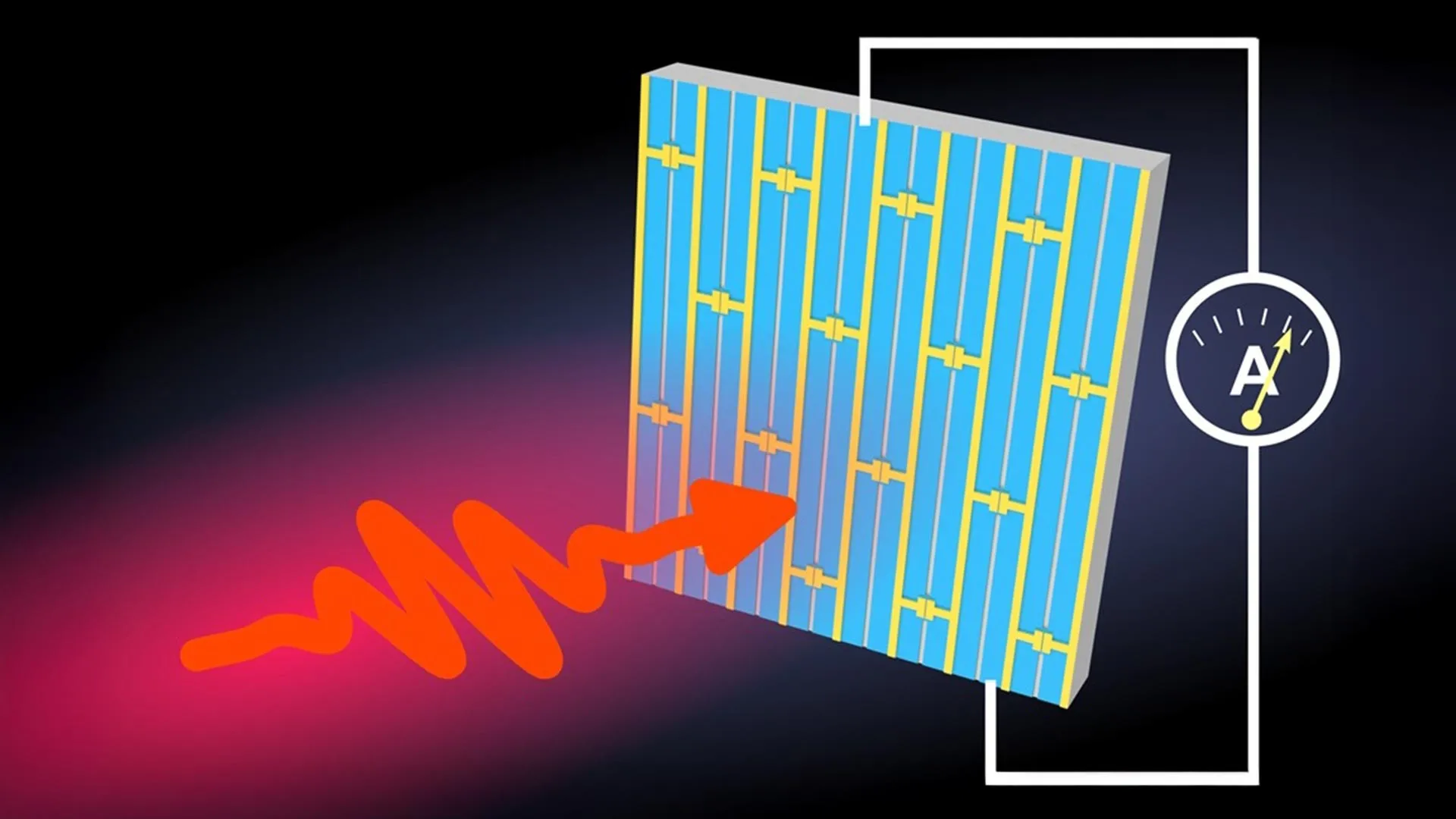
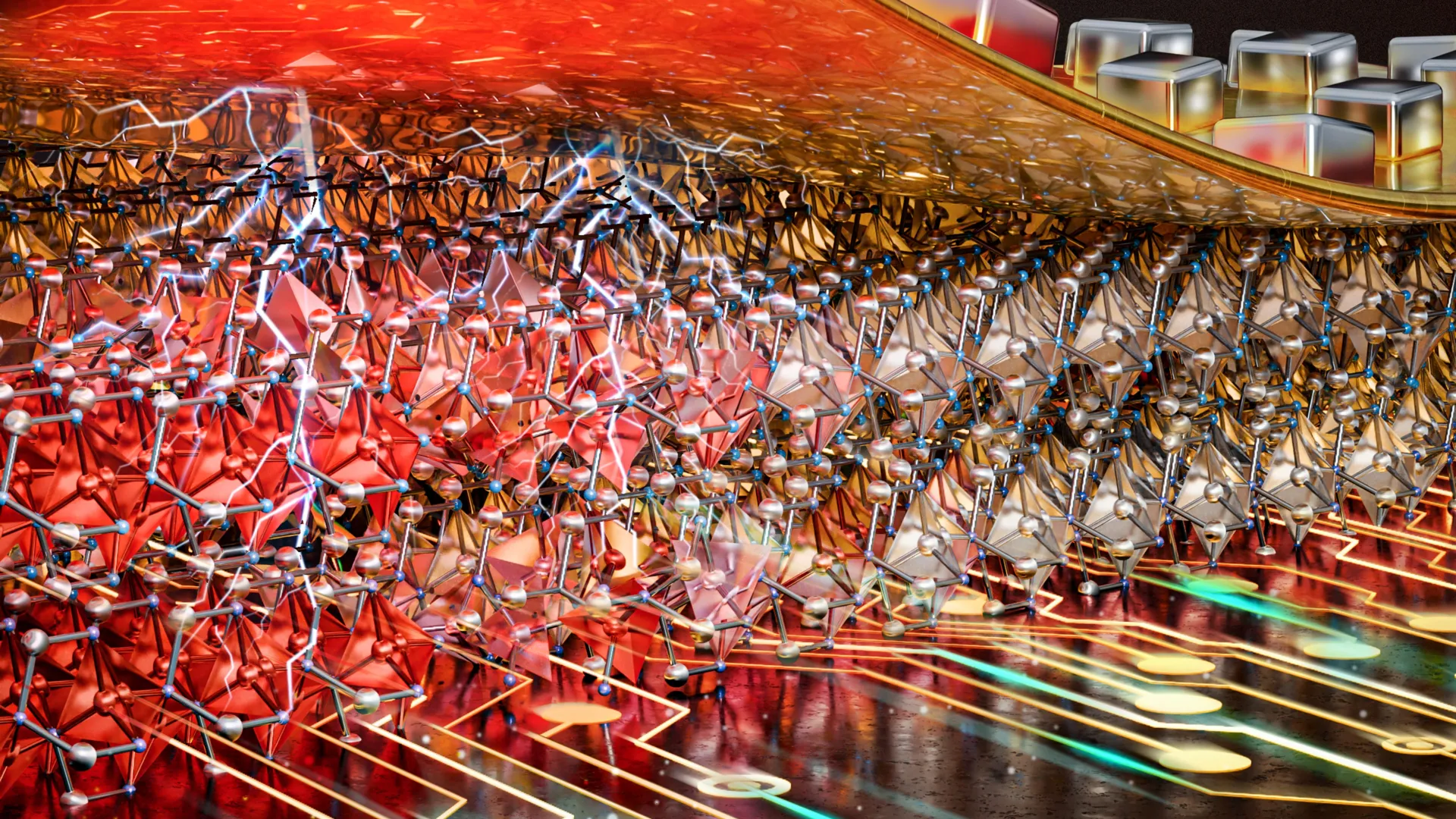
The key innovation is a nanostructure called a "metasurface" — an engineered optical surface that manipulates light at the nanoscale. The team placed precisely sized silver nanocubes on a transparent film held just 10 nanometers above a thin layer of gold. When photons strike a nanocube, they excite the silver's conduction electrons in a phenomenon known as plasmonics, trapping the light's energy in an intensely concentrated hotspot at the gap between the cube and the gold layer below. This localized energy is transferred almost instantaneously to an ultra-thin layer of pyroelectric material underneath, which responds to the rapid temperature change by generating an electrical signal. The result is a detector that converts absorbed light into electricity far faster than any previous thermal device.
Traditional pyroelectric detectors have suffered from an inherent speed limitation: the pyroelectric material takes time to respond to absorbed heat, and the larger the detector, the longer the signal must travel to reach the readout circuit. Duke's approach attacks both problems simultaneously. By fabricating a circular metasurface that maximizes light absorption while minimizing the distance the electrical signal must travel, and by procuring exceptionally thin, high-purity pyroelectric layers from collaborators, the team achieved an operating frequency of 2.8 GHz. PhD student Eunso Shin played a central role in refining the fabrication process and developing cost-effective measurement techniques to characterize the device's performance. The research involved collaboration with teams at the University of Michigan and the Army Research Laboratory.
The practical implications are substantial. Unlike conventional silicon-based photodetectors, which are sensitive only to a narrow range of wavelengths and typically require separate devices for different parts of the spectrum, Duke's pyroelectric metasurface responds to all wavelengths simultaneously. In medicine, such broadband detectors could enable compact real-time imaging across multiple spectral bands without the bulky optics, cooling systems, and separate detector arrays required today. In precision agriculture, they could allow rapid, highly accurate multispectral analysis of soil composition, crop health, or water stress from drones or low-altitude satellites. In security and surveillance, they could detect concealed materials or temperature anomalies across wavelengths that current sensors cannot cover.
The speed of the device also makes it valuable for next-generation wireless communications. At 2.8 gigahertz, it can track changes in optical signals fast enough to support terahertz-frequency wireless links — a technology widely expected to underpin 6G networks, which are projected to carry data at rates many times faster than current 5G systems. The team plans to push performance further by integrating custom readout electronics matched to the device's extraordinary speed and by experimenting with new pyroelectric materials that could extend the operating frequency beyond 2.8 GHz. Given the broad interest in high-speed broadband light detection across commercial, scientific, and defense research communities, the Duke metasurface approach may represent the beginning of a new class of universal optical sensors.