Quantum Metasurface Breakthrough Makes Terahertz Detection 20 Times More Efficient
Compact room-temperature detector could revolutionize terahertz technology for healthcare, communications and scientific research.
Researchers have developed a revolutionary quantum detector that dramatically improves the detection of terahertz radiation, a challenging frequency range that sits between microwaves and infrared light. The new device combines quantum physics with a specially engineered metasurface to boost efficiency by roughly 20 times compared to earlier designs, potentially making terahertz technology more practical for healthcare, communications, and scientific applications. The breakthrough addresses long-standing limitations that have made terahertz detectors slow, insensitive, or dependent on large, costly equipment requiring cryogenic cooling.
The detector relies on the in-plane photoelectric effect, where incoming terahertz photons transfer energy to electrons confined within a two-dimensional electron gas. Unlike conventional photoelectric detectors, this mechanism does not require photons to exceed a minimum energy threshold, and the process occurs entirely within the plane of the material. This approach avoids several efficiency limitations that have constrained earlier detector designs, but previous versions captured only a small portion of incoming radiation because they depended on individual antenna elements.
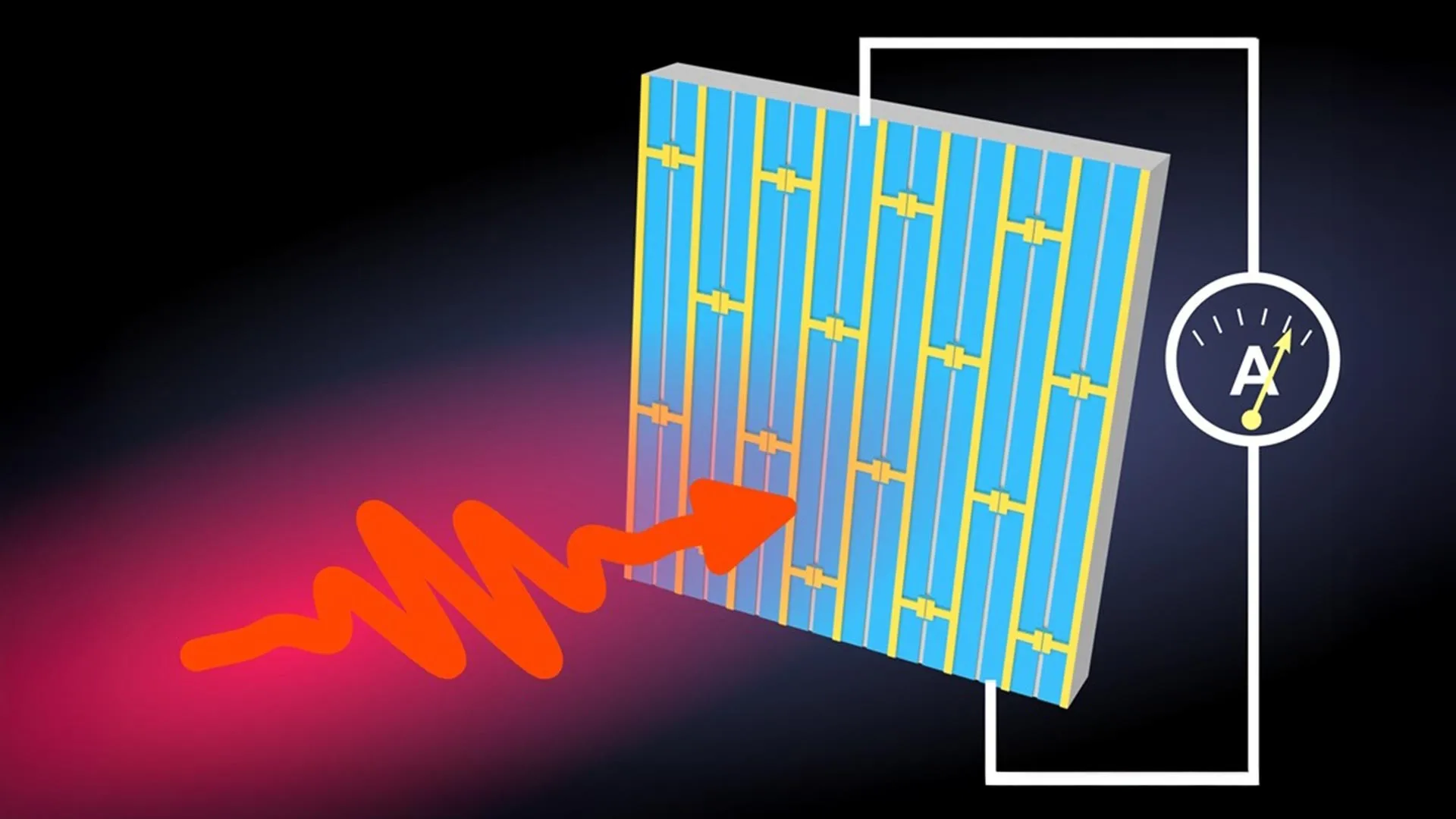
To overcome this limitation, the research team designed the detector around a metasurface with a repeating "brickwork" pattern that serves dual purposes. The structure collects incoming terahertz radiation and channels it into narrow gaps where the detection process takes place. Each gap functions as an individual detector, and by distributing many detection elements across the surface and electronically linking them together, researchers combined their outputs into a stronger overall signal. This eliminates the need for external optics or complicated detector arrays.
The metasurface approach ensures that incoming radiation is concentrated only in areas where it directly contributes to signal generation. Rather than designing the detector and light-collection system separately, the team began with the metasurface itself and built photoelectric tunable-step (PETS) detection elements directly into regions where the electric field is strongest. According to corresponding author Wladislaw Michailow, who led the research at the University of Cambridge and later at Swansea University, this ensures optimal coupling between the metasurface and detection elements.
The findings, published in Advanced Photonics, could help close what researchers call the "terahertz gap" – a frequency range where practical detectors have been difficult to develop despite promising applications. Terahertz radiation can penetrate many materials while being safe for biological tissue, making it valuable for medical imaging and security screening. The technology also shows promise for high-speed wireless communications and studying molecular structures. By making terahertz detection more efficient and practical, this quantum metasurface approach could accelerate the development of real-world terahertz technologies.