Quantum Metasurface Breakthrough Could Close the Terahertz Gap
Researchers developed a compact detector that boosts terahertz radiation detection efficiency by roughly 20 times, potentially revolutionizing healthcare and communications.
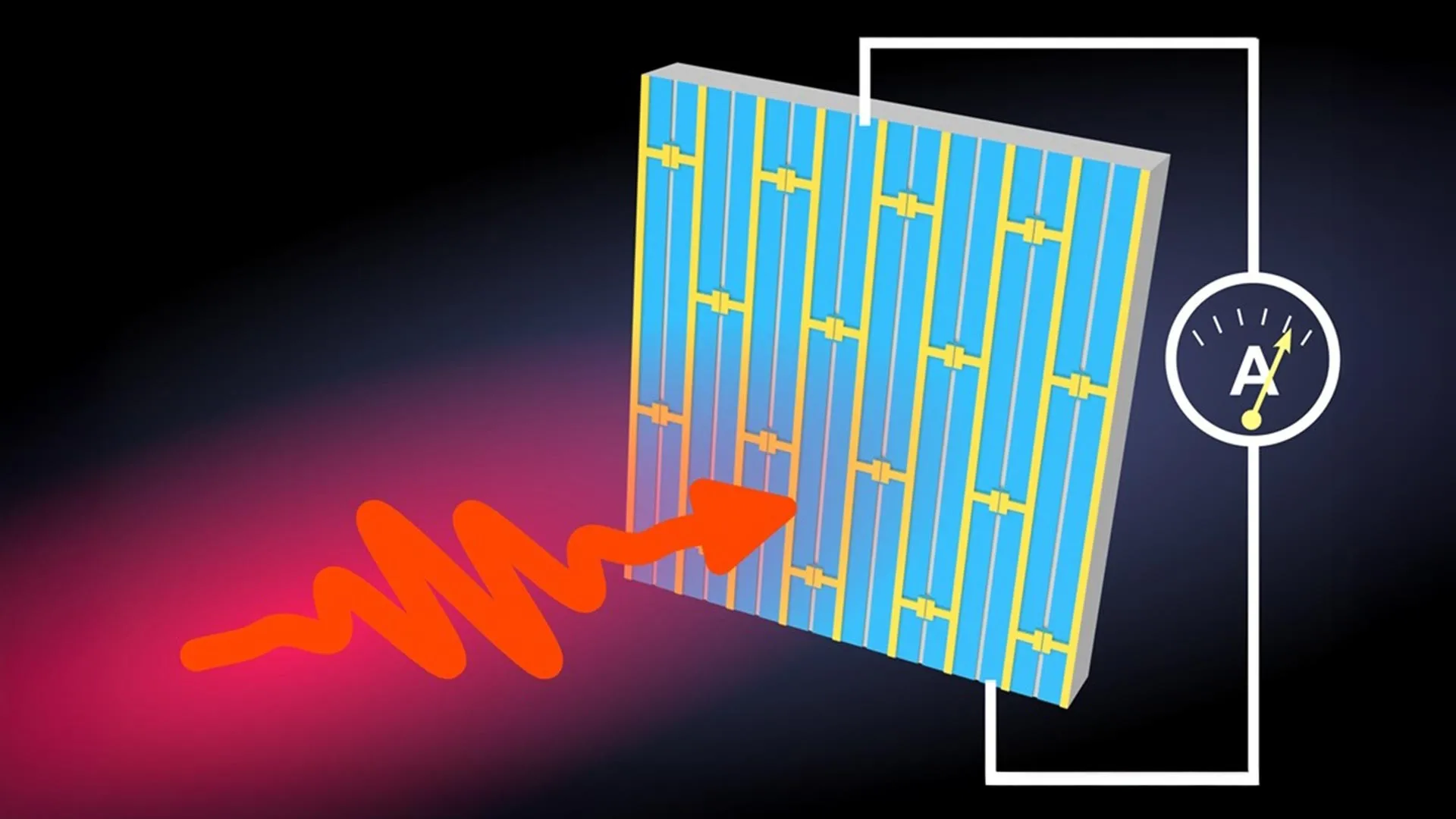
Scientists have achieved a significant breakthrough in quantum technology by developing a compact detector that dramatically improves the detection of terahertz radiation, potentially closing one of the most challenging gaps in the electromagnetic spectrum. The new device, described in Advanced Photonics, combines quantum physics with a specially engineered metasurface to boost detection efficiency by approximately 20 times compared to earlier designs.
Terahertz radiation, which sits between microwaves and infrared light, has long been one of the most difficult regions of the electromagnetic spectrum to work with effectively. Existing detectors for these frequencies are typically slow, lack sensitivity, or require large, expensive equipment that often needs cryogenic cooling. The breakthrough addresses these limitations by using a novel approach that relies on the in-plane photoelectric effect within a two-dimensional electron gas.
The key innovation lies in the device's metasurface design, which features a repeating "brickwork" pattern that serves dual purposes. The structure both collects incoming terahertz radiation and channels it into narrow gaps where individual photoelectric tunable-step detection elements are embedded. This approach eliminates the need for external optics or complicated detector arrays while ensuring that radiation is concentrated only in areas where it directly contributes to signal generation.
Unlike conventional photoelectric detectors, this new mechanism does not require photons to exceed a minimum energy threshold, and because the process occurs entirely within the plane of the material, it avoids several efficiency limitations that have constrained previous detector designs. The researchers were able to distribute many detection elements across the surface and electronically link them together, combining their outputs into a stronger overall signal.
The breakthrough could have far-reaching implications for healthcare, communications, and scientific research. Terahertz radiation can penetrate many materials while being safer than X-rays, making it valuable for medical imaging and security screening. The technology could also enable new forms of high-speed wireless communication and improve scientific instruments used to study everything from atmospheric chemistry to astronomical phenomena, all while being more compact and cost-effective than current alternatives.