Physicists Show That Engineered Chaos in Optical Surfaces Unlocks 11 Functions in One Device
A Monash University team defied decades of engineering convention by demonstrating that deliberate disorder in ultra-thin metasurfaces dramatically multiplies what they can do, publishing in Nature Communications.

Engineers have long treated disorder as the enemy of precision — the unwanted noise that degrades a system's performance. Now a team from Monash University in Australia has shown that the opposite can be true: by deliberately engineering chaos into ultra-thin optical devices, they integrated 11 separate optical functions into a single surface the thickness of a few atoms, a result that challenges assumptions that have governed the field for decades.
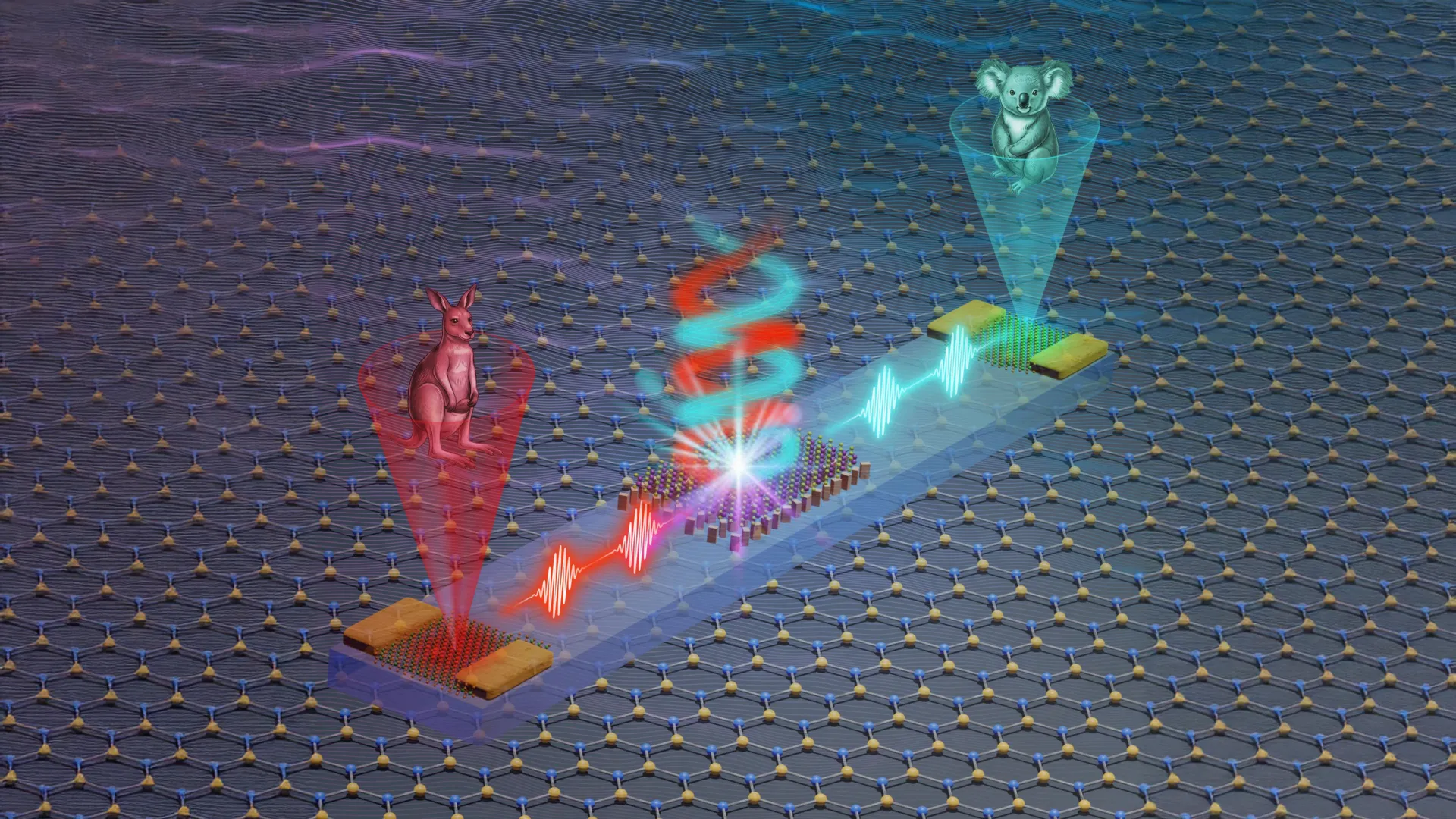
The research, published April 10 in Nature Communications, describes a new class of devices the scientists call "disordered mosaic metasurfaces." Conventional metasurfaces — synthetic materials engineered to manipulate light at subwavelength scales — are designed with painstaking uniformity, with each tiny structural element (called a meta-atom) carefully positioned to produce a single, well-defined optical function. The Monash team showed that introducing controlled, randomized disorder into the arrangement of these meta-atoms does not degrade their performance. Instead, it dramatically expands what the device can do.
The breakthrough was led by Dr. Haoran Ren, an Australian Research Council Future Fellow at Monash University's School of Physics and Astronomy, with Dr. Chi Li as first author. Collaborators included Professor Stefan Maier, head of the school, Dr. Changxu Liu from the University of Exeter in the United Kingdom, and Professor Andrew Forbes' group at the University of the Witwatersrand in South Africa.
"Disorder is usually something engineers try to eliminate," Dr. Ren said. "But we found that if you design it carefully, disorder can actually enhance what these devices can do." The team's prototype device demonstrated broadband achromatic lensing — focusing light across multiple wavelengths simultaneously without the color distortion known as chromatic aberration — alongside advanced polarization imaging capabilities, all without increasing the device's physical size or structural complexity.
The DOI for the paper is 10.1038/s41467-026-71774-5. The result has potential implications across multiple industries. In biomedical diagnostics, single-surface multi-function devices could enable compact imaging systems capable of analyzing tissue samples in several ways simultaneously. In telecommunications, the approach could simplify the hardware required for wavelength-division multiplexing. In space-based imaging and environmental sensing, the reduced size and mass of multi-function optical components could translate directly into lighter, cheaper instruments.
Conventional single-function metasurfaces already represented a significant advance over traditional bulk optics, enabling the miniaturization of lenses, holograms, and beam shapers into flat, manufacturable surfaces. The challenge has been that each new function required a new device. The disordered mosaic approach collapses this limitation: instead of 11 separate devices performing 11 separate tasks, a single surface performs all of them at once.
The key insight was that the apparent randomness of the mosaic could be statistically tuned — not random in the sense of uncontrolled, but random in the same sense that the structure of glass is disordered but still transmits light predictably. The Monash team developed new design algorithms to specify the statistical properties of the disorder that would enable the desired multi-function behavior.
Physicists outside the group called the results unexpected. The finding challenges the conventional wisdom that photonic devices require high spatial coherence — the precise, repeating arrangements that have been the hallmark of the field since its inception in the 1990s. The paper joins a small but growing body of work suggesting that carefully engineered disorder could be a powerful tool in photonics, sensing, and quantum information science.