Overlooked Branch of Gravity Theory Lets Dark Energy Flip From Negative to Positive
Istanbul Technical University physicists say a teleparallel f(T) model produces a sign change about 9.5 billion years ago with no extra free parameters, matching the hints in DESI data.

For years, the simplest picture of dark energy was that it never changes. Whatever drives the universe's accelerating expansion, the thinking went, behaved the same way at every epoch. A growing body of observations is straining that view, and a new theoretical study from Istanbul Technical University (ITU) offers one way it could work.
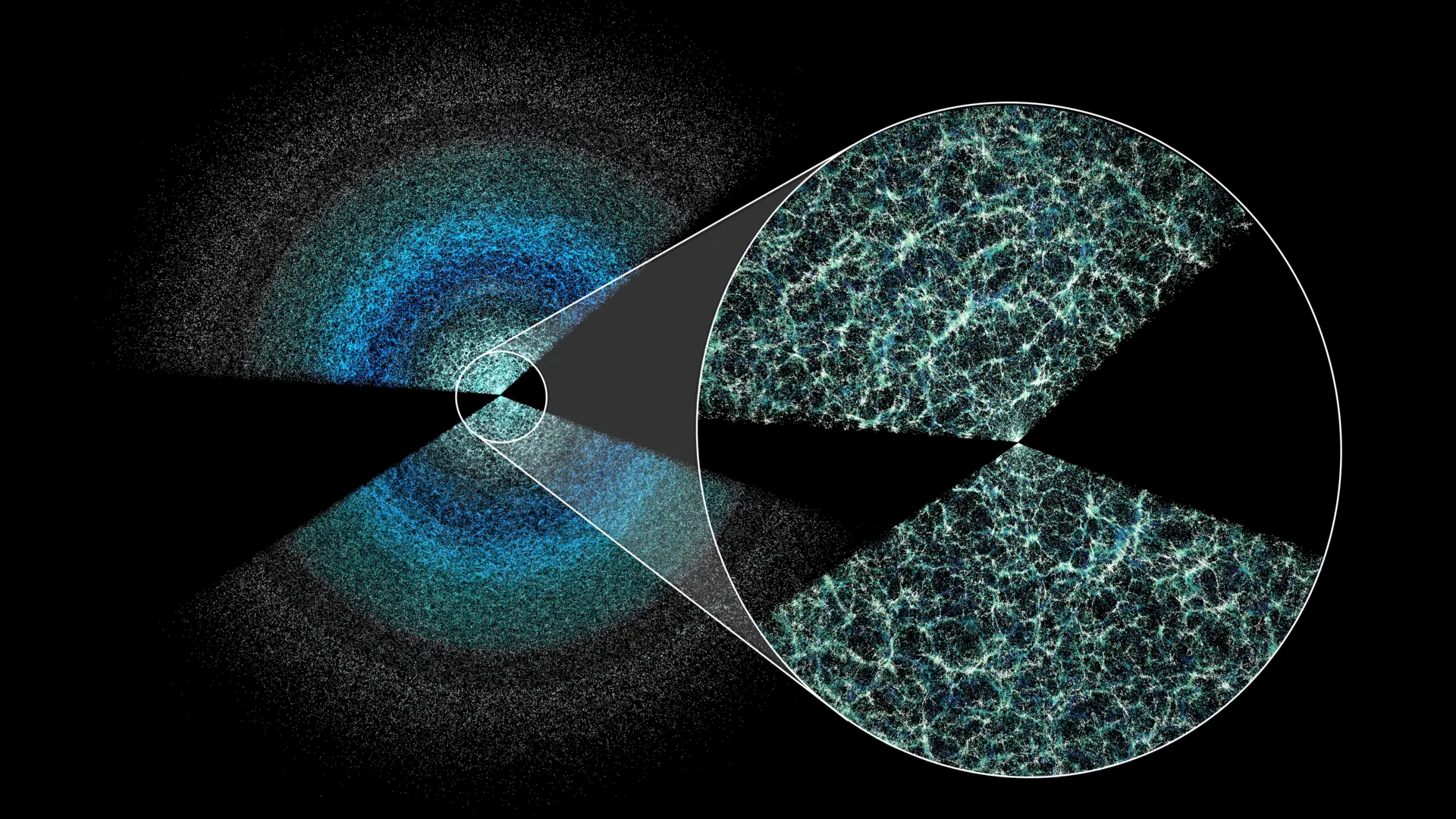
Data from the Dark Energy Spectroscopic Instrument, or DESI, which is building the largest three-dimensional map of the universe, suggest dark energy's effect may have evolved over time. The evidence is not strong enough to call a discovery, but it has sharpened one of cosmology's central questions: what if dark energy is not constant?
In a 2025 paper in Physical Review D, an international team led by ITU physics professor Özgür Akarsu examined an alternative theory of gravity called teleparallel f(T) gravity. Unlike Einstein's general relativity, which describes gravity through the curvature of spacetime, teleparallel gravity is built on torsion. The team worked on an exponential version of the theory and deliberately explored a region earlier studies had set aside, because it breaks the usual assumption, inherited from general relativity, that dark energy density must always be positive.
That overlooked branch produced an effective dark energy whose density was negative during the universe's first few billion years and then turned positive. It crossed zero at a redshift of about 1.5, roughly 9.5 billion years ago, and has been positive since. The same amount of matter today can lead to two very different cosmic histories in this theory: one that tracks the standard cosmological model closely and one that follows the sign-switching path.
The behavior is not the result of simply adding a free parameter. Which branch appears depends on the present-day matter density, so the model has the same six cosmological parameters as the standard ΛCDM model. The paper also shows the branch can remain consistent with precise solar-system tests of gravity, because in dense environments its deviations from Einstein's theory are naturally suppressed.
Akarsu and collaborators had already developed a scenario called sign-switching ΛCDM, in which the cosmological constant flips from negative to positive a few billion years after the Big Bang. Analyses of that scenario have found it consistent with DESI data and able to ease several long-standing tensions, including the disagreement over the universe's present expansion rate known as the Hubble tension. What was missing was a physical mechanism. "The sign change emerged naturally from the theory itself," Akarsu said.
The timing was fortunate. The study was first submitted in October 2024, months before the DESI collaboration reported its first three years of data in March 2025. Combined with measurements of the cosmic microwave background, supernovae and weak lensing, those results strengthened earlier hints that dark energy changes with time. DESI has since completed its planned five-year survey, observing more than 47 million galaxies and quasars.
The model has not yet been tested against DESI's full data set. Doing that is the team's next step, and it will show whether this gravity-based route to evolving dark energy survives contact with the sharpest map of the cosmos yet made.