Simulations Show Two Touching Neutron Stars Can Boost Their Magnetic Field 300-Fold Within Milliseconds
A supercomputer study led by Kenta Kiuchi finds turbulence at the contact point could forge a magnetar, one of the universe's most strongly magnetized objects.

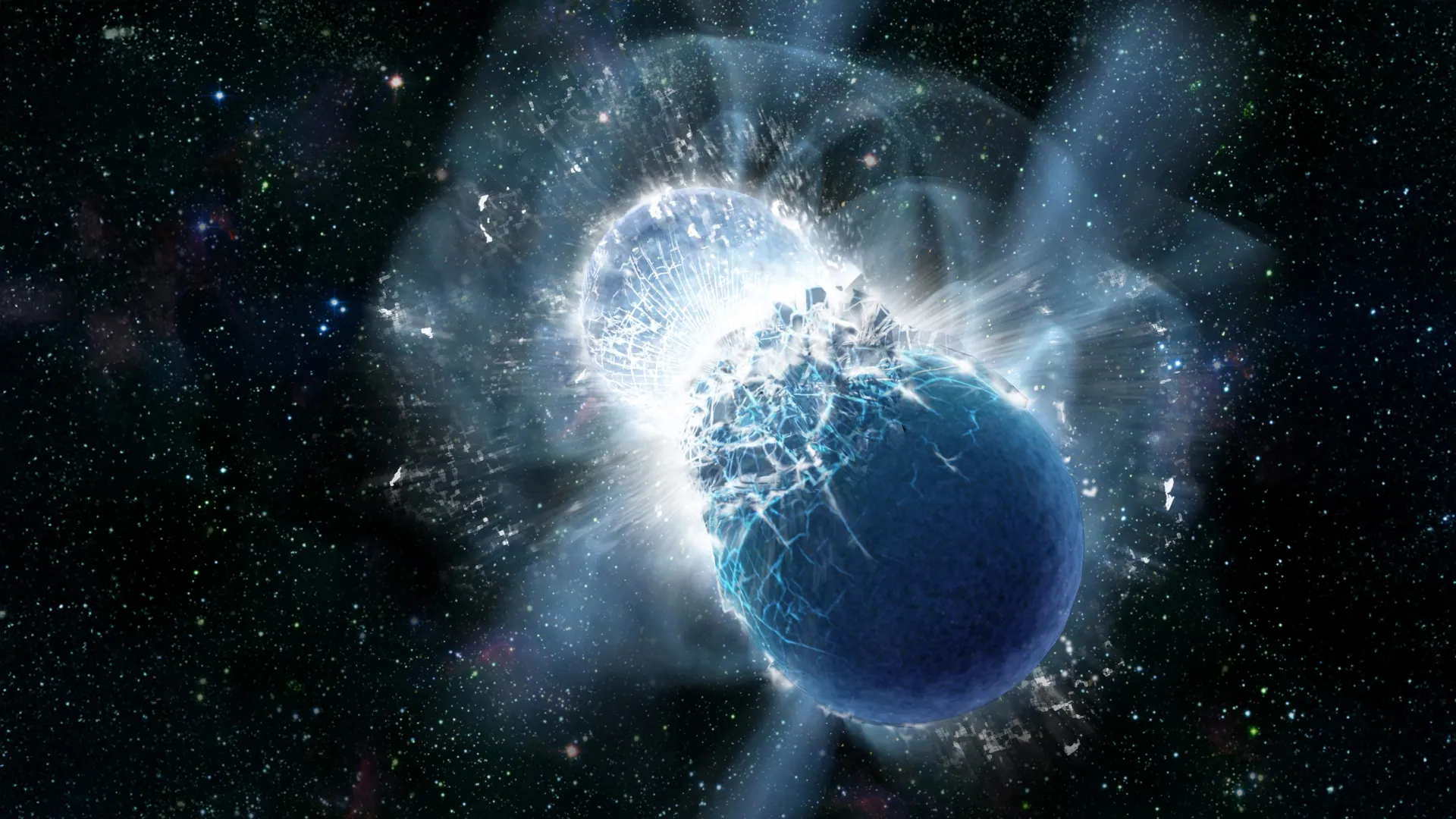
Magnetars are neutron stars with magnetic fields so strong they are thought to drive some of the most violent flashes in the sky. A new simulation study suggests one way they can be born: when two lighter neutron stars touch and merge into a single star instead of collapsing into a black hole.
All neutron stars have intense magnetic fields, typically about 100,000 times stronger than the strongest fields humans can create on Earth. About 1% have fields roughly 1,000 times stronger still. These are the magnetars, a likely source of events such as soft gamma-ray repeaters and fast radio bursts. How they form has been an open question.
The new work, posted on the arXiv preprint server, focuses on mergers of binary neutron stars. When two neutron stars collide, the result is often a black hole, because their combined mass exceeds the Tolman-Oppenheimer-Volkoff limit of around 2.6 solar masses. But some neutron stars are lighter. If their total mass falls below that limit, they can merge and survive as one neutron star.
Kenta Kiuchi and colleagues ran high-resolution simulations of such low-mass binaries on the Japanese supercomputer Fugaku. To keep the problem manageable, they assumed two stars of identical mass and typical properties, each with a magnetic field of about 3 trillion gauss, at the upper end of the usual range. The runs covered the period from just before the stars collide until just after.
Within milliseconds of contact, they found, the neutron fluid along the boundary becomes turbulent through what physicists call the Kelvin-Helmholtz instability. It is the same effect that makes the smoke from a blown-out candle rise smoothly and then curl into random swirls. In the stars, that turbulence mixes the neutron material so fully and so fast that the magnetic field is amplified sharply, dragged along as the mixing spreads through the merged star.
The magnetic field of the merged object came out more than 300 times stronger than the fields the two stars started with. Further turbulence could strengthen it even more, the study notes, though that lies beyond what the simulation can follow. The amplification spreads through the stars in about a millisecond, fast enough that it could influence how the merger itself unfolds and the structure of the star left behind.
More work will be needed to learn how the process plays out in full, including with stars of unequal mass. Still, the result shows that a collision between neutron stars can produce a magnetar, giving astronomers a specific formation channel to look for in the gamma-ray bursts and radio flashes such mergers might produce.