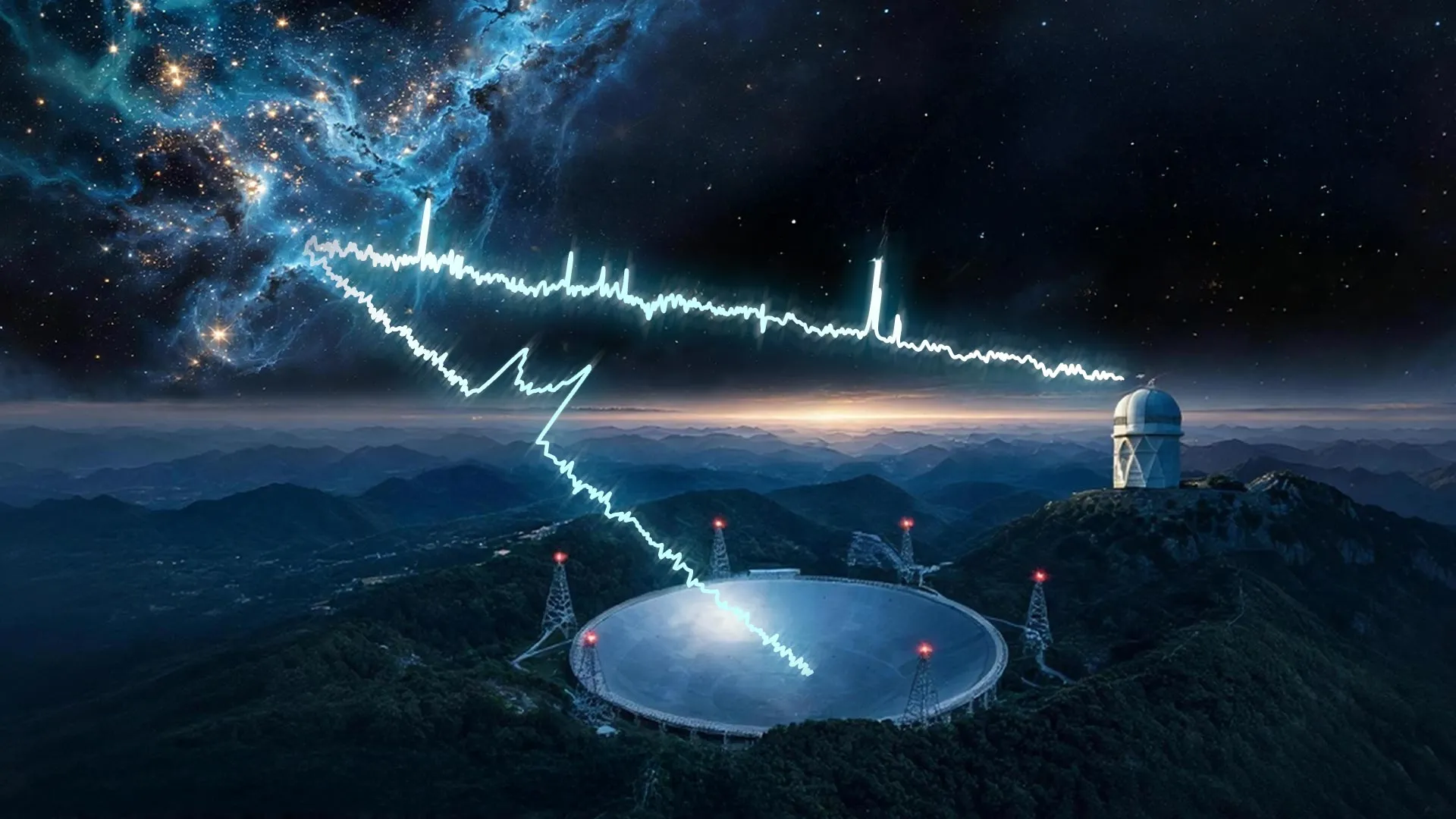
Lowest-Mass Double Neutron Star Pair Found by China's FAST, Merging in 82 Million Years
PSR J1856-0039 weighs about 2.49 suns combined and orbits in 2.36 hours. When its stars collide, the remnant is likely to be a neutron star rather than a black hole.

Astronomers using China's Five-hundred-meter Aperture Spherical radio Telescope have discovered the lightest pair of neutron stars ever found orbiting each other, a system that will eventually merge in a collision about 82 million years from now.
The binary is called PSR J1856-0039. Its combined mass is roughly 2.49 times that of the Sun, the lowest known for any double neutron star system. The two stars circle each other every 2.36 hours, the second-shortest orbital period among confirmed systems. The findings were published in Physical Review Letters by researchers at the Chinese Academy of Sciences and the State Key Laboratory of Radio Astronomy.
One member of the pair is a pulsar, a rapidly spinning neutron star that sweeps beams of radio waves across space like a lighthouse. Each time a beam crosses Earth, it produces a pulse that can be timed with extreme precision. The team made 17 observation sessions between 2020 and 2025 and extracted 253 pulse arrival times, which is how they pinned down the orbit and the masses.
The timing revealed three relativistic effects that Einstein's general theory of relativity predicts. The orbit is shrinking as the pair radiates gravitational waves, the closest point of the orbit is rotating, and a small delay in the pulse arrival times shows the effect of gravity and motion on the pulsar's clock. All three agree with the theory, giving physicists another strong test of gravity in a regime far beyond anything on Earth.
The pulsar is faint, which is why it took the world's largest single-dish radio telescope to catch it. JinLin Han, a member of the team, noted that FAST's "exceptional sensitivity enables high signal-to-noise ratio detection" of the weak signal.
The low mass matters for what happens next. When two neutron stars merge, the outcome depends on their total mass. Heavy pairs collapse into black holes. This one is light enough that the merger is likely to produce a stable neutron star instead. That makes the system a valuable laboratory for the equation of state, the rule that describes how matter behaves at densities far greater than an atomic nucleus.
Mergers of this kind are also where heavy elements such as gold and platinum are thought to be forged. Systems like J1856-0039 help astronomers estimate how common low-mass mergers are, and what they leave behind.
The 82-million-year countdown is far beyond human timescales, but the system is useful now. As the orbit keeps shrinking, continued timing with FAST should sharpen the mass measurements and test whether gravity keeps following Einstein's predictions.