China's FAST Telescope Found Two Hydrogen Clouds Near M51 With No Stars in Them at All
Each holds about three million suns' worth of hydrogen inside a halo weighing 3.7 billion solar masses. If the interpretation holds, they are dark matter halos that never lit up.

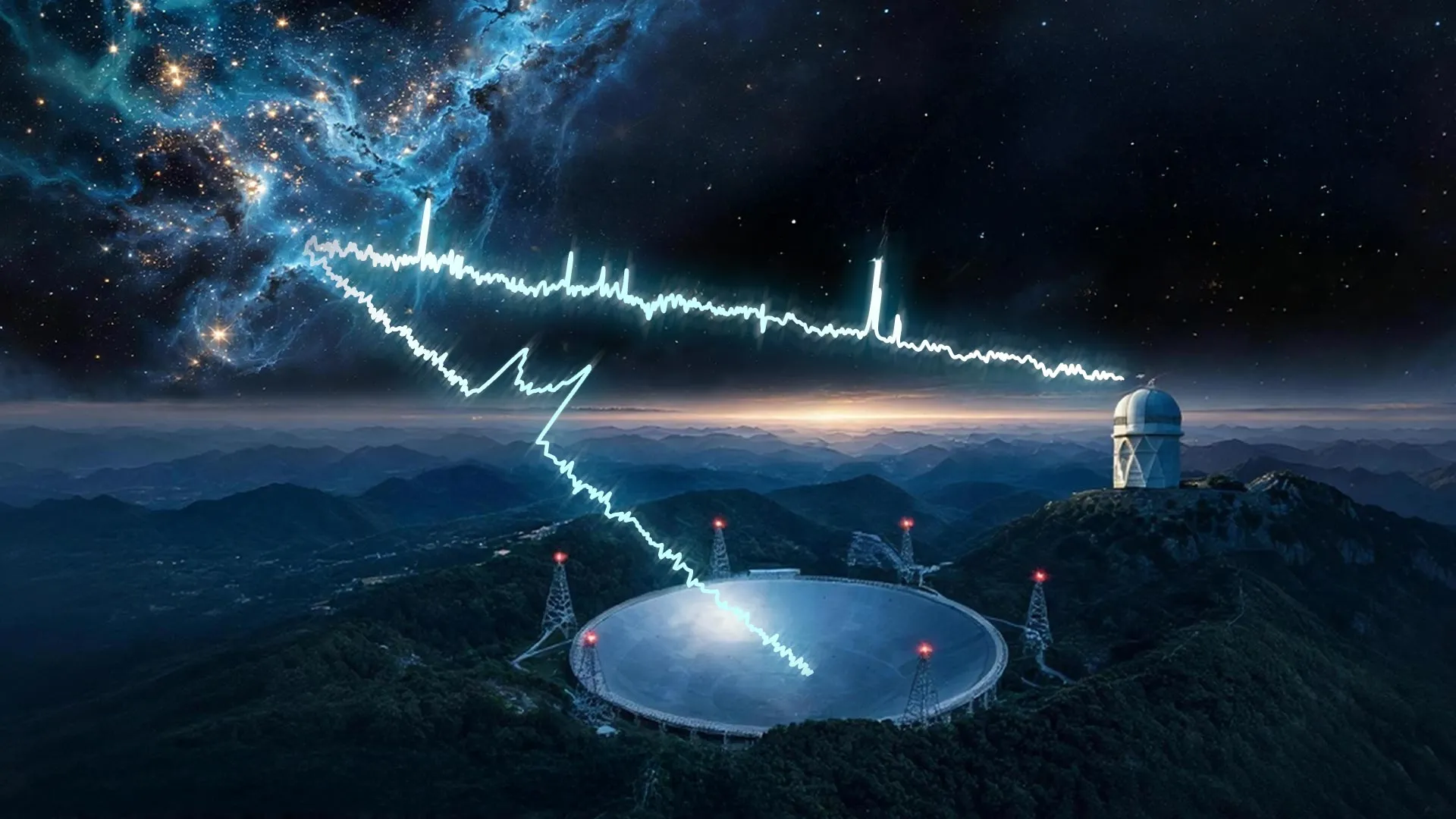
A team led by Qingze Chen at the National Astronomical Observatories of the Chinese Academy of Sciences has found two clouds of neutral hydrogen in the outskirts of the Whirlpool Galaxy that appear to contain no stars whatsoever. The detections came from FAST, the 500-meter dish in Guizhou province, working at the 21-centimeter line that hydrogen atoms emit when the spin of the electron flips relative to the proton.
The objects, designated Cloud N and Cloud S, sit 70 to 90 kiloparsecs from the center of M51 — between roughly 228,000 and 293,000 light-years out, well beyond the galaxy's visible spiral arms. Each contains about three million solar masses of hydrogen. The spectral lines are narrow, around 20 kilometers per second, which means the gas is not being violently stirred. From the dynamics the team infers a total halo mass near 3.7 billion solar masses around each cloud, the overwhelming majority of which is not gas and is not stars.
The candidate explanation is a class of object that cosmologists predicted before anyone saw one. In the standard Lambda Cold Dark Matter picture, the early universe should have produced enormous numbers of small dark matter halos. When reionization switched on and ultraviolet light from the first stars and quasars flooded the intergalactic medium, the smallest halos were stripped of their gas entirely. A narrow band of intermediate-mass halos held onto their hydrogen but were kept warm enough by that same UV background that the gas never cooled, never collapsed, and never formed a single star. Those are called reionization-limited H I clouds, or RELHICs. They should be everywhere, and they should be invisible except in radio.
The clouds turned up in FEASTS, a FAST survey that mapped the extended hydrogen around 55 nearby galaxies. Out of all 55, exactly two candidates emerged, which is itself a data point about how rare or how hard to detect these things are.
The team is careful about the claim. M51 is a textbook interacting system — it is visibly tangled with its companion NGC 5195 — and galactic collisions fling long streams of gas into the surrounding space. The authors write that they "cannot completely rule out the possibility that the clouds could instead be tidal debris," and settling the question will take higher-resolution imaging that can show whether the clouds are self-contained and gravitationally bound or are simply the brightest knots in a much larger tidal stream.
The paper appeared in Astronomy & Astrophysics on August 4, 2026. If the RELHIC interpretation survives follow-up, these would be among the first direct sightings of the dark matter substructure that cold dark matter cosmology insists should fill the universe — halos that pulled together, caught some gas, and then sat there for 13 billion years doing nothing at all.