Webb Telescope Spots a Giant Black Hole That Formed Before Its Galaxy, Upending Theory
In a 'little red dot' 13 billion light-years away, a supermassive black hole makes up most of the object's mass — a finding scientists call a paradigm shift.
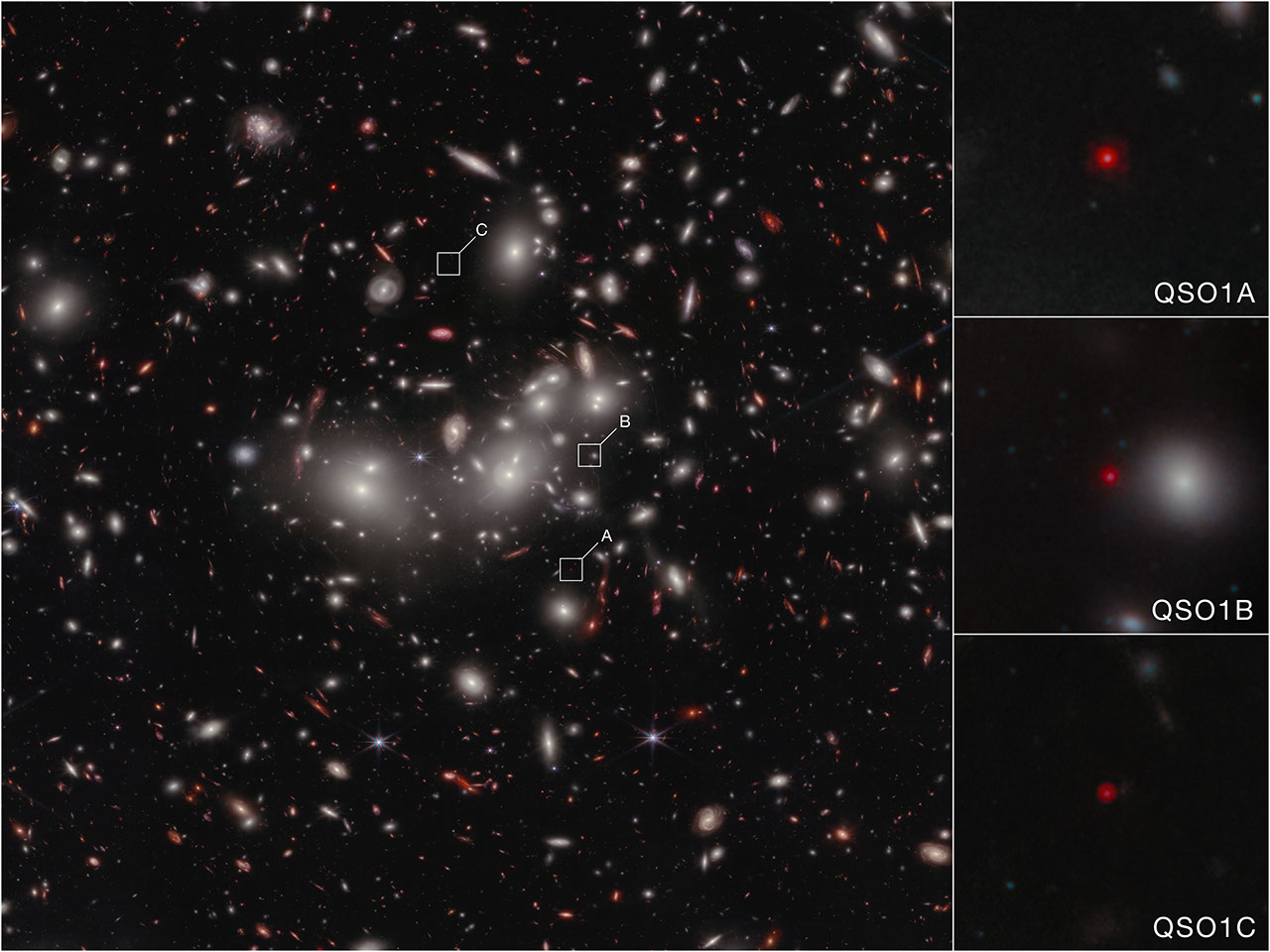
Astronomers using NASA's James Webb Space Telescope have measured a supermassive black hole in the distant early universe that is so enormous relative to its surroundings it appears to have formed before the galaxy around it — a discovery researchers say overturns the classical understanding of how black holes and galaxies grow together.
The object, catalogued as Abell2744-QSO1, is one of the mysterious "little red dots" that Webb has been turning up in the infant cosmos. It is seen as it existed roughly 700 million years after the Big Bang, more than 13 billion years ago. What stunned the team was the math: the central black hole weighs about 50 million times the mass of the Sun and accounts for at least two-thirds of the entire object's mass — thousands of times the proportion seen in galaxies near our own, where black holes make up only a tiny fraction of the total.
"It's a paradigm shift, a total revisiting of classical scenarios of how black holes form," said the research team, whose findings were published in the journals Nature and Monthly Notices of the Royal Astronomical Society. In the familiar picture, galaxies assemble first from collapsing clouds of gas and stars, and their central black holes grow up alongside them, fed by infalling material. A black hole that dwarfs its host flips that sequence on its head.
The measurement, led by astronomers including Roberto Maiolino and Francesco D'Eugenio of the University of Cambridge, is notable not just for what it found but for its precision. "This is the first direct measurement of a black hole mass within the first billion years after the Big Bang," the team said — a milestone made possible by Webb's ability to dissect faint, ancient light into detailed spectra.
The result lends weight to the idea that some of the universe's first black holes were not the end products of dying stars but formed through "direct collapse," in which a vast cloud of primordial gas folds in on itself to create a heavy black hole seed without first becoming a star. Such a head start would help explain how black holes grew so massive so quickly in the cosmic dawn, a question that has nagged at astronomers since Webb began revealing surprisingly mature objects in the early universe.
If little red dots like QSO1 turn out to be common, theorists may need to redraw the timeline of cosmic history, allowing for black holes that lead rather than follow the galaxies they inhabit. For now, the finding stands as one of the clearest signs yet that the first billion years of the universe unfolded in ways the textbooks did not anticipate — and that Webb is only beginning to map the strangeness of that era.