China's FAST Telescope Finds a Starless Hydrogen Cloud That May Be a True 'Dark Galaxy'
The isolated cloud J1351+0039 holds about 130 million suns of mass and shows no stars in deep optical images.

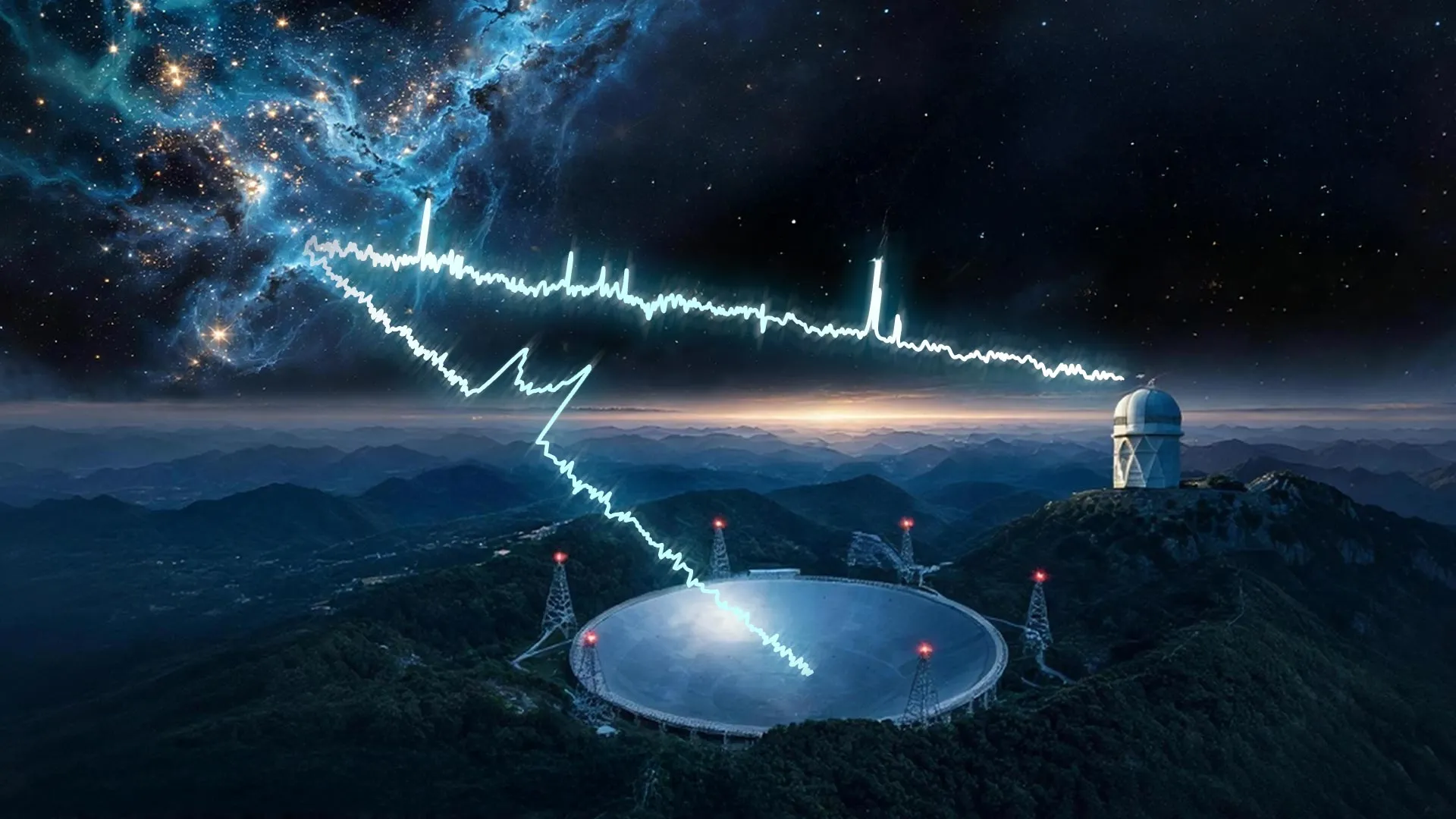
Astronomers using China's Five-hundred-meter Aperture Spherical radio Telescope, known as FAST, have found a compact cloud of hydrogen with no visible stars or galaxy around it, one of the strongest candidates yet for a so-called dark galaxy, according to a new paper posted to arXiv.
In the standard lambda cold dark matter model, structure builds up in stages: small dark matter halos form first, then merge into larger halos and galaxies. The model also predicts that some low-mass halos never form stars at all. After cosmic reionization, ultraviolet radiation from quasars and galaxies heats a halo's gas so that it never becomes cold and dense enough to ignite stars. These starless, gas-bearing halos are called reionization-limited H I clouds, or RELHICs, and are nicknamed dark galaxies.
Because they have few or no stars, they can only be found through the 21-centimeter radio line emitted by neutral hydrogen. There is a catch. A faint dwarf galaxy can look dark simply because of surface-brightness limits, so astronomers must tell those apart from truly starless halos. To date, only one RELHIC has been observationally confirmed and two promising candidates have been found.
The new object, J1351+0039, turned up in a blind hydrogen survey with FAST. Jin-Long Xu of the National Astronomical Observatories in China and colleagues observed it three times between July and August 2026. It is isolated: no large galaxies lie within 1.5 degrees on the sky, under 100 kiloparsecs at its distance, and within 250 kilometers per second in velocity. The team saw no cometary tails, gas bridges or nearby companions, which rules out a tidal origin from a gravitational encounter.
The dynamics point to a total mass of about 130 million suns. Deep optical images from the DESI Legacy Survey found no stellar counterpart, so most of that mass is attributed to dark matter. The cloud is round, with a temperature near 10,000 kelvin in equilibrium with the ultraviolet background. All of this fits a dark galaxy that has never cooled enough to form stars.
The gas rotates at only about 4.2 kilometers per second, while its random motions run about 11.6 kilometers per second. Because random motion outweighs ordered rotation, the cloud is held up mainly by the pressure of its own moving gas rather than by spin, unlike a disk galaxy. The team writes that this "suggests that J1351+0039 may be a RELHIC that has gradually acquired angular momentum."
The authors caution that a very faint stellar component could still be hiding below DESI's sensitivity, and say deep images from the James Webb Space Telescope or Hubble may be needed to confirm the cloud is truly starless. Earlier dark galaxy candidates sat near massive galaxies. J1351+0039's complete isolation makes it, in the researchers' words, the cleanest and most compelling isolated RELHIC candidate identified to date.