Astronomers Find a Giant Hydrogen Cloud With Almost No Stars, 310 Million Light-Years Away
Radio surveys from Arecibo and China's FAST telescope point to AGC 322753, a candidate dark galaxy holding 2 billion Suns' worth of gas and little or no starlight.

Astronomers have identified a huge reservoir of neutral hydrogen that shows little or no sign of starlight, a candidate "dark galaxy" cataloged as AGC 322753. The object lies about 310 million light-years away and holds roughly 2 billion times the mass of the Sun in neutral hydrogen, according to a paper in Monthly Notices of the Royal Astronomical Society led by Marco Monaci of Swinburne University of Technology in Australia.
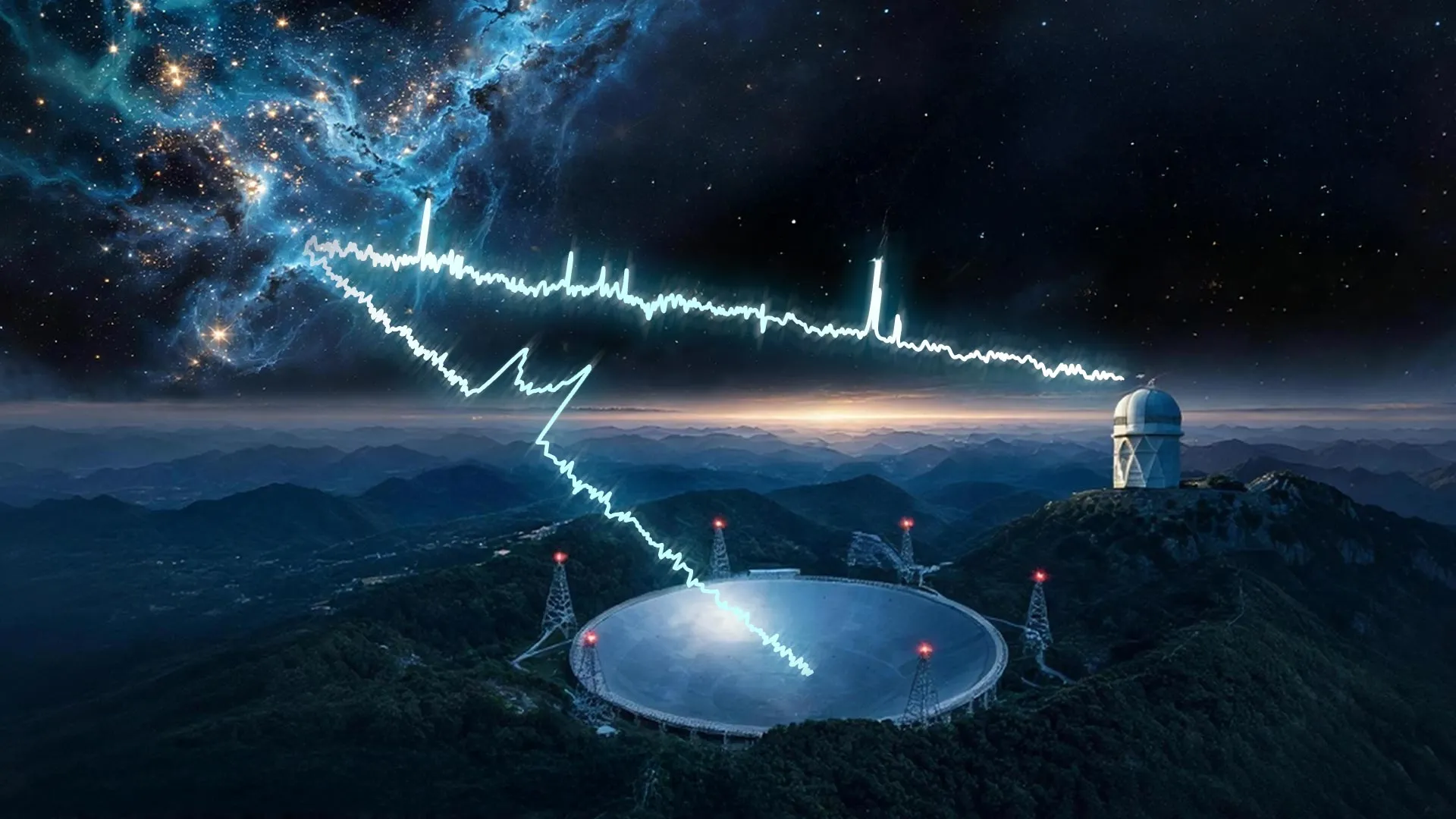
A dark galaxy is a system with very few stars or possibly none at all. Because stars are what telescopes usually see, such systems are found with radio dishes that detect the faint emission of neutral hydrogen gas. The team compared candidates from two radio surveys: ALFALFA, conducted with the Arecibo telescope, which is now decommissioned, and FASHI, a survey using China's FAST telescope.
Cross-matching the two catalogs produced 13 matching sources. The researchers screened them by checking nearby galaxies, image quality and possible visible counterparts, and that left AGC 322753. Both detections agreed closely in velocity and signal shape. Because separate telescopes saw it at different times, the signal is unlikely to be radio interference. Each observation showed two peaks, a pattern consistent with gas rotating in a disk, though the data cannot yet map that disk.
A blank optical image does not prove there are no stars, so the team tested what their images might have missed. They inserted artificial galaxies of different sizes and stellar masses and checked which remained detectable. The results leave room for an exceptionally faint stellar population. Under model-dependent assumptions, the upper limit is roughly 50 million solar masses in stars, which means at least 40 times more neutral hydrogen than stars. The authors wrote that the galaxy "could have a stellar mass too low to be detectable in the Legacy Surveys."
The gas mass is the puzzle. The team found that AGC 322753 holds more hydrogen than current models predict for a completely starless system. Its nearest luminous neighbor is about 950,000 light-years away in projected separation, a wide gap.
There is a mundane alternative. The gas might have been pulled out of neighboring galaxies by gravitational interactions, a tidal origin. The large gas mass and apparent rotation argue against that, but the authors acknowledge they cannot rule it out.
Precedent suggests caution. A separate proposed dark galaxy was later reclassified after deep follow-up observations revealed faint stars associated with its gas, and AGC 322753 could follow the same path.
The next steps are straightforward. Sharper radio observations could confirm whether the gas forms a rotating disk, and deeper optical images could reveal hidden stars. Either result would settle whether this is a starless gas cloud, a very faint galaxy, or stripped gas, and would show how many galaxies in the universe are almost entirely invisible to ordinary telescopes.