Light Beams Trapped in Warm Rubidium Vapor Form Discrete Solitons for the First Time
Croatian physicists built an optical lattice out of laser interference in atomic gas and showed a beam can hold its shape inside it.

Scientists at the Institute of Physics Zagreb, working with a colleague from the Physics Department at the Faculty of Science, report the first experimental demonstration of discrete one-dimensional solitons in an optically induced photonic lattice made from warm rubidium vapor. The work, led by Vjekoslav Vulić and colleagues, was published in Laser & Photonics Reviews.
Photonic lattices are periodic structures in which light moves in a way that resembles electrons moving through a crystal. Most are built from fixed materials such as semiconductors, lithium niobate, glass or waveguides. This team instead used rubidium vapor, a dynamic and tunable medium in which the laser light itself creates the lattice.
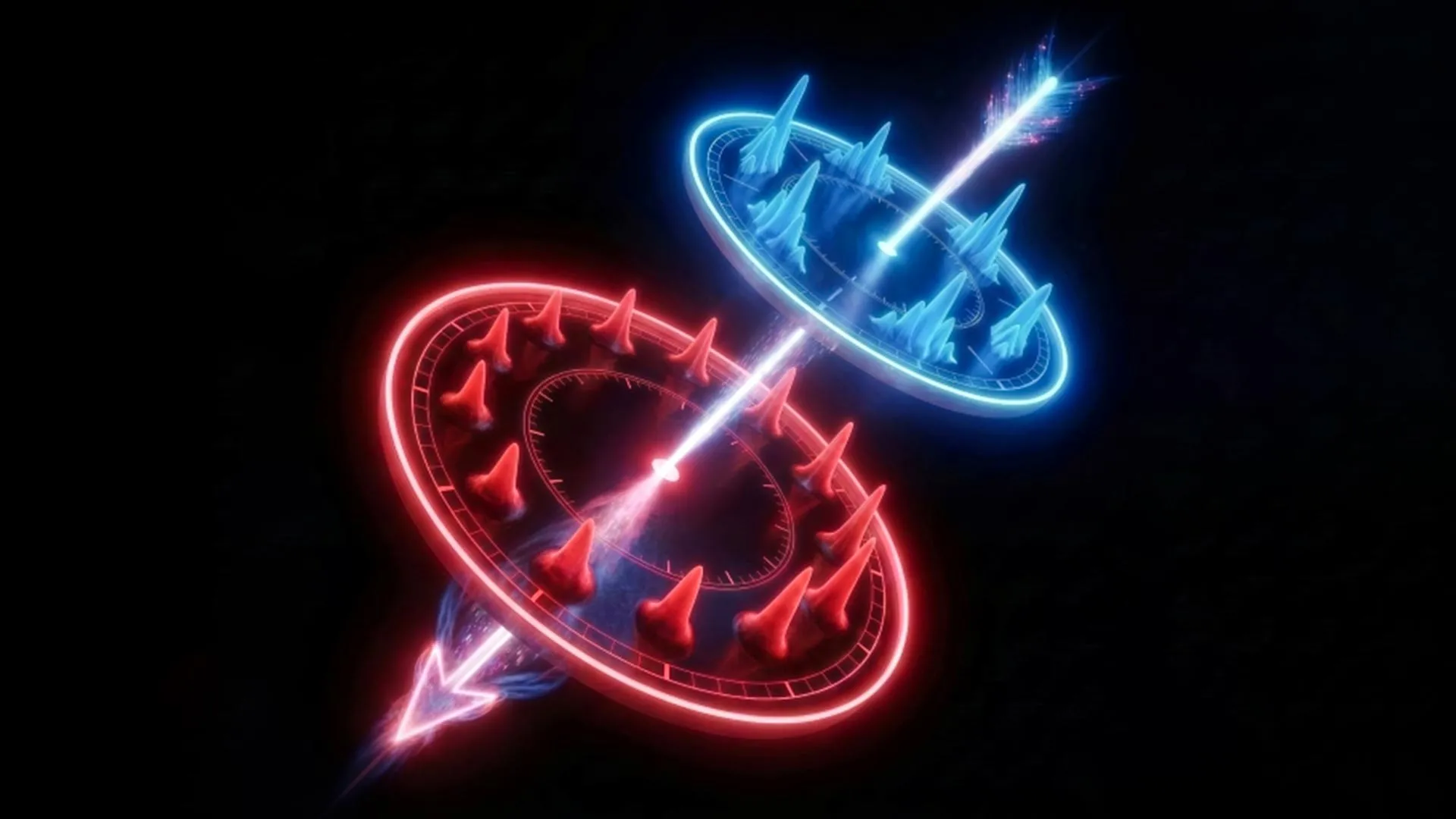
Two coupling laser beams cross at a small angle inside a glass cell of rubidium vapor. Their interference pattern modulates the vapor's refractive index, forming the lattice. A separate probe beam is then focused onto a single lattice site and sent through the structure.
At low intensity, the probe spreads to neighboring sites, a behavior called discrete diffraction that differs from ordinary diffraction in a uniform medium because of the lattice's periodicity. At higher intensity the atomic response becomes nonlinear and the beam self-focuses. At about 6 milliwatts of probe power, self-focusing balances the discrete diffraction and a soliton forms, a localized beam whose transverse profile stays nearly unchanged as it travels.
The team measured the beam at the cell exit, 50 millimeters in, across probe powers from 0.5 to 6.0 milliwatts. The results show progressively stronger self-focusing and the emergence of a stable one-dimensional discrete soliton.
The mechanism relies on the rubidium atoms interacting with both laser fields in a three-level scheme, with electromagnetically induced transparency playing a central role at large detuning from single-photon resonance. To model it, the authors coupled the paraxial wave equation, which describes beam propagation, with optical Bloch equations, which describe the atomic response, and included the full hyperfine structure of rubidium. The measured and simulated intensity patterns agreed well.
Atomic vapor offers advantages over solid materials because lattice properties can be adjusted simply by changing the frequencies and intensities of the beams. The vapor also allows coherent control of optical gain and loss, which makes it useful for studying non-Hermitian nonlinear dynamics, parity-time symmetry, dissipative solitons and quantum fluids of light.
The authors point to longer-term relevance for quantum optics and atomic technologies, including quantum memories, atomic clocks and chip-scale devices. Those uses are possibilities rather than demonstrated results, and the experiment so far shows only that the soliton can be made and controlled in this platform.