Physicists Made Quantum Entanglement Out of Raw Sunlight. No Laser Anywhere in the Setup
A Fresnel lens, a cone-shaped concentrator and a millimeter of crystal produced photon pairs 94% faithful to a perfect entangled state — and they violated Bell's inequality.

Every quantum entanglement experiment for the past half-century has started the same way: with a laser. A research team spanning Canada and Germany has now done it with sunlight instead, generating entangled photon pairs from ordinary daylight collected outdoors.
The result runs against a deep instinct in the field. Lasers are used because entanglement generation demands light that is coherent, bright and spectrally narrow, and sunlight is the opposite of all three — it is incoherent, spread across a huge range of wavelengths, and arrives from a source 93 million miles away with no phase relationship to speak of. Converting that into a quantum resource was widely treated as impractical.
The mechanism itself is standard. Spontaneous parametric down-conversion, or SPDC, sends light into a nonlinear crystal where, very occasionally, one incoming photon splits into two lower-energy photons that emerge entangled — correlated in polarization in a way no classical description can reproduce. The difficulty is the "very occasionally": the conversion odds are tiny, which is why the process is normally fed by an intense laser beam. The engineering problem was therefore concentration, not physics.
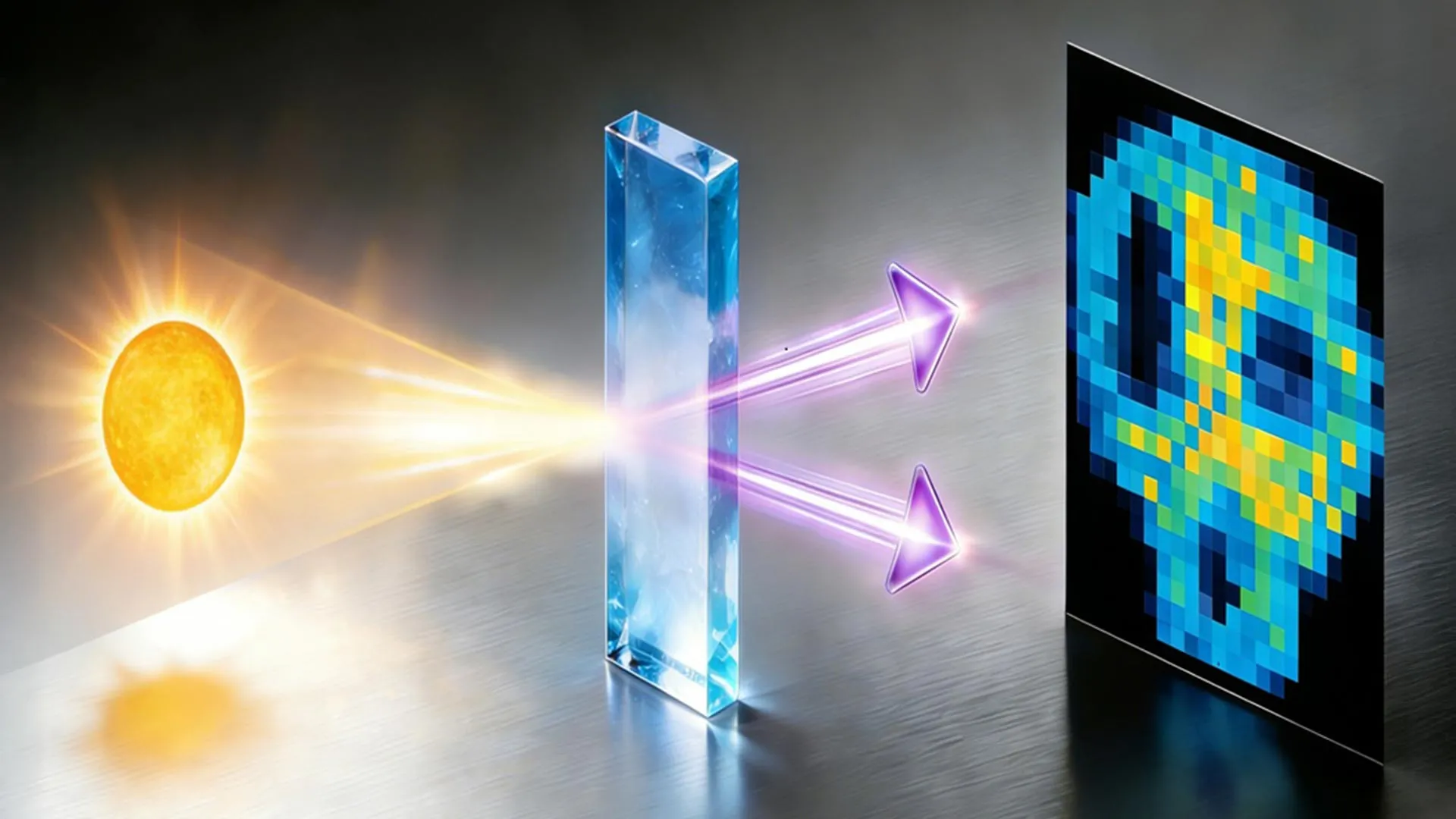
That is where the hardware came in. Hanieh Fattahi's team at the Max Planck Institute for the Science of Light in Germany built a cone-shaped solar concentrator that takes sunlight gathered by a Fresnel lens and funnels it into an optical fiber thinner than a human hair, delivering it onto a crystal only millimeters across. Cheng Li, a University of Ottawa graduate who led the work, ran the experiment alongside the theory group of Robert Boyd at Ottawa. The resulting photon pairs matched a perfectly entangled state to about 94% fidelity and violated Bell's inequality — the standard test that rules out any explanation based on classical correlations hidden in the light beforehand. The work is published in Optica.
The obvious application is orbital. "This technology could one day enable satellites to create secure encryption keys using the sunlight already abundant in space," Li said. Satellite quantum key distribution currently requires flying a laser, its power supply and its thermal management hardware — a meaningful share of a small satellite's mass and power budget. A spacecraft above the atmosphere sits in unfiltered, uninterrupted sunlight, and swapping the laser for a lens is the kind of tradeoff that changes what fits on a cubesat.
There is a second, quieter implication. If entanglement can be pulled from a thermal, incoherent source as messy as the sun, the sharp line researchers draw between "quantum light" and "ordinary light" is doing less work than assumed. The photons streaming off a star were never fundamentally different — they were simply never concentrated hard enough onto the right crystal.