Sunlight Powers Quantum Ghost Imaging in Breakthrough That Could Work Anywhere
Chinese researchers generate quantum-linked photon pairs using only natural sunlight, achieving 90.7% imaging quality comparable to laboratory lasers.
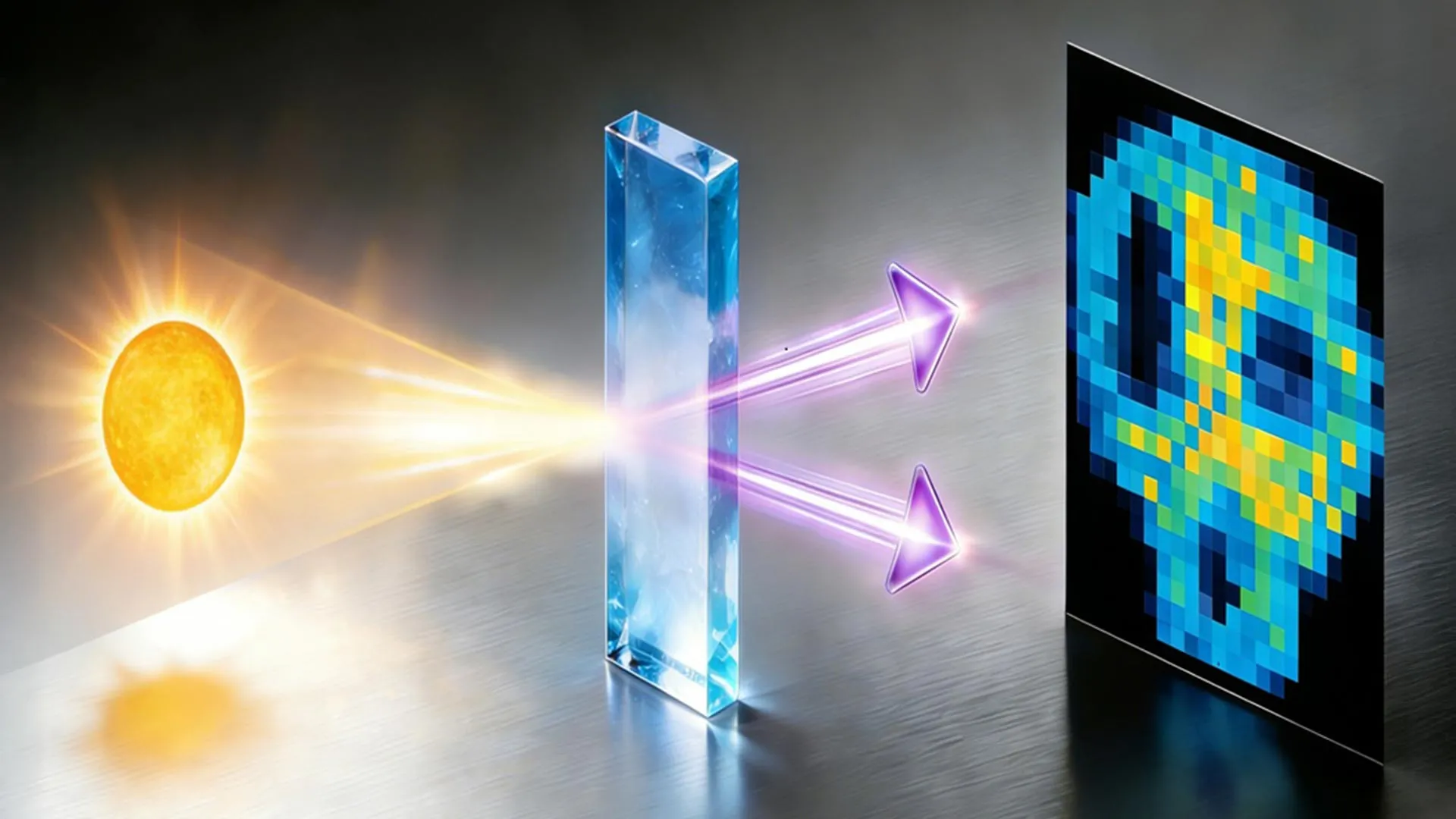
Scientists have achieved what once seemed impossible by using ordinary sunlight to create quantum-linked photon pairs capable of "ghost imaging," a breakthrough that could bring quantum technologies to remote locations without the need for complex laboratory equipment. Researchers at Xiamen University successfully generated strongly correlated photons using only natural sunlight as a power source, demonstrating that quantum optics experiments can work outside carefully controlled laboratory environments.
The breakthrough challenges the long-held belief that quantum photon pair generation requires highly stable, coherent laser light. Traditional spontaneous parametric down-conversion relies on powerful lasers shining into nonlinear crystals, but the Chinese team proved that even partially coherent sunlight can produce the quantum correlations needed for advanced imaging applications.
To overcome the inherent instability of natural sunlight, the researchers built an automatic sun-tracking system similar to an equatorial telescope mount that continuously follows the Sun throughout the day. The system directs sunlight into a 20-meter plastic multimode optical fiber that transports the light into a dark laboratory, where it pumps a periodically poled potassium titanyl phosphate nonlinear crystal to generate correlated photon pairs.
Despite sunlight's constant fluctuations in brightness and direction, the setup achieved remarkable results in ghost imaging experiments. The sunlight-powered system produced imaging visibility of 90.7%, coming remarkably close to the 95.5% visibility achieved by a standard 405 nanometer laser operating at the same pump power. The team even successfully reconstructed complex two-dimensional images, including what they described as a "ghost face."
The research opens up entirely new possibilities for quantum technologies in situations where traditional laser systems would be impractical or impossible to operate. According to the research team, sunlight's broad spectrum actually helps support quasi-phase matching inside the nonlinear crystal, allowing efficient photon pair production. This could enable quantum imaging and sensing applications in remote locations, field conditions, or even space-based platforms where electrical power for lasers may be limited.