Europe's JUPITER Supercomputer Fully Simulates a 50-Qubit Universal Quantum Computer, Smashing World Record
The Jülich team and Nvidia threw 23,000 GH200 Superchips and 2 petabytes of memory at the calculation, pushing the 'quantum simulation horizon' two qubits further — and raising the bar that real quantum hardware will eventually have to clear.
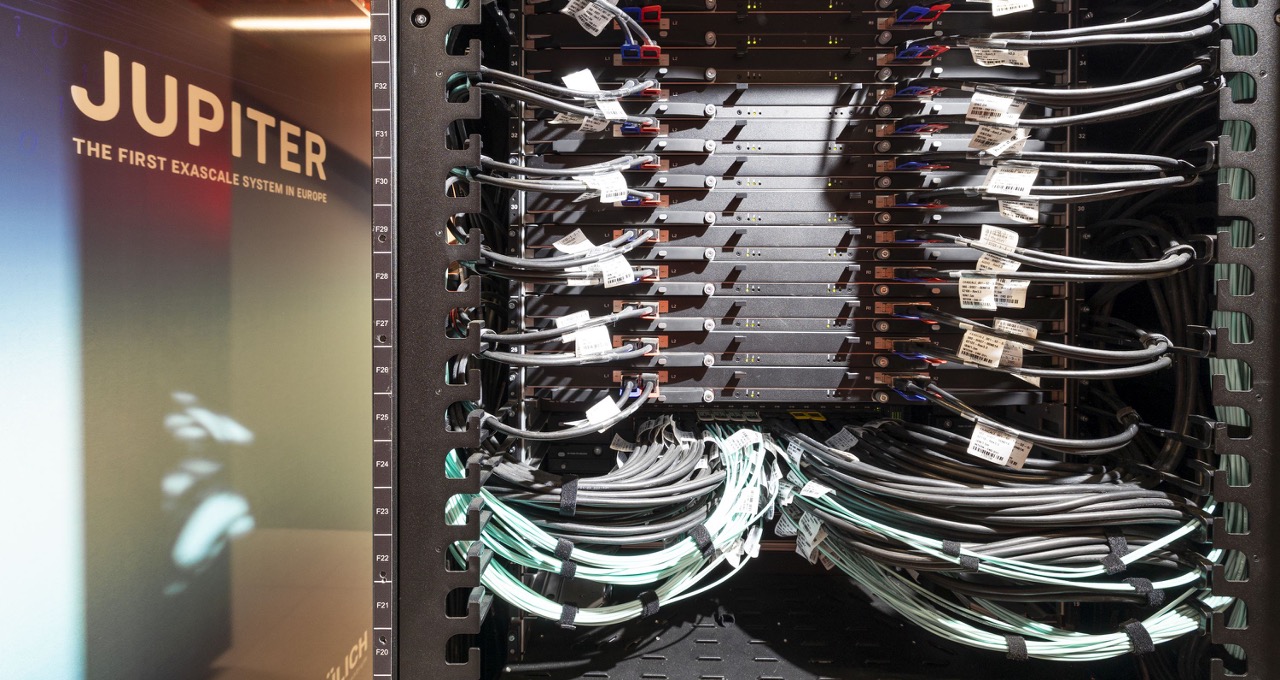
JÜLICH, Germany — Europe's first exascale supercomputer, JUPITER, has fully simulated a universal 50-qubit quantum computer in a single calculation, smashing a record that had stood for less than two years and pushing what physicists call the "quantum simulation horizon" a measurable step further into the future.
The achievement, announced this month by the Jülich Supercomputing Centre and Nvidia, broke the previous 48-qubit world record set by the same Jülich team and confirmed what JSC director Thomas Lippert called "the dual identity" of the new system: both a classical workhorse for climate, neuroscience, and biology and a benchmark against which the next generation of real quantum computers will have to prove themselves. The work, posted to arXiv last week as paper 2511.03359, will appear in a forthcoming issue of the International Journal of High Performance Computing Applications.
Under the hood, the simulation devoured about 2 petabytes of memory and called on the full choreography of more than 23,000 of Nvidia's GH200 Grace Hopper Superchips, each of which fuses a 72-core Arm CPU with an H100 GPU on a single carrier. The breakthrough was made possible by a complete rewrite of Jülich's longstanding simulator, JUQCS, into a version dubbed JUQCS-50 that takes advantage of GH200's coherent CPU-GPU memory to swap quantum-state vectors between GPU high-bandwidth memory and slower CPU memory with minimal performance loss. "It is a brutal physics calculation," said principal investigator Hans De Raedt of the University of Groningen. "Every additional qubit doubles the memory you need. Going from 48 to 50 is going from 'enormous' to 'almost impossible.'"
JUPITER itself, inaugurated in September 2025 after years of pandemic-related delays, ranks as the fastest supercomputer in Europe and the fourth fastest in the world on the most recent TOP500 list. Funded by the EuroHPC Joint Undertaking, the German federal government, and the state of North Rhine-Westphalia at a total cost of roughly €500 million, the machine is housed in a purpose-built modular data center on the Forschungszentrum Jülich campus. Beyond quantum simulation it is being used for kilometer-scale climate models, full-brain digital twins, and large language model training, including a multilingual European foundation model called Teuken-7B.
The record matters for two reasons. First, every additional qubit a classical supercomputer can faithfully simulate raises the bar for what a real quantum computer must achieve before it can claim a "quantum advantage." Second, it gives algorithm designers a sandbox in which to test ideas at scales beyond what current real quantum hardware can run — IBM's most advanced quantum processor, Condor, has 1,121 physical qubits, but coherence times and error rates limit it to far fewer effective logical qubits. "This is the bridge," Lippert said. "It is how you make sure that when real 50-qubit systems do arrive, you already know what to do with them."