The Universe Still Has the Hydrogen. It Has Stopped Turning It Into Stars
Star formation is running at less than half the rate it did 4.5 billion years ago. A survey of 2.5 million galaxies says the raw gas supply has barely dropped, which breaks the standard explanation.
For decades the accepted story about the universe's declining birth rate was simple: galaxies are running out of gas. A survey published this week in Nature Astronomy says the gas is still there, and the story needs replacing.
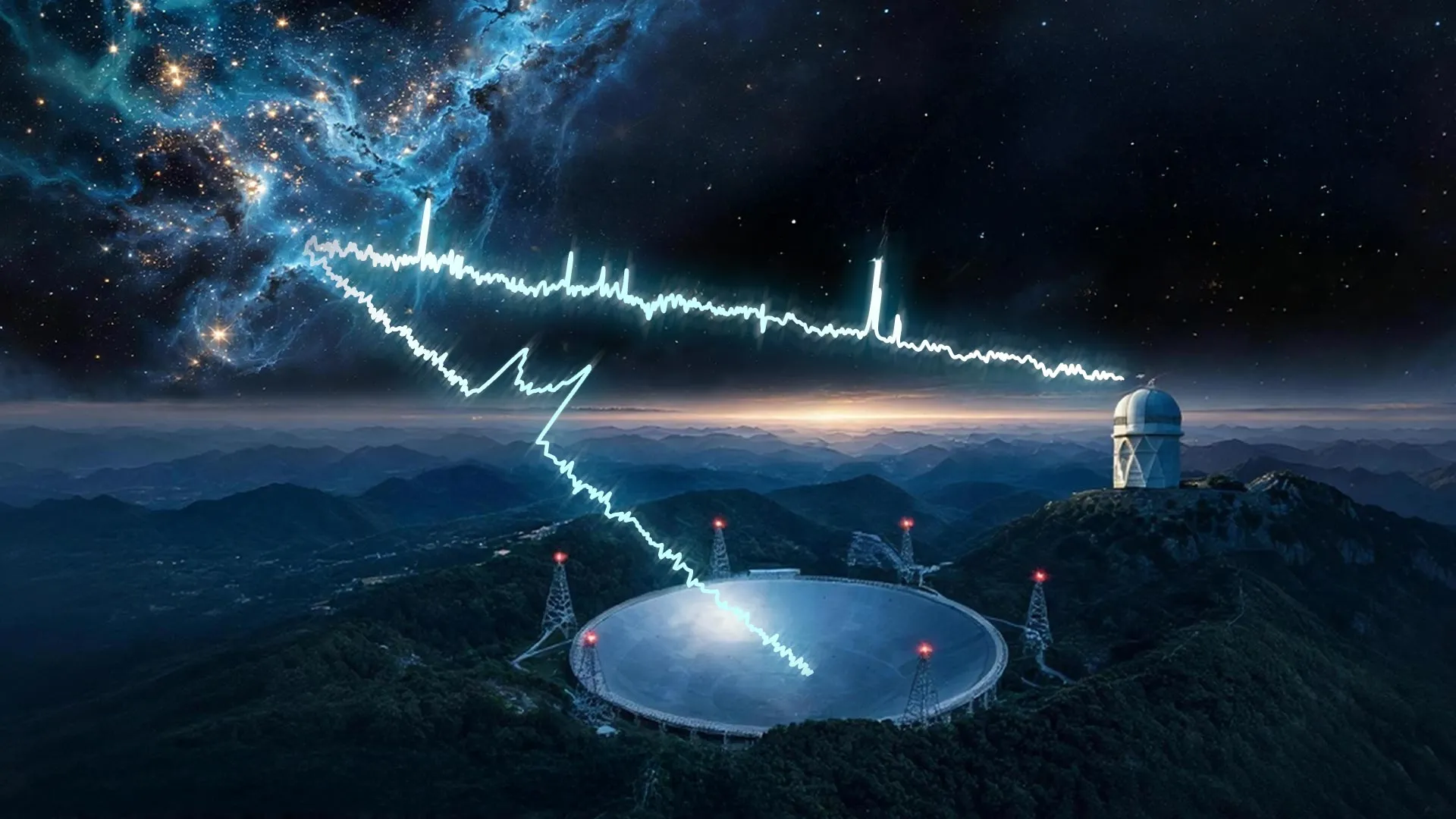
An international team led by researchers at the Chinese Academy of Sciences combined two instruments to measure the two halves of the problem at once. China's FAST radio telescope, the largest filled-aperture radio dish in the world, supplied the hydrogen measurements. The Dark Energy Spectroscopic Instrument supplied the galaxies — roughly 2.5 million of them, spread across nearly a third of the sky, each with a measured distance and therefore a place in cosmic time.
The mismatch they found is stark. Star formation was about 2.5 times higher 4.5 billion years ago than it is today, while neutral hydrogen levels over the same stretch were only about 1.4 times higher. Fuel supply fell by a factor of 1.4. Output fell by a factor of 2.5. Those two numbers cannot both be explained by exhaustion, because there is still plenty of hydrogen sitting in galaxies that have largely stopped building stars from it.
Getting that hydrogen measurement at all required a technique called HI spectral stacking. Neutral hydrogen radiates at 21 centimeters, and for individual distant galaxies that signal is far too faint for any telescope to pick out. Stacking works around the limit by adding together the spectra of thousands of galaxies whose positions and distances are already known from DESI, letting a signal that is invisible one galaxy at a time emerge from the sum. It trades information about any single galaxy for a reliable population average.
The result shifts the question the field has to answer. Instead of asking when galaxies will run out of gas, astronomers now have to explain why it is increasingly difficult to form stars despite abundant neutral hydrogen reserves. The team's own suggestion points at the step in the middle. Stars do not form directly from neutral atomic hydrogen; they form from molecular hydrogen, which requires the gas to cool, condense, and pair up first. If the conversion from atomic to molecular gas has become less efficient over cosmic time, the reservoir can stay full while the assembly line slows.
What would cause that is the open problem. Candidate mechanisms include the heating and stirring of galactic gas by supermassive black holes, the gradual depletion of the cold dense clouds where molecular hydrogen forms, and changes in the dust and metal content that catalyze the atomic-to-molecular transition. Each predicts a different signature, and each is now testable against a dataset that did not exist before.
The paper appeared in Nature Astronomy on September 1.


