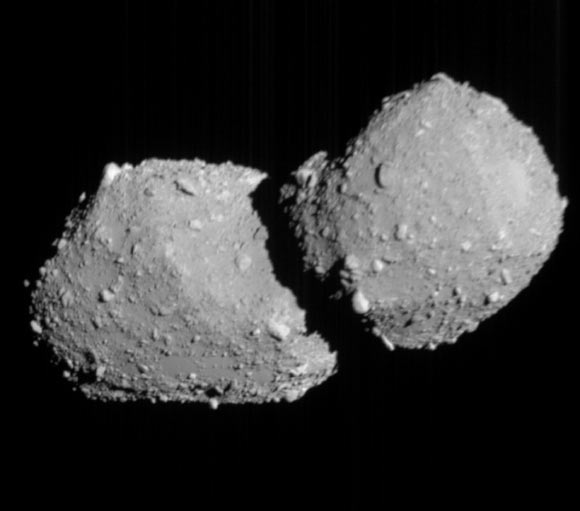
Japan Readies Rocket Launch to Bring Back the First Samples From Mars' Moon Phobos
The MMX probe is set to lift off from Tanegashima on Tuesday, with a French-German rover named IDEFIX and a plan to return at least 10 grams of Phobos material to Earth.

Japanese scientists are preparing to launch a mission to the moons of Mars that aims to be the first round trip to the Martian region. The unmanned Martian Moons eXploration probe, known as MMX, is set to lift off aboard the flagship H3 rocket from the Tanegashima Space Center on Tuesday at 4:41 a.m. local time (1941 GMT Monday), according to the Japan Aerospace Exploration Agency.
"Being able to be involved in such a grand mission is incredibly exciting," Makoto Arita, project manager of JAXA's H3 rocket team, told reporters two days before the launch. The spacecraft is due to arrive near Mars around August next year. It will orbit the moon Phobos before landing and collecting at least 10 grams (0.35 ounces) of surface material during three years of operations in the Martian system. A rover named IDEFIX, after the dog in the Asterix comics, will first make surface observations to help ensure a safe landing.
"The sampling from Phobos is of course the world's first, but it means this is the first round trip to the Martian system," MMX project manager Yasuhiro Kawakatsu told AFP. The probe will also observe Mars' other moon, Deimos, though it will not land there, before heading home. JAXA says the mission will examine whether Phobos could serve as a "natural space station" and establish the requirements for a round trip to Mars, which it calls essential for crewed exploration.
The science centers on a long-running argument about where the moons came from. Under the "giant impact" hypothesis, they formed after a celestial body collided with Mars. Under the "capture" hypothesis, they are asteroids caught by Mars' gravity. Settling the question, JAXA says, will help explain how habitable environments arose on the rocky planets. French astrophysicist Patrick Michel, who works on IDEFIX, said the mission could shed light on how water, volatiles and organic compounds were delivered from the outer solar system to the inner planets. If the moons are remnants of that delivery system, he said, they may hold clues to "the transport of the materials that were key to the emergence of life on rocky planets."
MMX is a collaboration with France's CNES, the German Aerospace Center, NASA, the European Space Agency and about 20 universities and tech companies. Building landing legs was particularly hard because gravity on Phobos is extremely weak, JAXA scientists say. Japan has relevant experience. Its SLIM lander tipped over after touching down on the Moon in 2024 yet still sent data and survived several lunar nights, and the Hayabusa-2 probe returned 5.4 grams of asteroid rock and dust in 2020.
The return leg is the hard part. Phobos orbits about 6,000 kilometers (3,700 miles) above Mars, so the spacecraft must go deep into what Kawakatsu called the planet's "gravity well" and then climb back out. A broader sample race is under way. NASA's Perseverance rover has collected samples on Mars since 2021, but the effort to return them was effectively canceled by the Trump administration after a congressional vote in January. China says its Tianwen-3 spacecraft will launch around 2028 and hopes to bring Mars samples home as early as 2031, potentially before MMX returns. JAXA scientists say rocks and sand from Phobos may offer a wider variety of material than the planet's surface, especially if the moon formed from a collision.