Hayabusa2 Fired a Laser at a Rock 20 Kilometers Away While Moving at 18,000 km/h
It Got Two Echoes Back, a First for Any Spacecraft.
JAXA says the July 5 flyby of asteroid Torifune produced the first successful laser-ranging measurement of an asteroid, a technique that sharpens the orbit predictions planetary defense depends on.

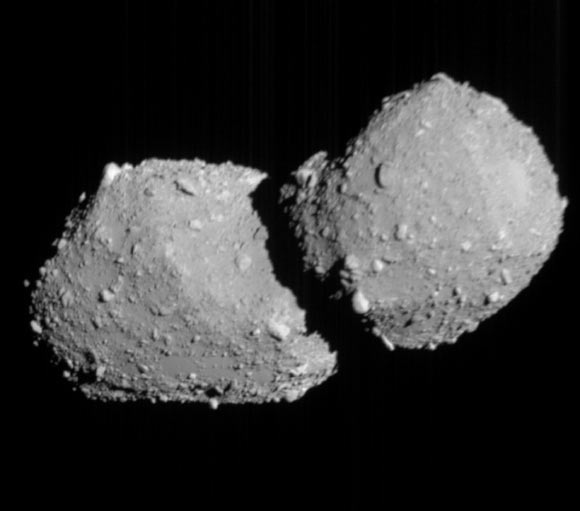
Japan's Hayabusa2 spacecraft has pulled off something no probe had managed before: bouncing a laser off an asteroid during a high-speed flyby and catching the return. The Japan Aerospace Exploration Agency said the experiment, carried out on Sunday, July 5, as the spacecraft swept past the asteroid Torifune, succeeded on both of its two attempts. Torifune is the first target of Hayabusa2's extended mission, which began after the probe dropped its samples of the asteroid Ryugu back to Earth in December 2020.
The laser pulses went out at 6:29 p.m. Japan time, 56.5 and 57.5 seconds before closest approach, from distances of roughly 20 kilometers and 15 kilometers. Hayabusa2 was moving at 5.3 kilometers per second, about 18,000 kilometers per hour, and the beam is narrow enough that it lit patches of Torifune's surface only about 30 meters and 23 meters across. Hitting a target that small from that far away, at that speed, required the spacecraft's attitude and trajectory to be controlled precisely and the detector to be tuned so that stray light from space did not register as a false echo. The mission team spent months preparing the sequence.
The instrument that did the work is the LIDAR laser altimeter, known as LALT, which JAXA adapted from the altimeter flown on its Kaguya lunar orbiter. At Ryugu, LALT was a workhorse: it helped the spacecraft navigate down to the surface for its two touchdowns and produced detailed topography of the asteroid. It was also designed to probe density and porosity, surface reflectance and whether dust particles were levitating above the ground. What it had never done was range a target during a flyby, when there is a single fleeting window and no second chance if the pointing is off.
The reason to bother is scale. In deep space there are no reference objects, so a camera image of an asteroid gives shape but not size. A laser range measurement pins the distance, which turns pixels into meters and lets scientists state how big the object actually is. Taken at several moments and combined with tracking of the spacecraft itself, ranging also fixes the asteroid's position far more tightly than optical observations alone, which tightens predictions of its orbit. That is the core business of planetary defense, where the question of whether a rock will pass Earth or hit it comes down to how well its path is known years in advance.
JAXA says the experiment also proves that useful physical measurements can be gathered from objects passed at high relative speed, a capability that matters for any future mission that cannot afford to slow down and orbit. The team is now working out exactly where on Torifune's surface the two pulses landed. Hayabusa2 is continuing toward its final extended-mission target, the fast-rotating asteroid 1998 KY26, which it is scheduled to reach in 2031.