Marist Poll: Trump Approval at 38% as Democrats Lead House Ballot by 8 to 10 Points
The NPR/PBS News/Marist survey finds 53% strongly disapprove of the president, but it also shows Democratic weak spots among young, nonwhite and college-educated women voters.
WASHINGTON — With the midterm elections a week away, Democrats hold clear advantages in a new NPR/PBS News/Marist poll, but the survey also flags reasons a Democratic wave could be limited. The poll of 1,289 registered voters was conducted Oct. 19-20 and has a margin of error of 3.7 percentage points for registered voters and 3.8 points for likely voters.
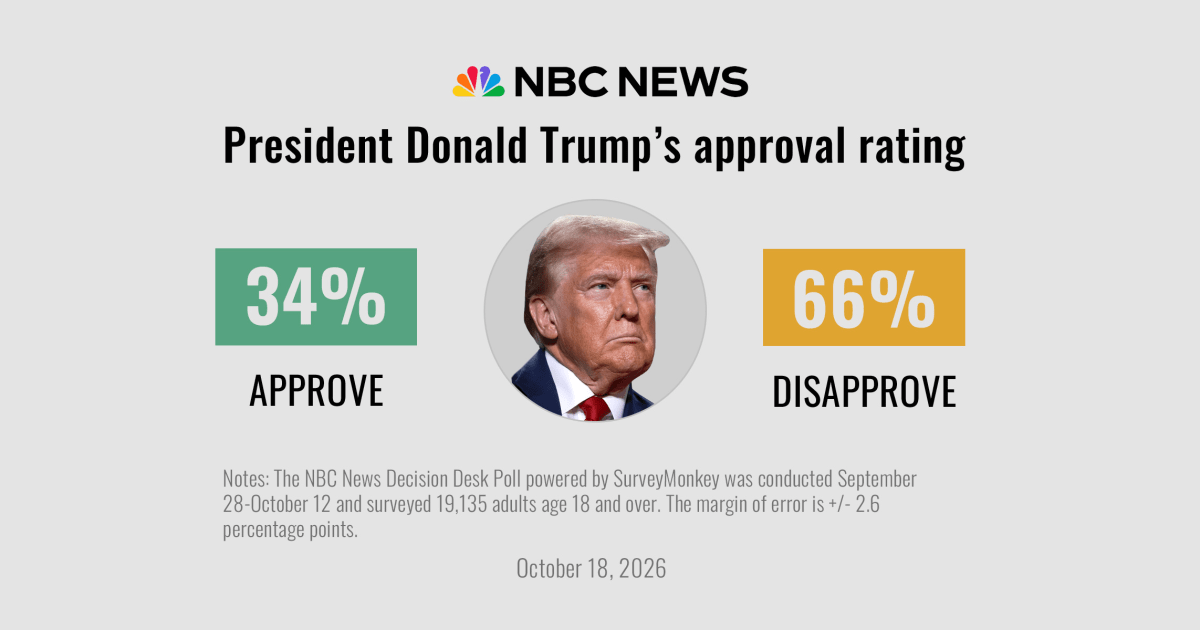
Only 38% of registered voters approve of President Donald Trump's job performance, while 61% disapprove, a net rating of minus 23. Among likely voters, a group Marist screened for the first time this cycle, it is 40% to 59%, still minus 19. Fifty-three percent of both registered and likely voters strongly disapprove of Trump, tied with last month as the highest share ever recorded in the poll. His favorability among likely voters is 37% favorable and 59% unfavorable.
On the generic congressional ballot, Democrats lead by 10 points among registered voters and 8 points among likely voters. When Democrats have held leads like that, they have historically done very well. The average was plus 7 in 2018 and plus 12 in 2006, and in both years they won the House with at least 30 seats flipped. But those races came before the 2020 Census and the regular redistricting that followed, and before the rare mid-decade redistricting of the last year and a half, after Trump asked Republican states to redraw their maps. Both rounds have tilted seats toward Republicans.
That helps explain Democratic nerves. Among Democratic likely voters, 98% say they will vote Democratic, but only 81% think a Democrat will win, a 17-point gap. Republicans were only 10 points less likely to believe their candidate would win. Cost of living dominates. A third of respondents say they experienced financial hardship in the past year and 4 in 10 say their finances have gotten worse. "The economy is at the top of my list right now," said Shun Maurice, a 47-year-old independent from Arizona who leans Democratic. "They're too expensive for everybody, no matter who you voted for."
Fifty-five percent of likely voters say it is more important to vote for candidates with new ideas who will bring change. Likely voters were twice as likely to say their vote would be against Trump (44%) than for him (21%). In the 2024 presidential election, 55% of Trump voters said their vote was for their candidate, according to exit polls. Trump is not on the ballot, but he has asked voters to "pretend" he is.
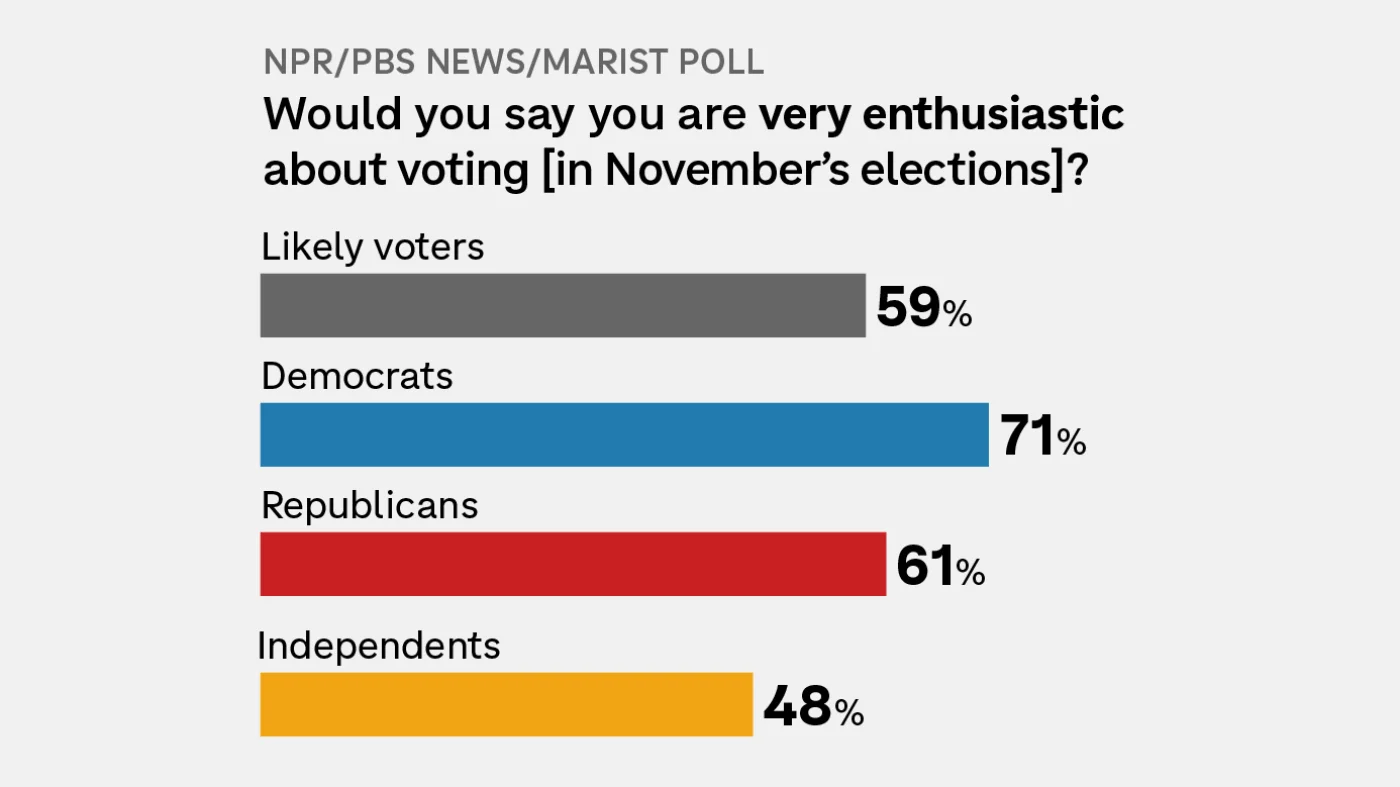
Enthusiasm favors Democrats overall: 71% of their likely voters say they are very enthusiastic, compared with 61% of Republicans. But several key Democratic groups lag. Just 42% of likely voters under 45, 53% of nonwhite voters and 56% of white women with college degrees say they are very enthusiastic, even though all three disapprove of Trump. Among MAGA voters the figure is 68%, among white women without degrees 66% and among white evangelicals 61%. Republicans have also closed the attention gap. Last month 34% of Republicans said they were following the election very closely, compared with 42% of Democrats. Now it is 45% to 46%.
Not every Trump critic is moving to Democrats. Matthew Schroder, a 38-year-old independent in Charlotte, N.C., who voted for Joe Biden in 2020 and Trump in 2024, said he is unhappy with Trump but is backing Republican Michael Whatley over Democrat Roy Cooper for Senate. He cited what he sees as the Democratic Party's embrace of democratic socialism. "It's not as much a vote of 'yes for Trump,'" he said, "as a vote of, Democrats need to completely reject that."
On election integrity, three-quarters of likely voters are confident their state and local governments will run a fair and accurate election. That includes 88% of Democrats, 75% of independents and 68% of Republicans.