Betelgeuse's Hidden Companion Is Plowing Through Its Atmosphere, Radio Images Show
VLA and ALMA data from 2021 to 2026 show the red supergiant's atmosphere has recovered from the Great Dimming, and that the star becomes more oval as companion Siwarha orbits.

Betelgeuse, the red supergiant marking the shoulder of Orion, has a houseguest that is shaking the place up. New radio observations indicate that its recently discovered companion star, Siwarha, is disturbing the giant's outer atmosphere as it orbits directly through it.
The study, led by Lynn Matthews, principal research scientist and assistant director at MIT Haystack Observatory, used the National Science Foundation's Karl G. Jansky Very Large Array and the Atacama Large Millimeter/submillimeter Array. Colleagues from the Center for Astrophysics | Harvard & Smithsonian, the University of Manchester and the European Southern Observatory took part. The data span seven radio frequencies, from 22 GHz to 485 GHz, collected between 2021 and 2026, and appear in The Astronomical Journal.
Radio waves of different frequencies probe different depths, so the combined data let the team build a layer-by-layer picture of the atmosphere, from just above the visible surface out to several times the star's radius. "It was the combination of the incredible data from the NSF VLA and ALMA that gave us a convincing result here," Matthews said. "The fact that we can use these facilities to actually resolve the disks of nearby stars is amazing."
The first result is a recovery. Betelgeuse dimmed to its faintest in more than a century of record-keeping in late 2019 and early 2020, in the episode known as the Great Dimming, when it ejected about a billion tons of material that partly blocked our view. In 2019, months before that event, an earlier study led by Matthews found the atmosphere was unusually cool at radio wavelengths, a sign that a convection-driven shock wave had disturbed the outer gas. The new observations show the brightness temperature has climbed back to more typical levels. The gas now measures around 3,500 kelvin, comparable to the star's own surface temperature, at roughly 2.7 times the star's radius. The team also confirmed a long-suspected temperature minimum, a layer about 2,200 kelvin, more than 1,000 degrees cooler than the visible surface. That layer coincides with the "MOLsphere," a shell of molecular gas long inferred from infrared observations but rarely probed directly at radio wavelengths.
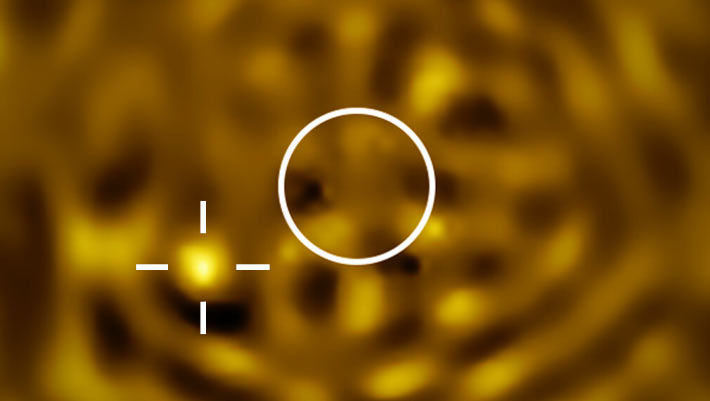
The most striking finding involves Siwarha. Its existence was proposed in 2024 to explain Betelgeuse's mysterious 2,100-day brightness cycle, and it has since been supported by direct imaging and spectroscopy. The name means "her bracelet," a nod to Betelgeuse, which means "the hand of al-Jawza" in Arabic. Siwarha is thought to orbit at only about twice the giant's radius. "This companion is orbiting so close to the star that it actually passes through its extended atmosphere," Matthews said. Like a jet boat on a lake, it likely leaves a wake.
The team cannot see Siwarha itself at radio wavelengths; they calculated it would be tens to hundreds of times too faint. Instead they measured the egg-like shape, or ellipticity, of Betelgeuse's radio-emitting atmosphere over several observing epochs. The star looked noticeably more elongated near the times when the companion should be at its greatest apparent separation, and rounder when the companion should be passing in front of or behind it. It is like watching ripples on a pond and inferring something is moving just beneath the surface.
The authors caution that observations covering more of the companion's orbit, especially at frequencies not yet well sampled, are needed to confirm and refine the result. They expect the Next Generation Very Large Array, now in development, to make this kind of work far more routine and to show how red supergiants shed material in the late stages of their lives, and how a nearby companion shapes that process.