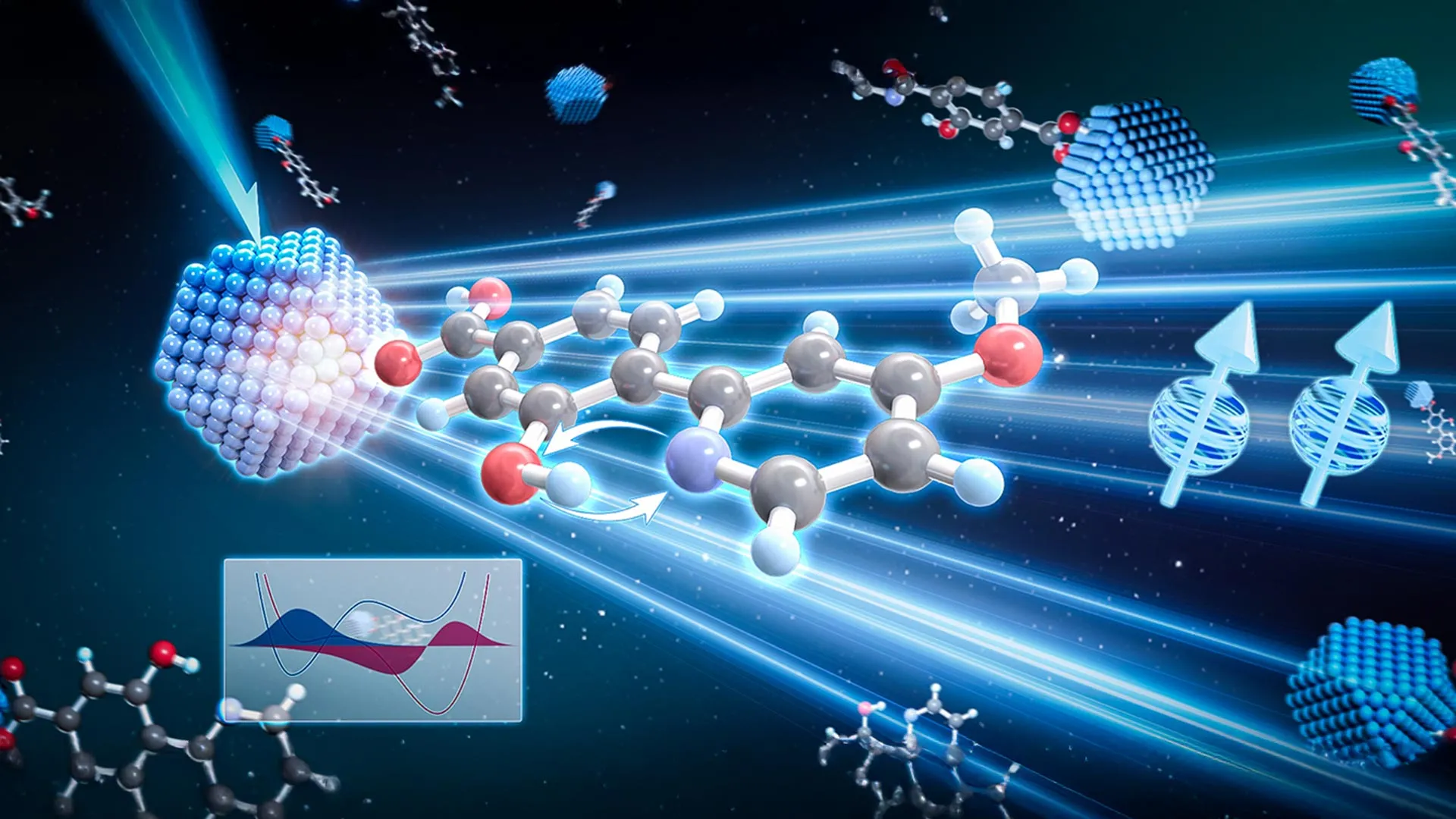
'Electron Waiting Room' Lets Blue Titanium Dioxide Hold Sunlight's Energy 2.5 Times Longer
KAIST-led researchers used an X-ray laser to watch oxygen vacancies trap electrons, a clue for better sunlight-driven hydrogen production.

Making hydrogen from sunlight depends on holding on to the energy a material absorbs long enough to use it. A team led by the Korea Advanced Institute of Science and Technology has now shown how tiny gaps inside a common light-driven catalyst buy that time, acting like an "electron waiting room."
The study, published in the Journal of the American Chemical Society, was led by Professor Tae Kyu Kim of KAIST's Department of Chemistry. It involved teams from Kyung Hee University, The Catholic University of Korea and the Pohang Accelerator Laboratory. The material at the center is blue titanium dioxide, a version of the widely studied photocatalyst that gets its bluish color from missing oxygen atoms.
Titanium dioxide promotes chemical reactions when light hits it. It has been studied for clean energy and environmental uses, including producing hydrogen from sunlight, converting carbon dioxide into useful substances and breaking down pollutants. When light strikes the material, electrons gain energy and move, leaving behind positively charged gaps called holes. Both can drive chemical reactions, but if an electron drops back into a hole too quickly, the energy is lost. That process is called recombination.
The team focused on oxygen vacancies, the empty sites left where oxygen atoms are missing. A hole is a site vacated by an electron, while a vacancy is a site vacated by an oxygen atom, so the two are different things. The researchers wanted to know exactly how the vacancies hold electrons and delay recombination.
They used the X-ray Free Electron Laser at the Pohang Accelerator Laboratory, a fourth-generation light source whose extremely short X-ray pulses work like an ultrafast camera. The researchers tracked changes around titanium atoms on the femtosecond scale, one quadrillionth of a second, and combined those observations with optical measurements of light absorption and with computational calculations.
Right after light absorption, electrons in both ordinary and blue titanium dioxide rapidly shed some energy and were briefly trapped. The difference came next. In the blue version, the oxygen vacancies pulled electrons into a more stable "deep trap state," over roughly 1.5 nanoseconds. The researchers compare it to a ball that is less likely to roll out of a deep hollow than a shallow dip, though no actual hole forms in the material; the electron simply occupies an energy state that is harder to escape.
After that, recombination in blue titanium dioxide ran about 2.5 times more slowly than in conventional titanium dioxide. Electrons keep the energy they got from light for longer, which raises the chance that it can be put to work in a chemical reaction.
The finding gives materials scientists a mechanism to design around rather than a trial-and-error recipe. If oxygen vacancies can be tuned deliberately, catalysts for solar hydrogen production could waste less of the light they absorb.