Oregon State Chemists Make Hydrogen From Water With a Sulfur-Based Light Catalyst
The new material, BVR-19, needs no added expensive metal catalyst and forms in water at room temperature, which could help cut the cost of green hydrogen.
Chemists at Oregon State University have built a light-activated material that produces hydrogen from water quickly and efficiently without needing an extra expensive metal catalyst, a step toward cheaper green hydrogen. The work, led by Kyriakos Stylianou of the OSU College of Science, was published in the Journal of the American Chemical Society.
Hydrogen is widely used in fuel cells for vehicles and in making ammonia, refining metals and manufacturing plastics. A catalyst speeds up a chemical reaction without being permanently changed. A photocatalyst does the same job but is switched on by light: after it absorbs light, it reaches a higher energy state and can use that energy to drive reactions faster.
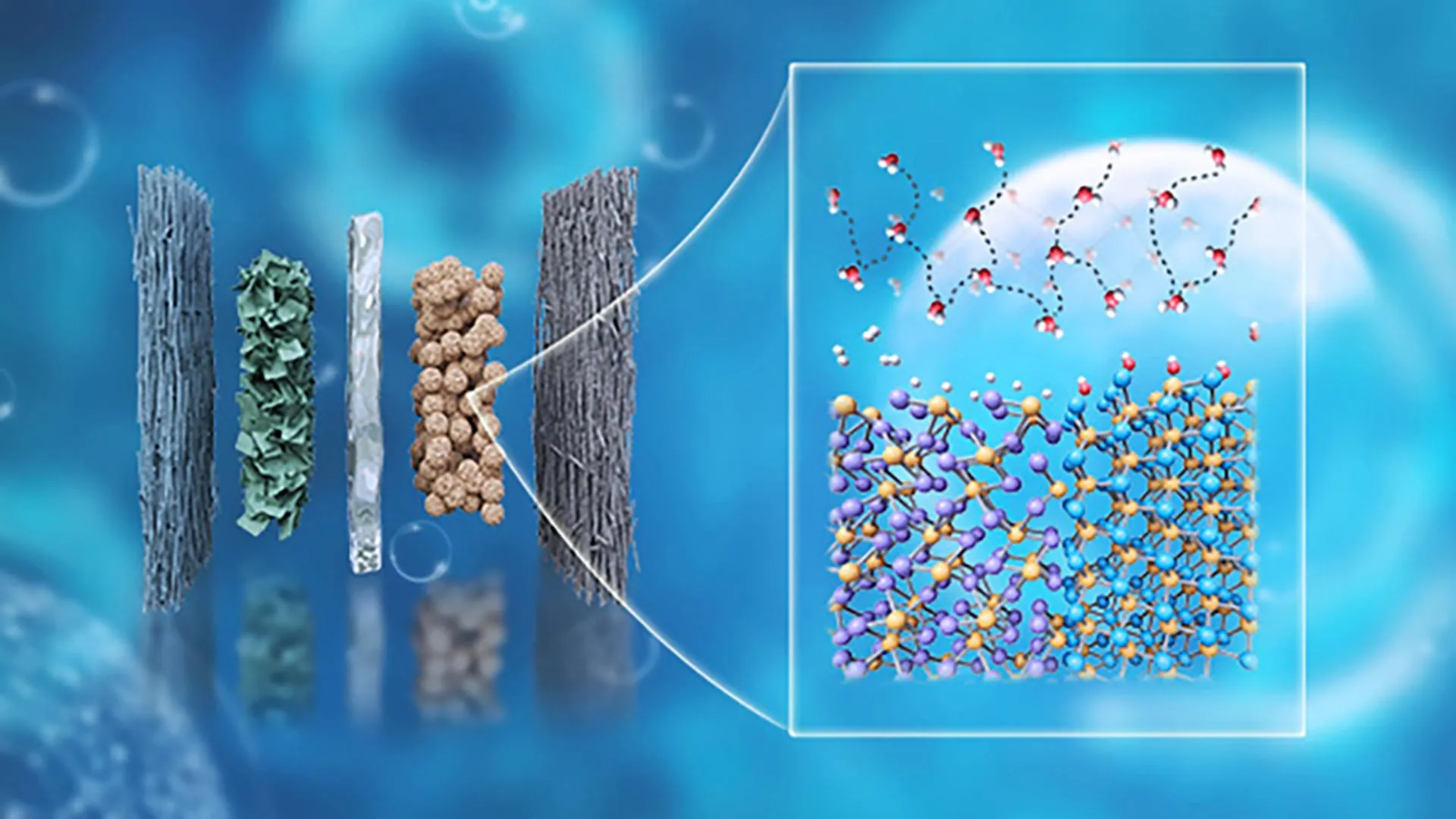
Stylianou's group works on metal-organic frameworks, or MOFs, which are crystalline, porous materials built from metal ions linked by organic molecules. Their tiny pores and adjustable structures let scientists tune their properties. Millions of MOF structures are theoretically possible, Stylianou said. Chemists have already synthesized nearly 100,000 of them, and the properties of roughly another half-million have been predicted.
For this study the team focused on a MOF called BVR-19. It contains an unusual sulfide-to-sulfide bond that temporarily breaks under light, producing highly reactive sulfur species. "The organic component does the important work," Stylianou said. "Instead of relying primarily on the metal atoms, our material uses its sulfur-containing organic building blocks to capture light energy and move electrons where they are needed to produce hydrogen. This represents a different way of thinking about how these materials should be designed."
Because the material does not need an added metal catalyst, future light-driven systems could be simpler to design. BVR-19 also forms spontaneously in water at room temperature, which lowers the energy needed to make it.
The economics explain the interest. Most hydrogen today comes from methane-steam reforming, which releases carbon dioxide and costs about $1.50 per kilogram. Green hydrogen costs roughly $5 per kilogram. Splitting water with electricity can be clean, but its climate benefit depends on the power source, and it stays competitive only with cheap renewable electricity. A photocatalyst that runs on sunlight directly offers another route.
The team also learned why some versions of the MOF outperform others. By swapping the metal while keeping the rest of the structure essentially the same, they identified design rules for what makes the best versions work. "Our work provides a blueprint for designing better materials that can bring down the cost of green hydrogen," said Stylianou, who directs OSU's Materials Discovery Laboratory.
As with most laboratory chemistry, the distance from a flask to a power plant is long. The report does not give a production rate or how long BVR-19 lasts in sustained use, and scale-up, stability and cost will have to be proven. Still, the result adds a new family of sulfur-driven photocatalysts to the toolbox, and the design rules may speed up the search through the half-million predicted MOFs that no one has built yet.