Why Dense Rock Under Mountains Sometimes Sinks Hundreds of Miles Into the Earth
Istanbul Technical University simulations find that the size and density of buried rock decide whether it stays put, drips off in a small blob, or drags a huge slab of Earth's shell down with it.

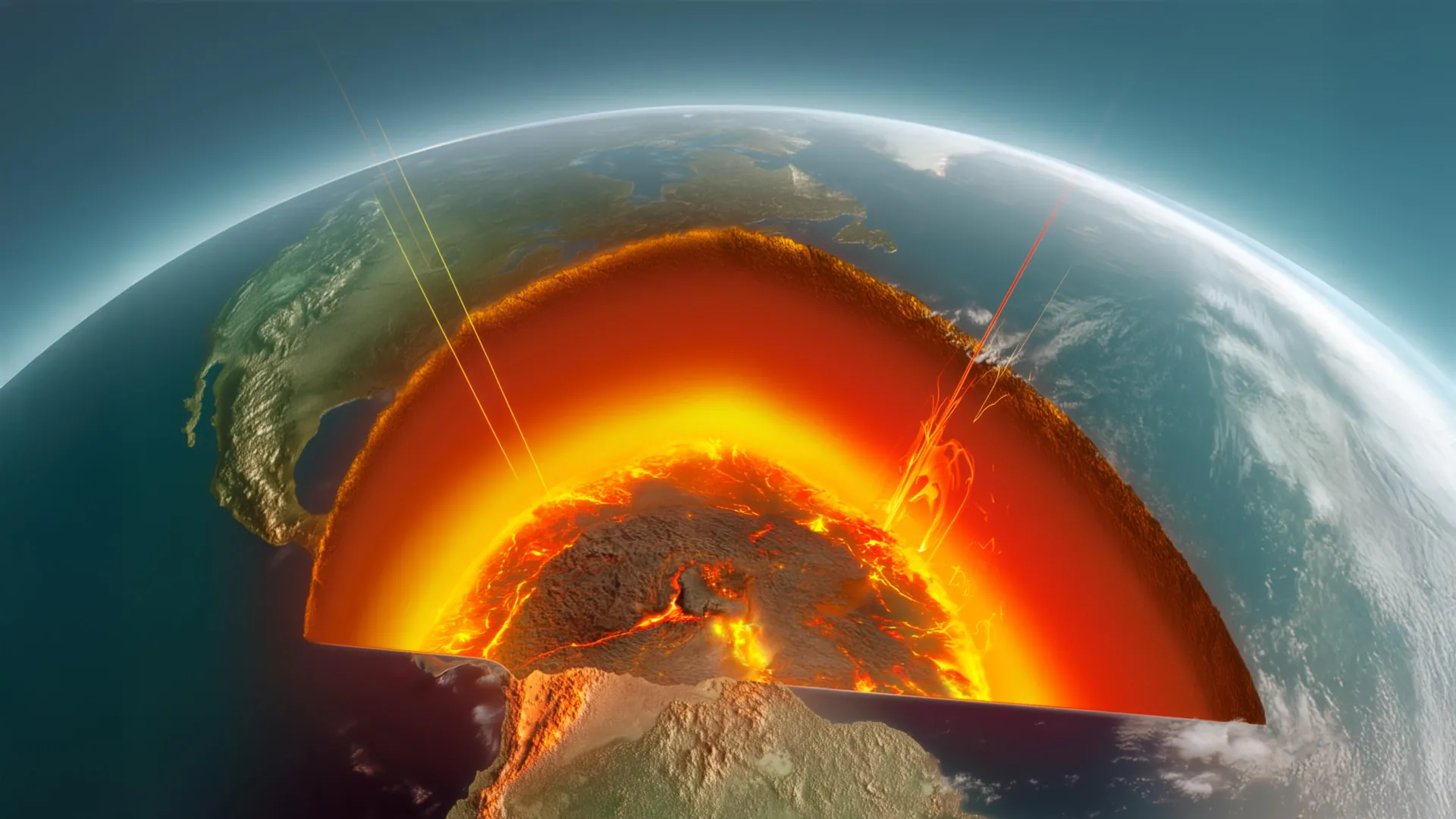
Mountain building is usually pictured as rock pushed upward. Deep beneath some mountain belts and volcanic arcs, the opposite happens: dense rock at the base of the crust becomes unstable, breaks away and sinks hundreds of kilometers into the mantle, pulling part of Earth's rigid outer shell, the lithosphere, down with it. Seismic images suggest this process, called lithospheric dripping, has occurred beneath the central Andes and California's Sierra Nevada.
What decides whether the rock stays put, sinks as a small drip, or drags a far larger piece of lithosphere along? A study led by researchers at Istanbul Technical University, published in the journal Terra Nova, tackles the question with computer simulations and finds three distinct outcomes.
"Dense rock beneath continents does not sink the same way everywhere," said lead author Dr. Açelya Ballı. "Our models show that its size and density, together with the density of the layers around it, help determine whether it stays in place, produces a small drip or becomes part of much larger lithospheric removal."
When continents collide, the crust can thicken to 60 to 80 kilometers (37 to 50 miles), and its bottom 20 to 30 kilometers can turn into eclogite, a rock denser than the mantle beneath it. Similar dense rock is left behind under volcanic arcs when magma is extracted. Rock samples suggest, however, that the deep part of old continental plates is chemically depleted and slightly buoyant, so it may not sink by itself. The team made that layer lighter than the hotter mantle below and asked whether an eclogite root could still pull it down.
The researchers ran 18 simulations using two eclogite shapes: a thick, compact body 25 kilometers thick and 100 kilometers wide, and a thin, broad one 10 kilometers thick and 250 kilometers wide. The sizes were modeled on fast seismic anomalies beneath the Andes, the Sierra Nevada and Tibet. In some runs the eclogite punched through and sank, taking about its own volume of lithosphere with it. In others, a section about four times larger sank with the eclogite inside it. In the rest, nothing moved.
Shape mattered first. Only the thick, compact body produced drips, while the thin, broad body stayed in place under every condition tested. Density mattered next. When the eclogite was at most 70 kilograms per cubic meter, about 2%, denser than the lithosphere beneath it, nothing sank. The thick body dripped only at 130 kilograms per cubic meter, about 4%, and above. Large drips formed only when the lithosphere was just slightly lighter than the mantle below it.
The eclogite did not sink in one piece. It split and sank in stages, triggering repeated drips. That could help explain why volcanic records in some arcs show activity in pulses roughly 10 to 30 million years apart. In the Altiplano-Puna plateau of the central Andes, two magmatic stages over the past 20 million years have been linked to lithospheric removal. The authors caution that the models are two-dimensional and do not simulate melting, so the link to volcanism remains a hypothesis. They also stress the results are model outcomes rather than universal thresholds, but they set physical limits that can be tested against field observations.
Dr. Oğuz Hakan Göğüş of ITU's Eurasia Institute of Earth Sciences said that by identifying what decides whether dense rock stays or sinks, researchers can "better read the hidden processes shaping continents from below."