A River of Molten Iron Beneath the Pacific Reversed Direction in 2010. Nobody Can Explain Why
Satellite and ground magnetic data going back 28 years caught a huge patch of Earth's outer core swinging from a weak westward drift to a strong eastward one — and then fading again after 2020.
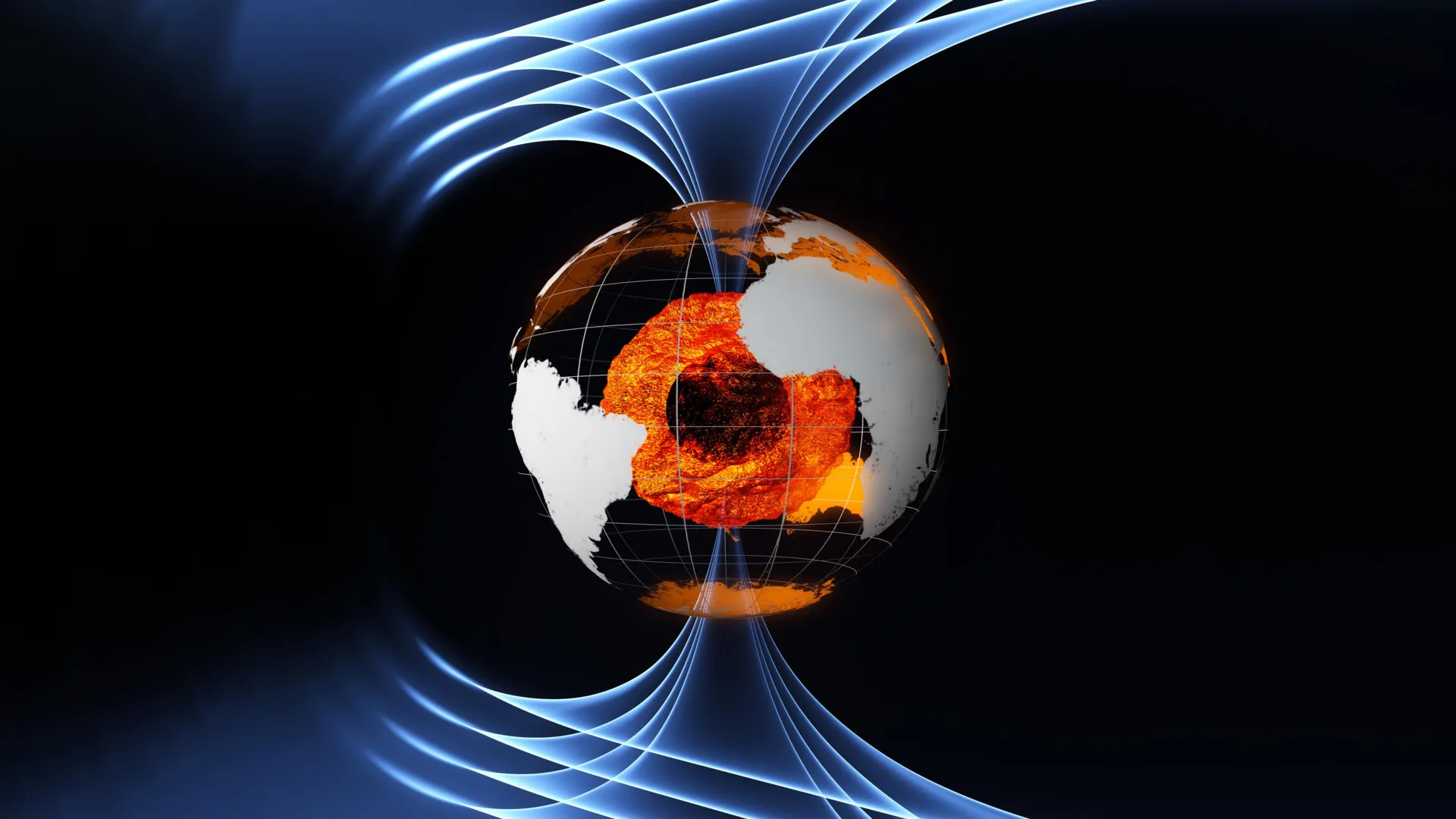
Somewhere between 2,200 and 3,000 kilometers beneath the Pacific Ocean, a region of liquid iron the size of a continent stopped moving one way and started moving the other. It happened in 2010. Sixteen years later, geophysicists have documented it in detail and cannot say what caused it.
The finding comes from a study led by Frederik Dahl Madsen of the University of Edinburgh's School of Geosciences, published in the Journal of Studies of Earth's Deep Interior. Madsen's team stitched together ground-based magnetic observatory records and satellite measurements spanning 1997 to 2025 — 28 years of continuous data — and used them to reconstruct how the flow at the top of Earth's liquid outer core has changed.
Nobody can see the core directly. What geophysicists can measure is the magnetic field it generates, and that field is not fixed: it drifts, warps and pulses on timescales of years to decades. Because the outer core is molten metal, its motion drags the magnetic field with it, so mapping how magnetic patches move across the globe is effectively a way of watching the metal underneath flow. The technique is closer to reading a wake than watching a ship.
What the reconstruction shows under the Pacific is a reversal, not a wobble. Before 2010, the flow in that region was a weak westward drift. After 2010, it became a strong eastward one. Then, since about 2020, the eastward flow has been weakening again — which leaves open the possibility that this is one leg of a natural oscillation rather than a permanent change of state.
"The large-scale flow reversal beneath the Pacific raises new questions about the behavior of Earth's deep interior," Madsen said.
The instruments that made the observation possible are largely European. The European Space Agency's Swarm constellation — three satellites launched to map the geomagnetic field with far more precision than ground stations alone allow — supplied the continuous global coverage the analysis required. "Swarm provides continuous global coverage over many years, allowing scientists to track how core dynamics evolve over time," said ESA's Anja Stromme.
The stakes are not academic. The geodynamo in the outer core is what generates the magnetic field that deflects the solar wind and keeps the atmosphere from being stripped away. Its behavior also drives practical problems: the north magnetic pole has been racing across the Arctic for decades, forcing repeated emergency updates to the World Magnetic Model used by aviation, shipping and every smartphone compass on the planet. Sudden changes in core flow are the upstream cause of those corrections.
What the study does not offer is a mechanism. Reversals of this scale are not predicted by the standard picture of gradual convective circulation in the outer core, and 28 years of data — long by the standards of satellite geomagnetism, an eyeblink by the standards of the geodynamo — is not enough to establish whether 2010 was a rare event or a routine one that nobody happened to be watching for before.