Indigenous Peruvians Carry More Copies of a Starch-Digesting Gene Than Any Population on Earth
The Potato Put Them There.
A UCLA and University at Buffalo team traced selection on the AMY1 gene back roughly 10,000 years, to the moment Andean highlanders started growing potatoes — and measured the advantage at 1.24 percent per generation.
Most human genes come in exactly two copies, one from each parent. AMY1 does not. It encodes salivary amylase, the enzyme that starts breaking starch into sugar the moment food hits your mouth, and it sits in a stretch of chromosome 1 that duplicates and deletes itself readily, so the number of copies a person carries varies -- typically somewhere between two and fifteen, with roughly seven the global average. More copies means more enzyme, and more enzyme means starch gets converted to usable calories faster.
Indigenous Andean Peruvians carry about ten. That is the highest average of any population yet measured, and a new study in Nature Communications argues it is not an accident of history but the signature of sustained natural selection driven by a single crop.
The work was co-led by Abigail Bigham at UCLA and Omer Gokcumen at the University at Buffalo, with collaborators at the University of Kansas, Penn State, the University of Pennsylvania, the University of Puerto Rico at Cayey, Syracuse University, Cayetano Heredia University in Lima, and Bilkent University in Turkey. The team used ultra-long DNA sequencing to count copies accurately -- a technical prerequisite, because repeated near-identical sequences are exactly what short-read sequencing gets wrong -- and compared Quechua-speaking Andean Peruvians against roughly 3,700 individuals drawn from more than 80 other populations worldwide.
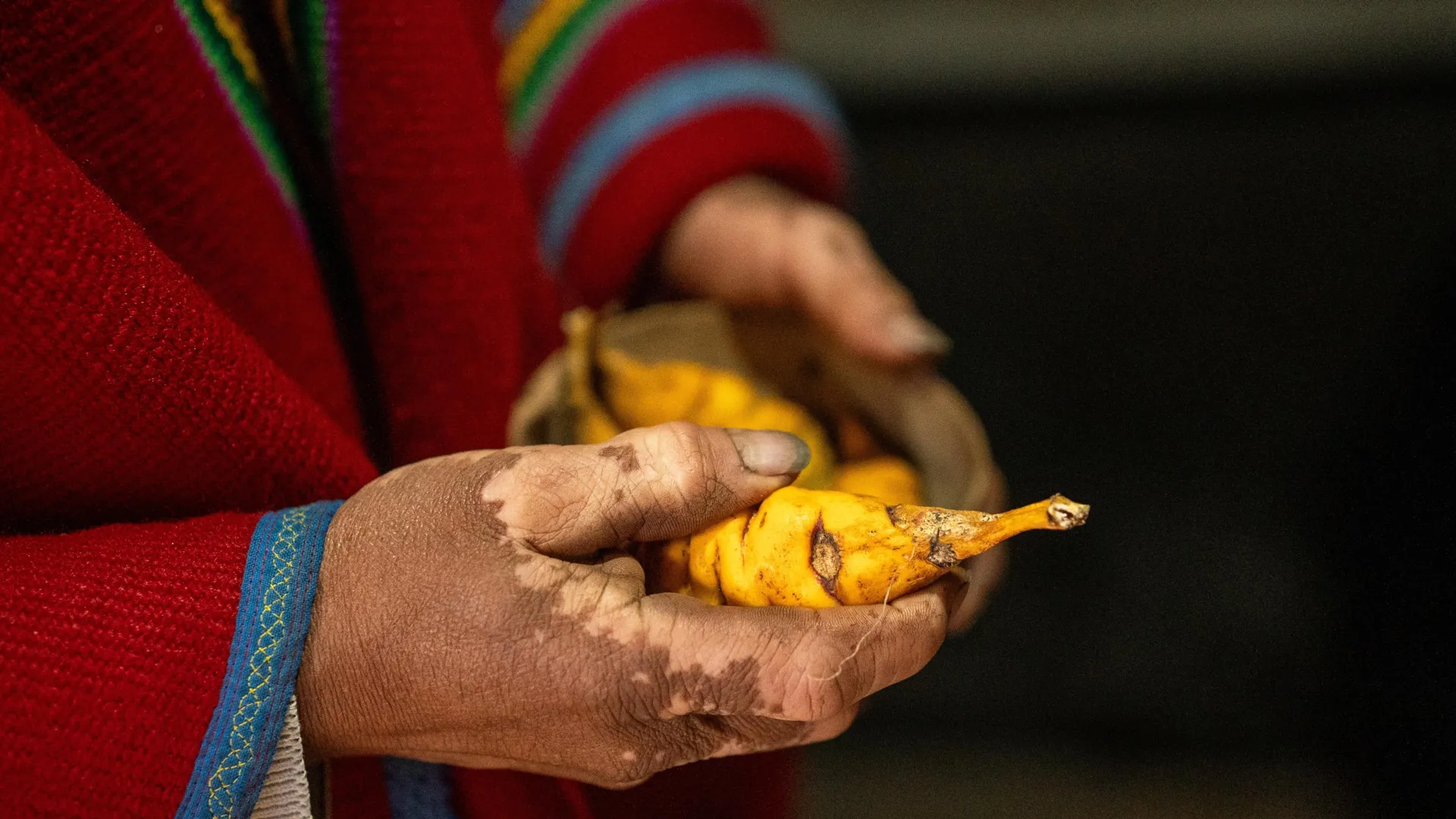
The contrast that carries the argument is with the Maya, who averaged about six copies. Maya populations farmed intensively for millennia, but their staple was maize, not tubers. Andean populations domesticated the potato in the highlands somewhere between 6,000 and 10,000 years ago and built a caloric base on it, along with other tubers such as oca and mashua. The selection signal in the genomes begins in the same window.
Quantifying it, the team estimates that from around 10,000 years ago onward, carrying ten or more copies of AMY1 conferred a survival or reproductive advantage of about 1.24 percent per generation. That number sounds trivially small and is not. Compounded across several hundred generations, an edge of that size is enough to sweep a variant from uncommon to typical, and it ranks among the stronger selection coefficients documented in recent human evolution.
The obvious alternative explanation had to be eliminated first. European contact after 1492 killed a catastrophic share of the Indigenous population of the Americas, and severe bottlenecks can leave genetic patterns that mimic selection by pure chance. The researchers checked the timing and found elevated AMY1 copy numbers already present several thousand years before Europeans arrived, which rules out the bottleneck as the source. What remains is a straightforward and slightly startling proposition: a vegetable reshaped the genome of the people who learned to grow it, and it is still legible in their saliva.