A German Turbine Ran 303 Seconds on Hydrogen Detonations and Made Electricity With No Compressor at All
Conventional gas turbines burn about half their own output driving an air compressor. Karlsruhe engineers deleted the compressor and used detonation waves to raise the pressure instead — beating NASA's runtime record by 53 seconds.
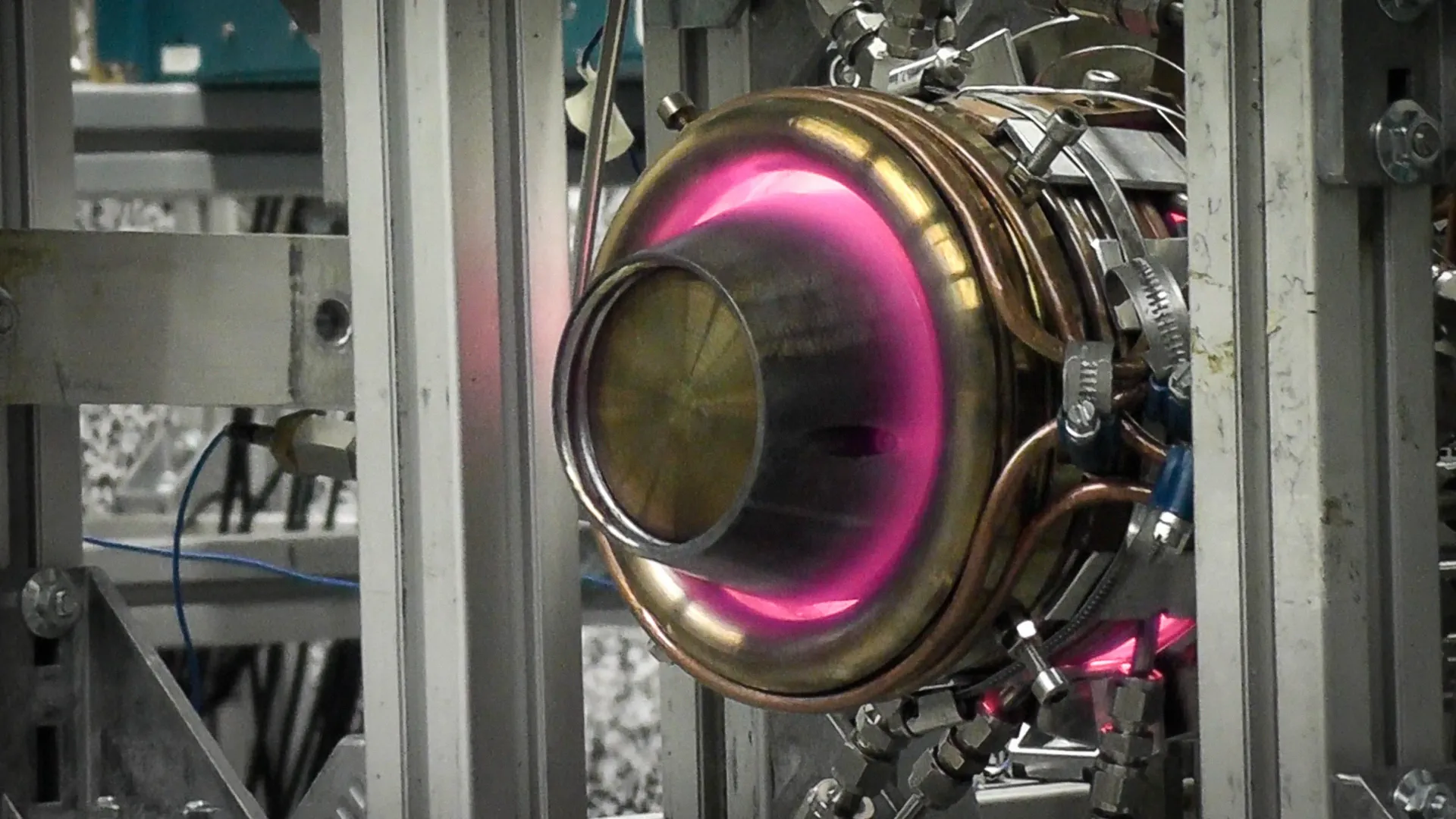
Engineers at the Karlsruhe Institute of Technology have run a hydrogen turbine for 303 seconds without an air compressor and generated electricity from it — the first time a compressorless turbine has actually put power on a wire, and a runtime that beats NASA's previous record of 250 seconds.
The number that makes this interesting is not 303. It is roughly 50 percent, which is the share of a conventional gas turbine's own power output that gets consumed driving its mechanical compressor. Every gas turbine on earth — in a power plant, under an aircraft wing — spends about half of what it produces squeezing air before combustion. Delete that stage and you recover the energy.
The Karlsruhe design does it with pressure-gain combustion. Instead of compressing the air mechanically and then burning fuel in it, the machine burns fuel in a detonation wave — a combustion front that travels supersonically and raises the pressure by itself. The waves are generated by fluid-mechanical instabilities, patterns of waves and vortices set up in the flowing gas, so the pressure rise that a compressor would normally provide comes out of the combustion process instead. The work was led by Professor Daniel Banuti, director of KIT's Institute of Thermal Energy Technology and Safety.
Hydrogen turns out to be an unusually good fuel for this. It reacts very quickly and produces a stable, repeatable pressure rise, which matters when the entire operating principle depends on detonations happening in a controlled, sustained pattern rather than as a series of destructive bangs. Natural gas is far more reluctant. Hydrogen also has the advantage that it can be produced with renewable electricity, which is the reason a laboratory in Germany is building hydrogen turbines in the first place.
Removing the compressor does more than improve efficiency. It removes the single most complex rotating assembly in the machine — fewer moving parts, less weight, fewer things to fail. For a stationary power plant that mostly means cheaper maintenance. For anything that has to fly, weight is the whole argument, and KIT has named aviation propulsion as a longer-term target.
Detonation engines have been a research curiosity for decades, chased by NASA, the U.S. Navy and academic groups, and repeatedly stalled at the same place: getting the thing to run steadily for more than a few minutes without shaking itself apart or losing its detonation cycle. Five minutes of continuous operation with real electrical output is not a commercial product. It is, however, the point at which the concept stops being a demonstration of physics and starts being an engineering problem with a schedule attached.
Originally reported by ScienceDaily.