A Single Proton Hops Back and Forth to Supercharge Energy Transfer in Quantum Dots
Chinese researchers found that a proton shuttling between two halves of a molecule opens a quantum tunneling route for energy — at room temperature.
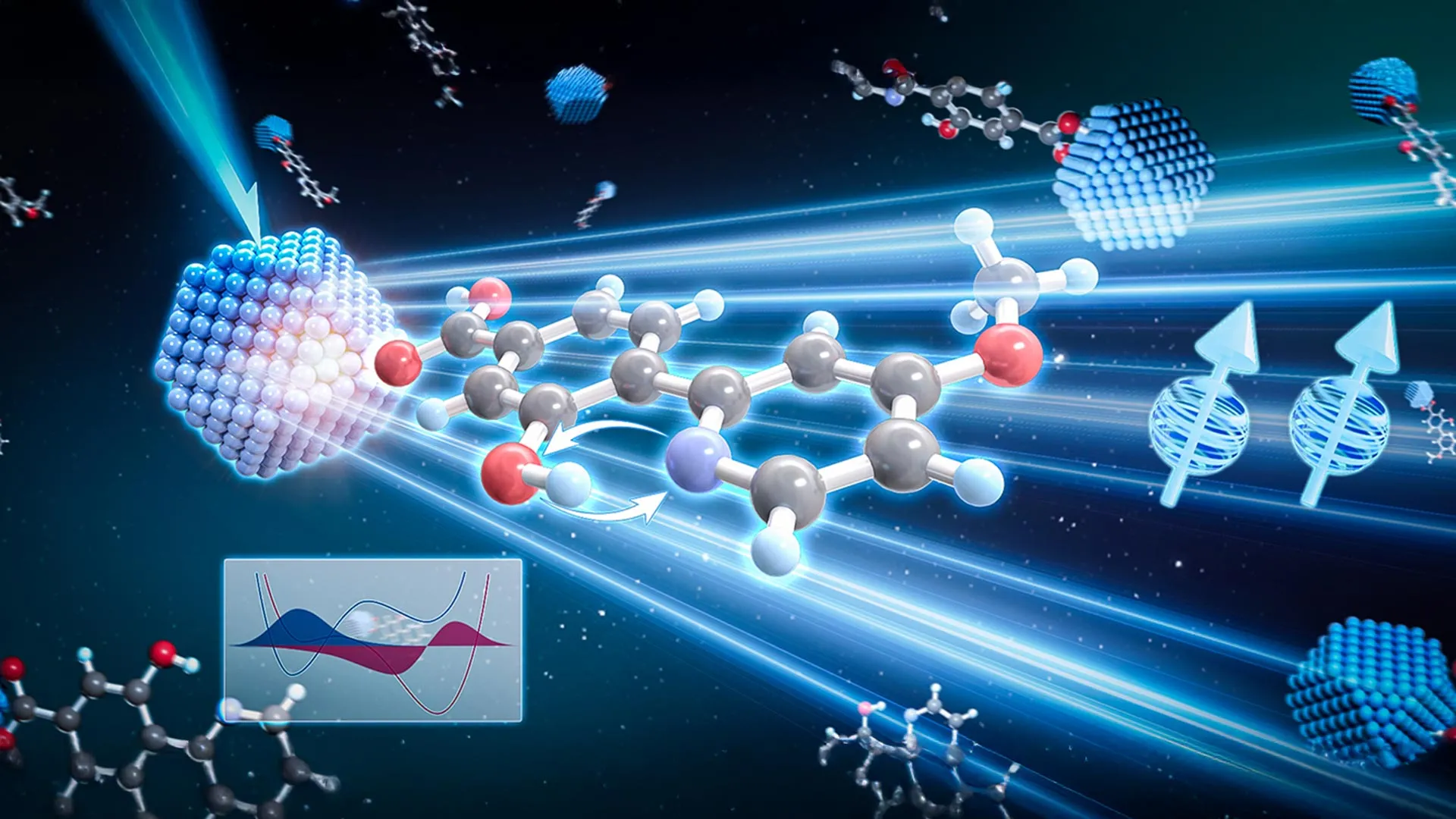
A single proton, hopping back and forth across a molecule, can dramatically accelerate the way energy moves out of a quantum dot — and it does so through quantum tunneling at ordinary room temperature, according to research published in Nature Materials.
The work comes from the Dalian Institute of Chemical Physics at the Chinese Academy of Sciences, led by Prof. Kaifeng Wu. The findings appear in the July 2026 issue of Nature Materials, volume 25, number 7, page 1190, authored by Wang, Zhu and Wu.
The system is deceptively simple. The researchers paired colloidal quantum dots made of zinc selenide with molecular acceptors built from a phenol group joined to a pyridine group. Quantum dots are nanoscale semiconductor crystals whose optical and electronic behavior can be tuned by changing their size, and one of the most useful things they can do is hand off energy to nearby molecules. The most valuable form of that handoff produces a triplet state — a long-lived excited state that drives photochemistry.
What the Dalian team observed is that the proton sitting on the phenol does not stay put. It temporarily relocates to the pyridine, and that migration opens a pathway for an electron to move from the zinc selenide dot to the resulting phenoxyl radical. The proton then returns to where it started. The net effect of that round trip is that triplet energy moves from the dot to the molecule far more efficiently than it otherwise would.
To prove the proton was doing the work, the researchers built a control version of the acceptor in which the relevant site was methylated — chemically capped so no proton could shuttle. The shuttle-equipped molecules substantially outperformed the capped ones, isolating the mechanism.
The temperature is the surprising part. "Quantum effects can be used to control charge and energy transfer in complex materials even at room temperature," Wu said, noting that the process runs through quantum tunneling rather than the conventional heat-driven pathway in which particles must climb over an energy barrier. Tunneling — where a particle passes through a barrier it lacks the energy to surmount — is usually associated with cryogenic conditions or exotic setups, not a beaker at room temperature.
Because the mechanism can be switched on or off by chemical design, it gives engineers a knob rather than a fixed property. Triplet states are essential in photoredox catalysis and in breaking down environmental pollutants with light, but they are a loss channel in organic solar cells and some laser materials, where they waste energy that should be producing current or photons. A design rule that can either enhance or suppress triplet formation is useful in both directions.