A Kagome Metal Pushes Heat Sideways Into Voltage With No Magnet at All — Ten Times Better Than the Standard Trick
LuCo6Ge6 conducts as if it were positive along one axis and negative along another, delivering 18.4 microvolts per kelvin of transverse thermopower at room temperature in zero magnetic field.
Thermoelectric devices normally work in a straight line: heat flows in one end of a material, a voltage appears across the same direction, and you harvest it. Transverse thermoelectrics do something more useful and much harder — heat flows one way, voltage appears at right angles to it — which means the hot side and the electrical contacts never have to compete for the same surface. A team publishing in Nature Materials has now found a way to get a large transverse effect at room temperature without applying any magnetic field.
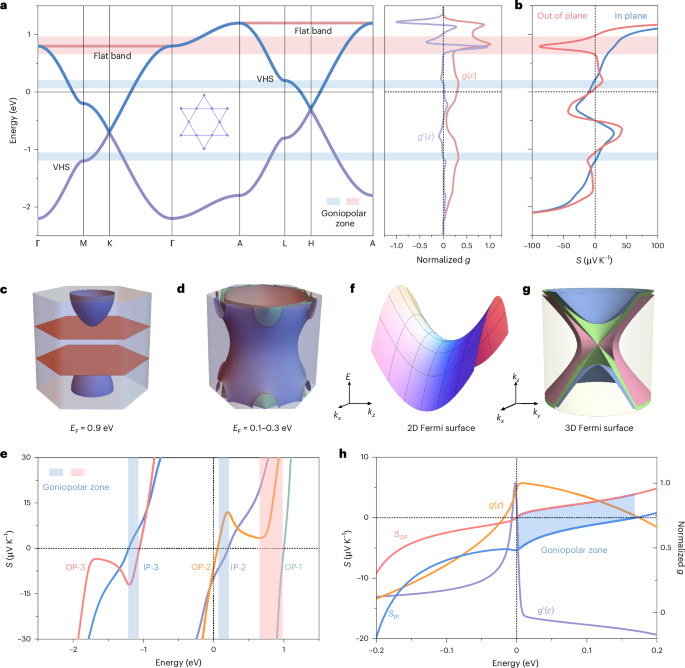
The material is LuCo6Ge6, a compound built on the kagome lattice — a pattern of corner-sharing triangles named after a Japanese basket weave that has become one of the most productive playgrounds in condensed-matter physics. In it, the researchers measured a transverse thermopower of 18.4 microvolts per kelvin and a transverse Peltier conductivity of 105 amperes per meter per kelvin, both at room temperature and at zero applied field.
The comparison that matters is with the anomalous Nernst effect, the approach that has dominated transverse thermoelectric research. Nernst-based devices rely on magnetic materials, and they have been stuck below about 6 microvolts per kelvin — while also emitting stray magnetic fields that interfere with anything sensitive placed nearby. The new result is roughly an order of magnitude larger than what conventional Nernst systems achieve, and because there is no magnetism involved, there is no stray field to manage.
The mechanism the authors propose is goniopolarity: axis-dependent carrier polarity. In an ordinary metal or semiconductor, charge is carried either by electrons or by holes, and the material behaves as n-type or p-type, full stop. A goniopolar material behaves as though it is n-type along one crystal axis and p-type along another. Drive a temperature gradient through it and the two populations push in opposite directions depending on orientation, and the imbalance shows up as a voltage perpendicular to the heat flow — no external field required to bend anything.
What makes LuCo6Ge6 unusually good at this is its electronic structure. Kagome lattices naturally produce flat bands — energy bands where electrons barely disperse, so enormous numbers of states pile up at nearly the same energy — and van Hove singularities, points where the density of available states spikes. Both features boost thermoelectric response, but flat bands usually come with terrible electrical conductivity, which kills the effect you were trying to enhance. In this compound the flat-band physics coexists with high conductivity, and the authors identify that synergy as the reason the numbers land where they do.
The practical target is waste-heat recovery and solid-state cooling in places where a magnet is unacceptable — near sensors, near superconducting electronics, inside instruments where a stray field is a design failure rather than an inconvenience. Eighteen microvolts per kelvin is still small in absolute terms, and a laboratory measurement on a single crystal is a long way from a module. But the paper reframes the search: instead of hunting for stronger magnets, look for materials whose Fermi surface changes sign depending on which direction you ask.