Copper Ions Jiggling in a Crystal Boost Its Solar Current 1.5 Times, Tokyo Team Finds
Institute of Science Tokyo researchers saw a bulk photovoltaic effect survive, and strengthen, in a crystal whose average structure should forbid it. The atoms' motion is doing the work.

Conventional solar cells need a junction between two different materials to turn light into current. A rarer route, the bulk photovoltaic effect, lets a single uniform crystal do it, but the textbook rule says the crystal must lack a center of symmetry. A team at the Institute of Science Tokyo has found a material that breaks the rule in a useful way: its photocurrent gets stronger once the structure looks symmetric on average.
The researchers, led by Ryoga Murata and Associate Professor Takao Sasagawa, studied copper chromium thiophosphate, CuCrP2S6. At low temperatures the crystal has a noncentrosymmetric structure, meaning it has no center of symmetry, which is the condition normally required for the bulk photovoltaic effect. As it warms to room temperature it passes into a centrosymmetric structure. On paper, the effect should switch off.
It did not. The photocurrent survived the transition and rose to about 1.5 times the size it had in the low-temperature phase. The results were published in Advanced Functional Materials (DOI 10.1002/adfm.77517) and released October 5.
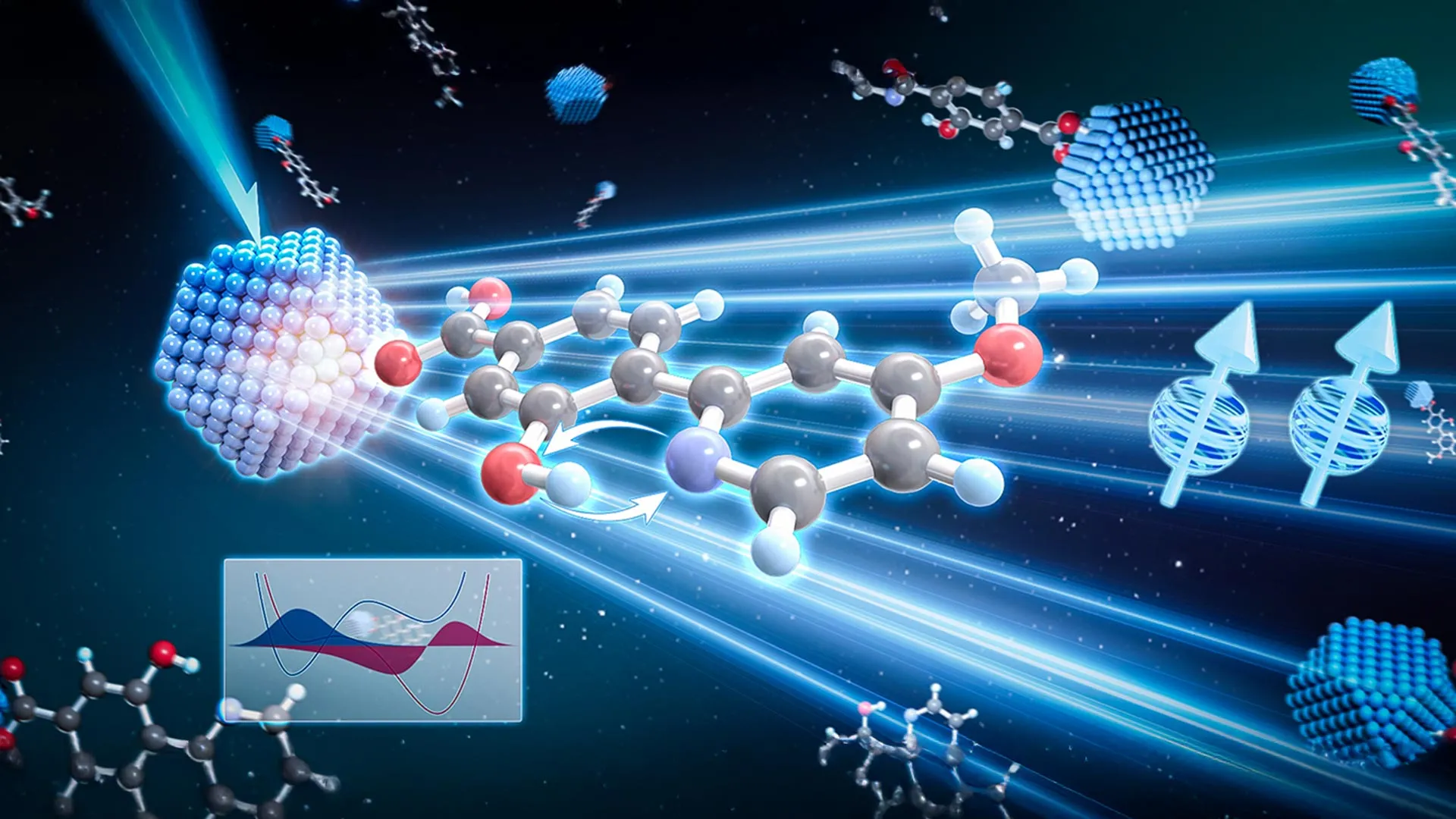
The explanation is in the copper ions. In the warm phase they do not sit still. They hop among several positions inside the crystal lattice, so the time-averaged picture looks symmetric. Electrons, however, respond to light in femtoseconds, millions of times faster than the picoseconds it takes the ions to move. From the electrons' point of view, the copper ions are frozen in whatever lopsided arrangement they happen to occupy at that instant. Each moment is asymmetric even though the average is not, and the electrons produce current from each one.
"Dynamic fluctuations can be deliberately utilized to strengthen photoelectric conversion," Sasagawa said, arguing that researchers should stop treating atomic motion only as a nuisance to be suppressed.
That is a change in how researchers think about the problem. Designers of photovoltaic materials usually search for crystals with a permanently broken symmetry, which limits the candidate list. The Tokyo result suggests another path: look for materials in which mobile ions create fleeting asymmetry that electrons can use, including at room temperature.
The result does not mean a new solar panel is close. The study measured photocurrent in a crystal in the lab, and conversion efficiency, cost and stability would have to be tested before anyone could compare it with silicon or perovskite cells. Bulk photovoltaic materials have a different appeal from junction cells: they can in principle produce voltages larger than the material's band gap, which is the ceiling for conventional cells.