Technion Team Spots Solar-Storm-Style Magnetic Eruption Around a Supermassive Black Hole
X-ray data from the XRISM telescope show the 'Neupert effect,' first seen on the sun in 1968, near the black hole in galaxy NGC 3783.

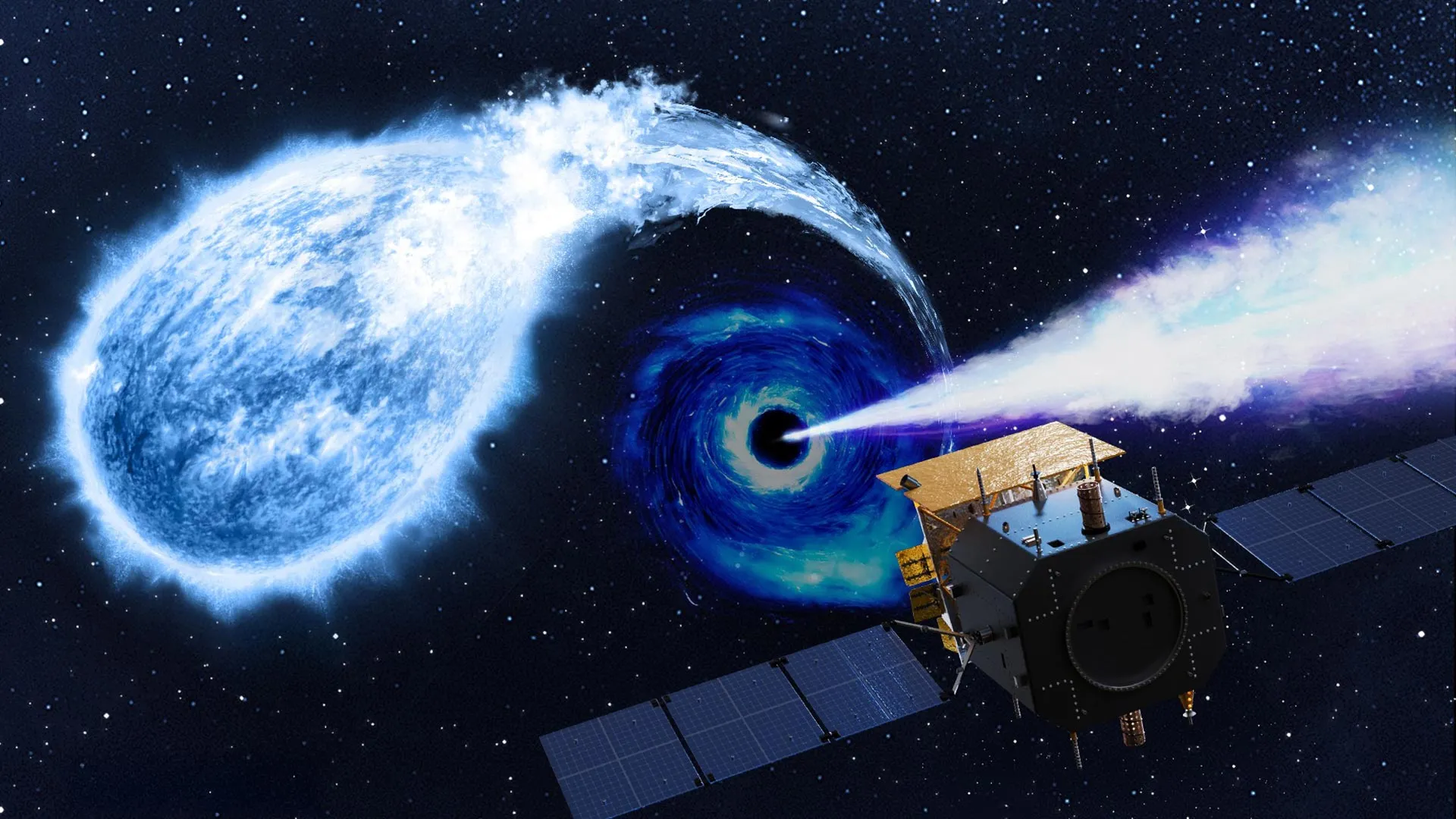
Astronomers at the Technion–Israel Institute of Technology report the first evidence that supermassive black holes produce eruptions resembling solar storms, a finding that suggests the same physics that flings plasma off the sun also operates around objects millions of times its size.
The team, led by doctoral student Gal Vardi under Professor Ehud Behar, monitored X-rays from near the black hole in the galaxy NGC 3783 using the XRISM space telescope. XRISM is a joint mission of NASA, the Japan Aerospace Exploration Agency and the European Space Agency. The group also used ESA's XMM-Newton telescope, and researchers from Japan, Europe and the United States took part. The results were published as Gal Vardi et al., "Observation of a Solar-like Magnetic Reconnection Event in an AGN Corona with XRISM."
Solar storms are powerful eruptions of X-ray radiation accompanied by winds of charged particles thrown from the sun's corona into the solar system. They can endanger astronauts and disrupt satellite communications. These coronal mass ejections originate in a process called magnetic reconnection, in which tangled magnetic field lines snap and rearrange, converting magnetic energy into kinetic energy.
What the Technion researchers saw near NGC 3783 is a signature known as the Neupert effect. It was first discovered on the sun in 1968 but had never before been observed around a black hole. The team says it found, for the first time, magnetic reconnection eruptions and a coronal mass ejection in the corona of a black hole. The supermassive black holes in question can be a million times larger than the sun or more.
The finding matters because the hot, X-ray-emitting corona that surrounds the disk of gas feeding an active galactic nucleus has long been poorly understood. The sun is the only star close enough for scientists to watch such eruptions in detail. Seeing the same timing signature in a distant galaxy's core indicates that the same physical processes underlying solar storms also occur in the environments of supermassive black holes, and it gives astronomers a way to test ideas about how those coronae are heated and powered.
The observation is a single event in one galaxy, and further XRISM monitoring of other active black holes will show whether such eruptions are common. For now, the result ties one of the most extreme environments in the universe to a phenomenon people can observe from Earth every time the sun flares. Behar's group credits the discovery to pairing XRISM's high-resolution X-ray spectroscopy with long monitoring of the source, which let them follow how the emission changed over time rather than relying on a single snapshot.