A Supermassive Black Hole With No Galaxy Around It Gave Itself Away by Shredding a Star
The flash astronomers named TDE 2025abcr came from 30,000 light-years off-center in a galaxy 750 million light-years away — the first quiet, wandering giant ever caught this far from home.
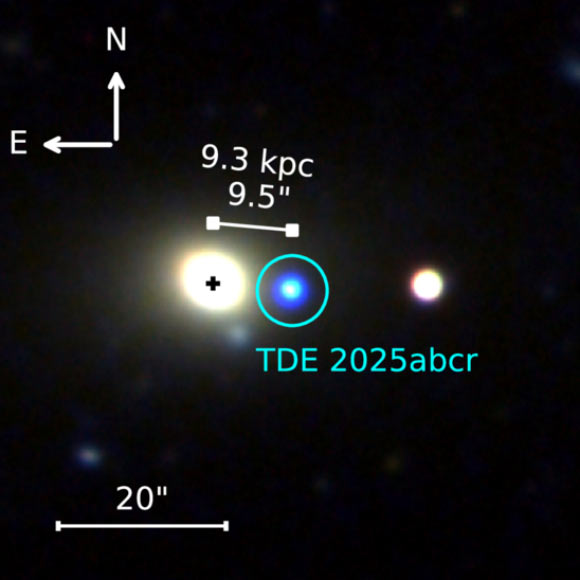
For as long as astronomers have studied them, supermassive black holes have come with an address: the center of a galaxy. A flash of light catalogued as TDE 2025abcr has just broken that rule.
The event was a tidal disruption — the brief, brilliant glare a black hole produces when it tears apart a star that strayed too close. What made this one extraordinary was where it happened: roughly 30,000 light-years from the center of WISEA J014656.04-152214.7, a massive galaxy about 750 million light-years away in the constellation Cetus. The black hole responsible carries about the same mass as the one at the heart of our own Milky Way. The findings were published on July 27 in The Astrophysical Journal Letters.
"This is a novel result. What's new is that, until now, we've started with the assumption that supermassive black holes reside in the centers of massive galaxies," said Suvi Gezari, an astronomer at the University of Maryland. "This discovery will have a huge impact. It means that we're going to find many more examples of wandering black holes, and we can understand how galaxies and their black holes merge and build up over time."
Theorists have expected wandering black holes for years. Galaxies collide and merge constantly over cosmic time, and the black holes they carry should sometimes end up flung to the outskirts or stranded entirely. The problem has always been detection: a black hole that is not actively swallowing anything emits no light at all, which makes a quiet one effectively invisible. It reveals itself only when something falls in.
Catching that moment required volume and automation. The event was first flagged by the Zwicky Transient Facility, which scans the entire northern sky every two days using two telescopes at Palomar Observatory. "The quiescent black hole described in this study was first detected through the Zwicky Transient Facility, which searches the whole Universe," said Robert David Stein of the Joint Space-Science Institute. ZTF logs hundreds of thousands of celestial events every night — far too many for people to sift by hand — so the team trained an artificial-intelligence program to pick out the characteristic light curve of a star being shredded. Tidal disruption events are rare, occurring roughly once every 100,000 years in a given galaxy, and of the more than 100 identified over the past decade, nearly all sat squarely at galactic centers.
The stranger part is what is not there. "Surprisingly, it has no observable galaxy swirling around it," said Sylvain Veilleux, also at the University of Maryland. "To have such a big black hole outside of a galaxy is surprising to me. There should be a Milky Way-like object around it — and that's definitely not the case."
Two explanations are on the table, both starting with a collision. In the first, a larger galaxy cannibalized a smaller one and then stripped away its stars over time until only the dense core and its black hole survived. In the second, one galaxy already hosted two black holes orbiting closely at its center, and a third arriving from another merger set off a chaotic three-body interaction that kicked the smallest one out. Continued observations of the fading flare could favor one story over the other.
For the astronomers involved, the bigger prize is the method. TDE 2025abcr is the first strong evidence that ordinary ground-based visible-light surveys can reliably turn up wandering black holes, which opens a census that has never been possible before. "Further discoveries could reveal the origin of this apparent 'orphan' black hole," Stein said. "The key science question we want to answer is: How common are wandering black holes?"
Originally reported by Sci.News.