
Physics
Australian Team's AI Method Independently Confirms the First Black Hole Image
CSIRO researchers rebuilt the M87 black hole's ring from raw Event Horizon Telescope data without being shown what a black hole looks like.
Topic
24 stories from Planck Standard. Latest: November 12, 2026.
CSIRO researchers rebuilt the M87 black hole's ring from raw Event Horizon Telescope data without being shown what a black hole looks like.

ALMA images of the Large Magellanic Cloud system LMC P3 reveal a narrow stream of heated gas that favors a 'microquasar' explanation over a pulsar wind.

X-ray data from the XRISM telescope show the 'Neupert effect,' first seen on the sun in 1968, near the black hole in galaxy NGC 3783.

TDE 2023mfm is a rare off-nuclear tidal disruption, hinting that a wandering black hole of 1 to 10 million solar masses roams the host galaxy.

A paper led by Andrea Botteon of Italy's INAF finds the clef-shaped radio structure sits inside two merging galaxy clusters hidden behind the Milky Way's plane.

The source, TXS 2354+015, sits at redshift 4.946, when the universe was under 1.2 billion years old, and its radio output beats the previous record from a 2008 census.

By separating three overlapping sources of X-rays, astronomers isolated Sagittarius A East for the first time and mapped its iron, sulfur, argon and calcium.

Astronomers in India found four nested pairs of radio hotspots around a galaxy 3.9 million light-years across, each one older the farther it sits from the core. The jets' direction has also swung by 24 degrees, a sign the black hole's spin axis is wobbling.

An algorithm called kine stitched 116 VLBA observations of the blazar 3C 345 into a continuous polarized video with four times the resolution and 140 times the contrast, and the bright knots did not behave like shocks.

Massive stars elsewhere in the galaxy come in pairs about 69% of the time. In the S cluster around Sagittarius A*, only 43% do. Tracking 100,000 simulated binaries shows tidal forces destroy or merge roughly the right number, which points to the stars forming where they are.
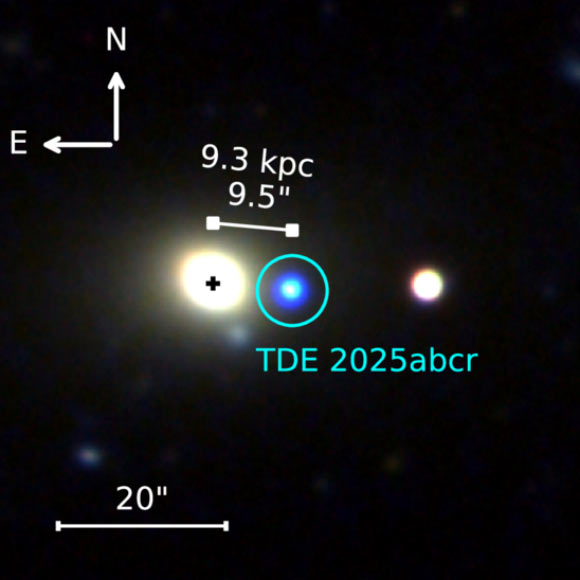
The flash astronomers named TDE 2025abcr came from 30,000 light-years off-center in a galaxy 750 million light-years away — the first quiet, wandering giant ever caught this far from home.

By combining Event Horizon Telescope and Global Millimeter VLBI Array images at two wavelengths, a Shanghai-led team produced the first spatially resolved spectral map of a black hole's shadow.
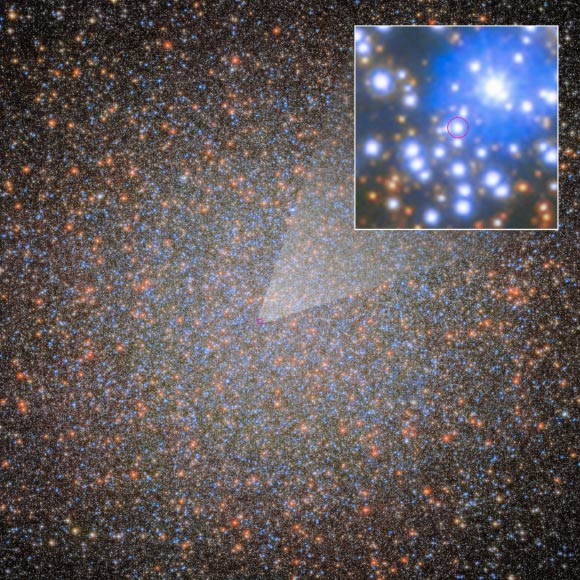
Sifting through two decades of Hubble images, a University of Utah team spotted a star being tugged by an invisible companion — the first of thousands of black holes thought to be hiding in the giant cluster.
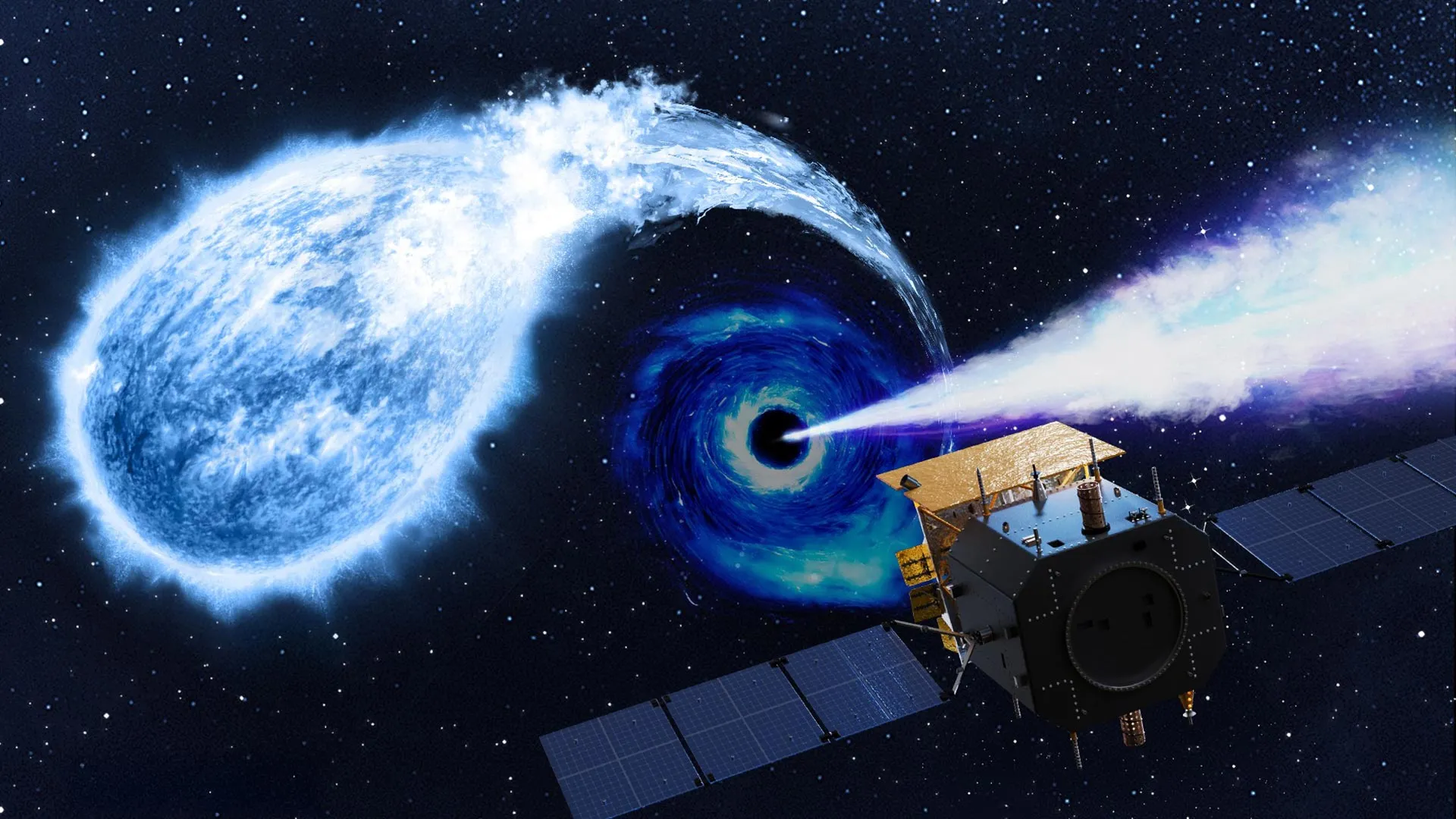
An extraordinarily bright X-ray flare could be the first direct evidence of a long-sought intermediate-mass black hole tearing apart and devouring a dead star.
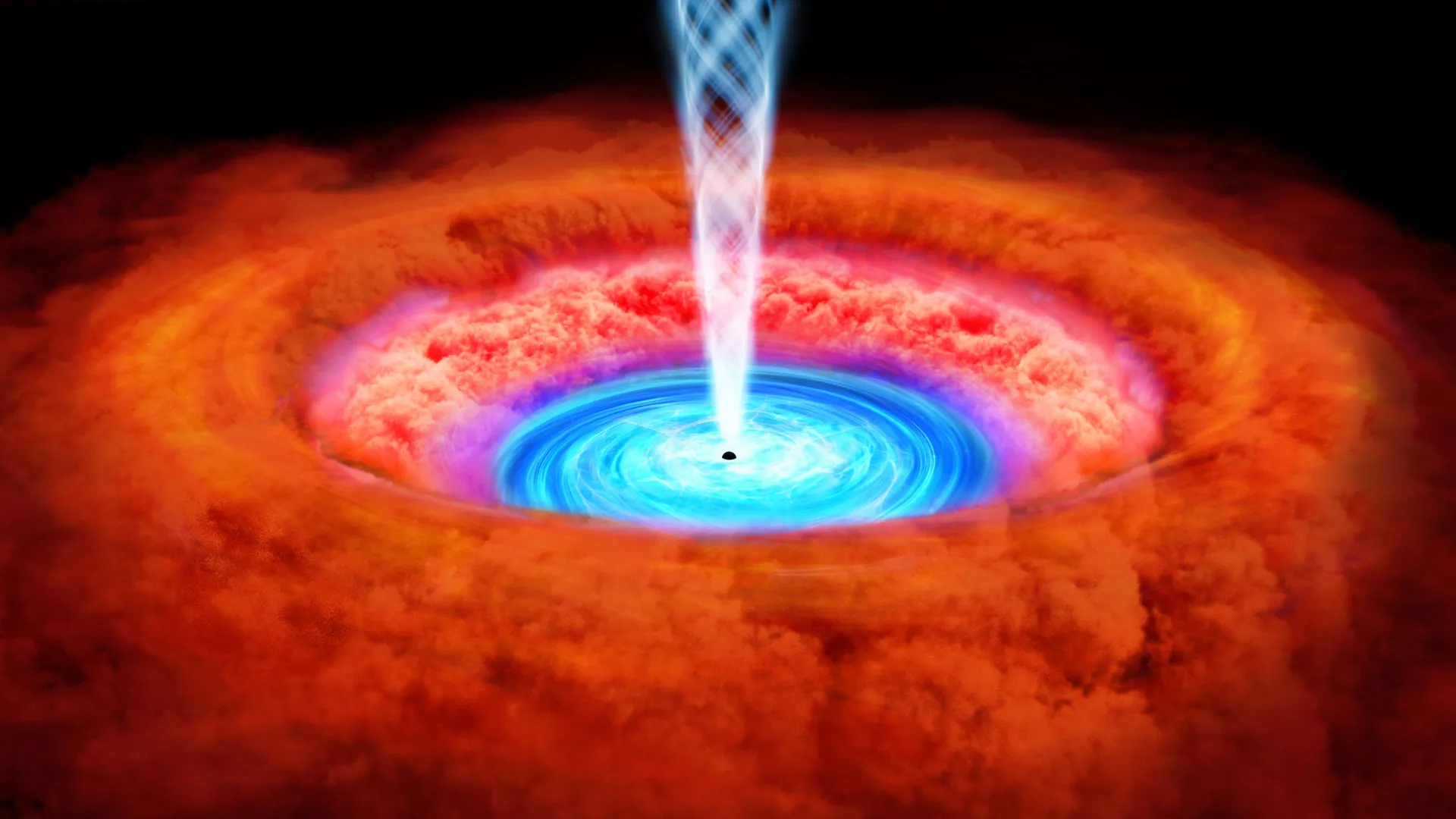
Using the XRISM X-ray observatory, astronomers tracked ferocious outflows from the supermassive black hole in NGC 4151 that can strip away the very gas needed to build new stars.

Spectra from a glowing red object called GLIMPSE-17775 reveal a supermassive black hole wrapped in a dense cocoon of gas just 1.8 billion years after the Big Bang.

Five years of observations with Chile's ALMA telescope revealed a cone of hot gas carved around Sagittarius A*, the long-sought outflow from our galaxy's central supermassive black hole.
Using the James Webb Space Telescope and a cosmic magnifying glass, scientists measured a dormant giant in a galaxy 10 billion light-years away, smashing the previous distance record fifteenfold.
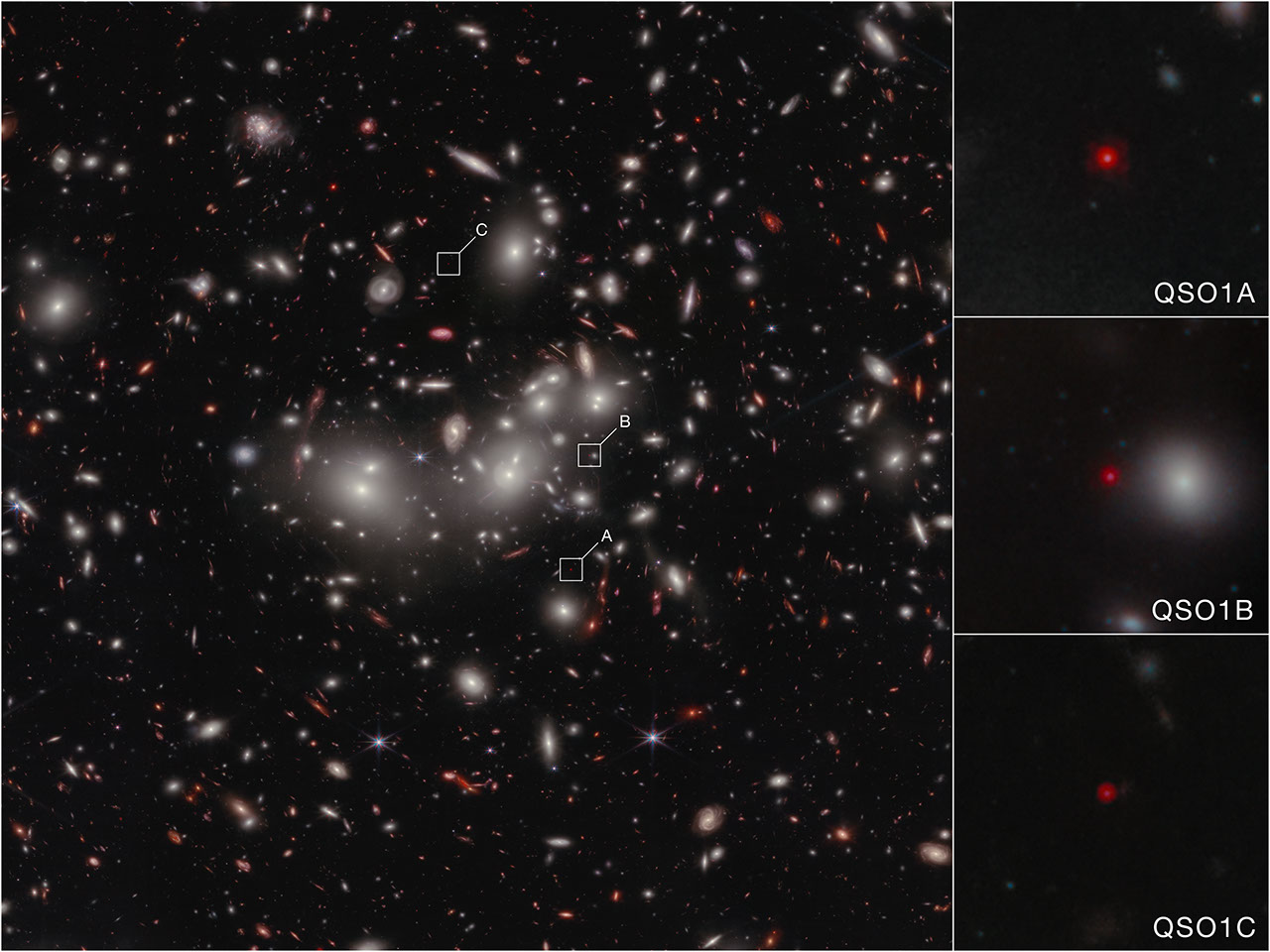
In a 'little red dot' 13 billion light-years away, a supermassive black hole makes up most of the object's mass — a finding scientists call a paradigm shift.
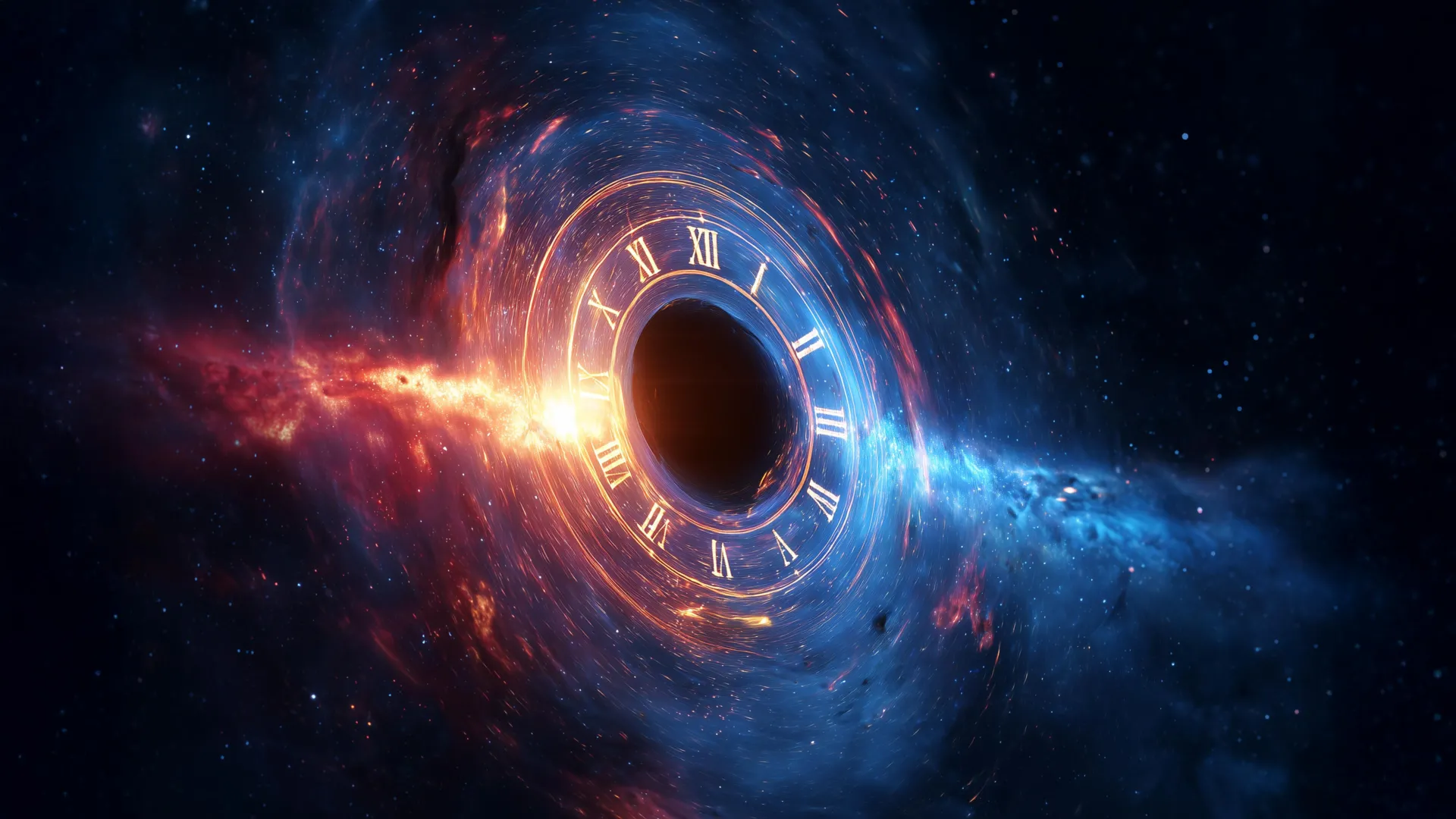
Physicists at the University of Portsmouth argue that the 'bridges' in Einstein's equations are not tunnels through space but mirrors of time — a framework they say could resolve the black hole information paradox and hint that our universe predates the Big Bang.

Using a planet-spanning network of radio telescopes to track how stellar winds bent the jets of Cygnus X-1, researchers calculated that roughly 10% of all infalling energy escapes as jets traveling at half light speed — confirming a key assumption of astrophysics.
Astronomers using LOFAR and India's uGMRT radio telescopes documented the dramatic reawakening of a dormant black hole in galaxy J1007+3540, with new plasma jets stretching nearly one million light-years.
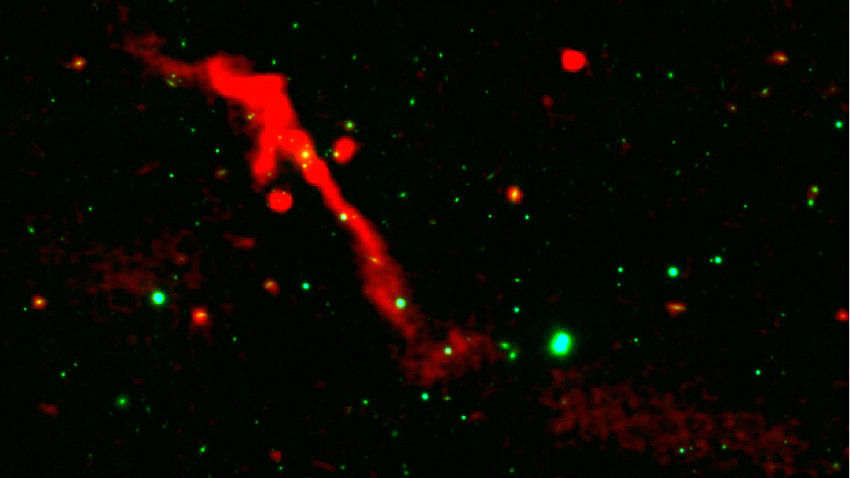
Using LOFAR and India's uGMRT, astronomers captured galaxy J1007+3540's supermassive black hole reawakening with jets stretching nearly a million light-years — evidence of episodic black hole activity across cosmic time.

A precessing black hole jet in galaxy VV 340a is sweeping hot plasma across its entire host galaxy like a cosmic sprinkler, stripping star-forming gas at a rate equivalent to 19 suns per year.