Supermassive Black Hole Roars Back to Life After 100 Million Years, Launching Jets Across Space
Astronomers using LOFAR and India's uGMRT radio telescopes documented the dramatic reawakening of a dormant black hole in galaxy J1007+3540, with new plasma jets stretching nearly one million light-years.
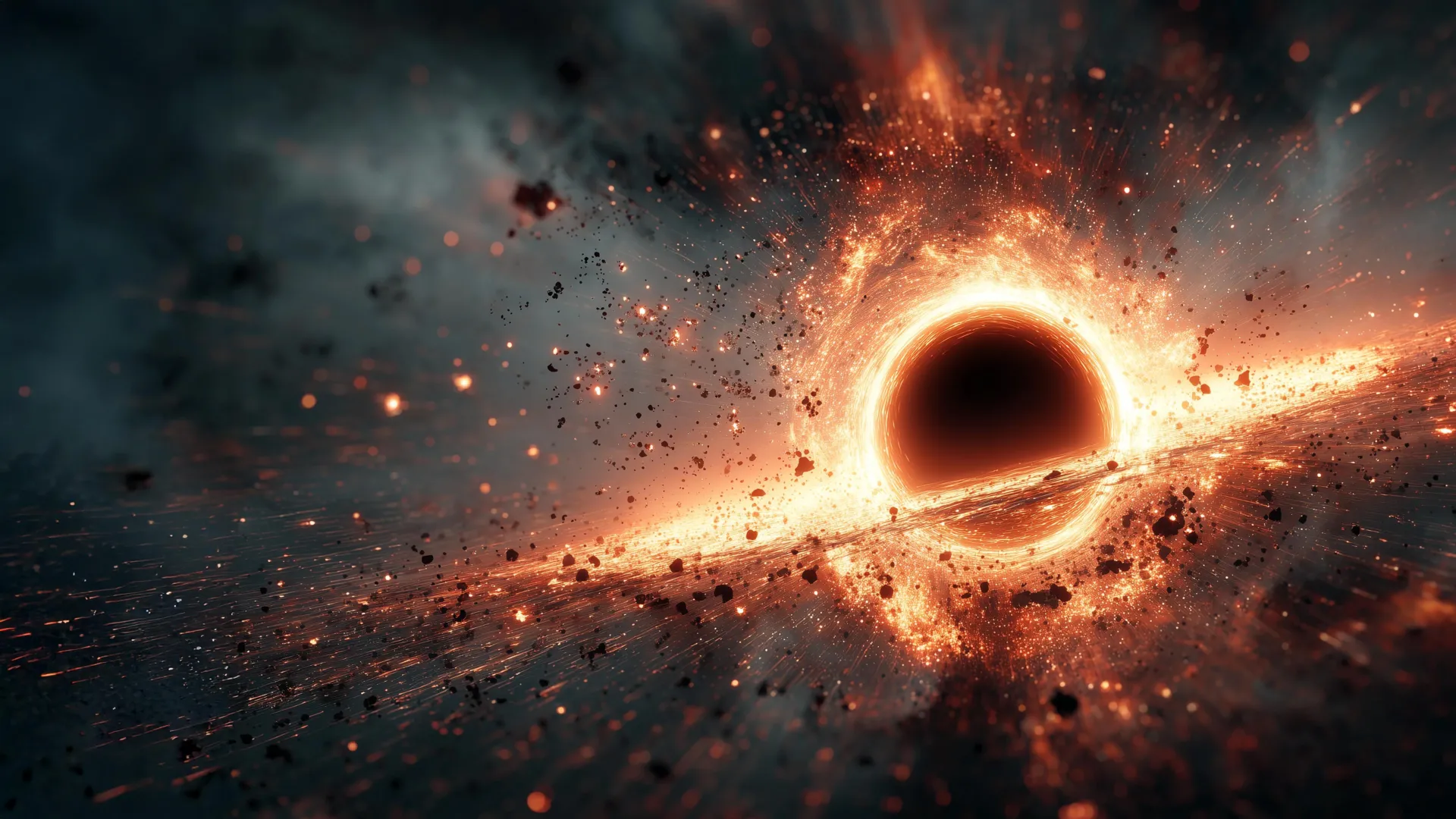
Astronomers have observed a cosmic spectacle not seen for 100 million years: a supermassive black hole in the distant galaxy J1007+3540 has suddenly roared back to life, launching colossal jets of plasma that now stretch nearly one million light-years across space — one of the most dramatic examples of episodic black hole activity ever documented by science.
The discovery, published in the Monthly Notices of the Royal Astronomical Society on April 13, 2026, was made by an international team led by Shobha Kumari of Midnapore City College in India, working with colleagues at Manipal Centre for Natural Sciences and Jagiellonian University in Poland. Using two of the world's most powerful radio telescope arrays — the Low Frequency Array (LOFAR) in the Netherlands and India's upgraded Giant Metrewave Radio Telescope (uGMRT) — the team found unmistakable evidence that a black hole is experiencing a new phase of violent activity after an extended period of dormancy estimated at approximately 100 million years.
"It's like watching a cosmic volcano erupt again after ages of calm — except this one is big enough to carve out structures stretching nearly a million light-years across space," said Kumari. Collaborator Sabyasachi Pal of Manipal Centre for Natural Sciences described the galaxy as "one of the clearest and most spectacular examples of episodic AGN with jet-cluster interaction, where the surrounding hot gas bends, compresses, and distorts the jets."
The evidence for the black hole's reactivation lies in a striking contrast visible in radio observations. The galaxy shows bright, compact inner jets indicating very recent activity — plasma accelerated to relativistic speeds just recently by the newly reawakened black hole. Surrounding this new energetic material are larger regions of older, fading plasma from a previous episode of activity that occurred approximately 100 million years ago. The stark difference between the two generations of material — one fresh and radiating intensely, the other degraded and diffuse — tells a story of a black hole that once burned brightly, went dormant, and has now reignited.
What makes J1007+3540 particularly interesting is its environment. The galaxy resides within an unusually dense galaxy cluster where hot, pressurized gas creates external forces far greater than those surrounding typical radio galaxies. As the newly restarted jets expand outward from the black hole, they collide with this dense medium and are warped and compressed rather than streaming freely into space. The result is an asymmetric, twisted structure that reveals both the power of the reactivated jets and the influence of the surrounding environment on their propagation.
Researcher Surajit Paul highlighted the broader significance of the finding: understanding how black holes cycle between active and dormant phases — a phenomenon astrophysicists call episodic AGN, or active galactic nuclei, behavior — has profound implications for models of galaxy evolution. Jets from active black holes can heat and stir the gas in surrounding galaxy clusters, suppressing star formation across billions of light-years. These periodic eruptions, it turns out, may play a critical role in shaping how galaxies grow over cosmic time.
The discovery also underscores an uncomfortable implication for how astronomers survey the universe: many seemingly quiet galaxies with no visible jet activity may harbor black holes that are simply between episodes. A galaxy that appears dormant today could reawaken in the geologically near future, launching new jets and reshaping its surroundings. J1007+3540 is a vivid reminder that cosmic silence can be temporary, and that the most powerful engines in the universe don't always announce themselves.