'Cosmic Volcano' Black Hole Erupts After 100 Million Years, Blasting Plasma Across a Million Light-Years
Using LOFAR and India's uGMRT, astronomers captured galaxy J1007+3540's supermassive black hole reawakening with jets stretching nearly a million light-years — evidence of episodic black hole activity across cosmic time.
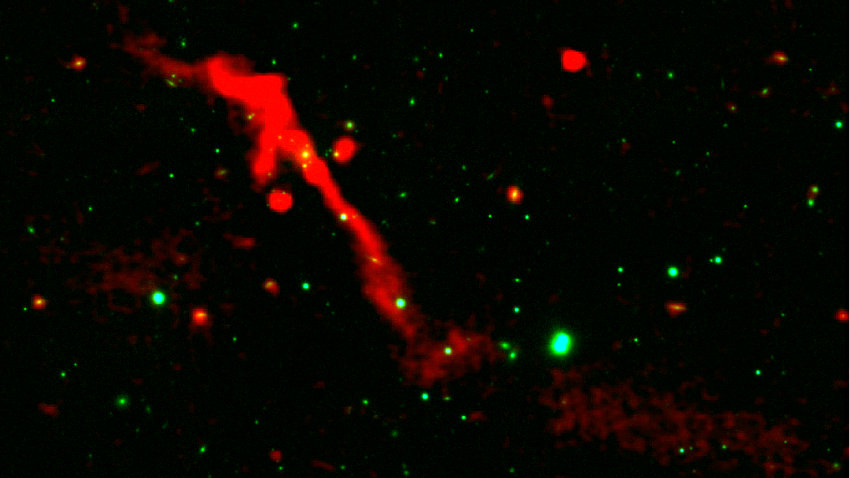
A supermassive black hole that had been dormant for approximately 100 million years has suddenly roared back to life in a distant galaxy, blasting twin jets of plasma across nearly one million light-years of space in what astronomers are calling one of the most spectacular examples of episodic black hole activity ever observed. The phenomenon, discovered by a team led by Shobha Kumari of Midnapore City College in India using the Low Frequency Array (LOFAR) radio telescope in the Netherlands and the upgraded Giant Metrewave Radio Telescope (uGMRT) in India, was published Monday in the Monthly Notices of the Royal Astronomical Society. "It's like watching a cosmic volcano erupt again after ages of calm — except this one is big enough to carve out structures stretching nearly a million light-years across space," Kumari said.
The galaxy in question, designated J1007+3540, is what astronomers classify as a radio galaxy — a type of active galactic nucleus in which a supermassive black hole at the galaxy's core generates enormous jets of radio-emitting plasma. What makes J1007+3540 exceptional is the clear evidence it displays of multiple distinct eruption cycles. Radio images show a compact, intensely bright inner jet that is the unmistakable signature of the black hole's recent reactivation, surrounded by a vast cocoon of older, faded plasma left over from previous eruptions hundreds of millions of years ago. That ancient plasma has been distorted and compressed by the extreme pressure of the surrounding galaxy cluster environment, creating a chaotic, twisted structure unlike anything previously observed.
The mechanism driving episodic black hole activity is still not fully understood, but the leading hypothesis involves cycles of gas accretion onto the black hole. When enough material — gas and dust falling inward from the galaxy's surroundings — accumulates at the black hole's accretion disk, the disk heats up and generates enormous magnetic fields that accelerate particles into the jets. Over millions of years, the jet activity can exhaust the available fuel, causing the black hole to go quiet. Then, new gas eventually falls inward — perhaps from a galaxy merger or the infall of intergalactic material — triggering a new episode of activity. J1007+3540 appears to have undergone at least two such cycles, with the current eruption beginning only recently on geological timescales.
The enormous scale of the jets makes this system an important laboratory for understanding how supermassive black holes regulate star formation across entire galaxy clusters. When the jets slam into the hot gas that permeates galaxy clusters, they create enormous cavities and shockwaves that can suppress or trigger star formation across millions of light-years. This "feedback" mechanism is believed to play a crucial role in determining the structure of the largest galaxies in the universe, but the details of how it operates — and how episodic activity modulates it over cosmic time — remain one of the biggest open questions in astrophysics. J1007+3540's clearly layered eruption history makes it uniquely suited for dissecting these processes.
The research team plans to follow up with observations across additional wavelengths, including X-ray data from the Chandra Space Telescope and optical observations from ground-based telescopes, to build a more complete picture of the galaxy and its surrounding cluster environment. The detection of the eruption with LOFAR, which operates at unusually low radio frequencies, highlights the power of next-generation radio observatories to identify structures that are invisible to conventional telescopes. Kumari's team said they expect to find additional examples of multi-cycle episodic black hole activity in other radio galaxies as LOFAR surveys more of the sky — suggesting that cosmic volcanoes like J1007+3540 may be far more common than the current sample of known examples would imply.