Chandra Decodes the 'Treble Clef,' a Radio Ghost Left by a Black Hole Outburst and a Cluster Collision
A paper led by Andrea Botteon of Italy's INAF finds the clef-shaped radio structure sits inside two merging galaxy clusters hidden behind the Milky Way's plane.

Astronomers have used NASA's Chandra X-ray Observatory to work out what produced a radio formation nicknamed the "Treble Clef" because its shape strongly resembles the musical symbol. The answer, they report, is likely an outburst from a supermassive black hole followed by a collision between two galaxy clusters.
The paper, led by Andrea Botteon of the National Institute for Astrophysics, or INAF, in Italy, was published Wednesday in the journal Astronomy & Astrophysics. An explanation has been hard to find, the team noted, because the formation lies almost directly behind the plane of the Milky Way. Stars, gas and dust from our own galaxy largely block the view from Earth, so the researchers relied on telescopes able to peer through that material.
Chandra and the German eROSITA X-ray telescope found diffuse, hot gas at the location of the Treble Clef. That showed a galaxy cluster hosts the object. The team also determined that the cluster is in fact two clusters in the process of merging. Galaxy clusters are among the largest structures in the universe, containing hundreds of individual galaxies and huge reservoirs of superheated gas.
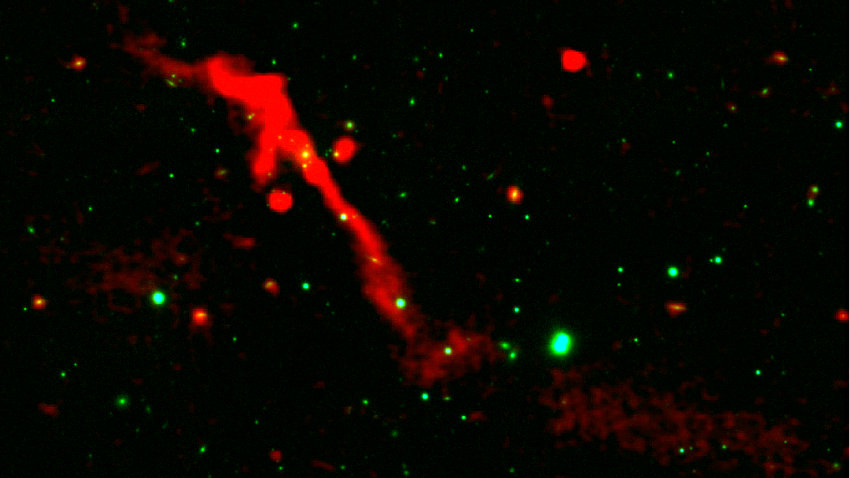
The composite image combines three kinds of light. Multimillion-degree gas detected in X-rays by Chandra and eROSITA appears in blue. Radio data in red from the LOw Frequency ARray, or LOFAR, a large network of radio telescopes in Europe, traces the clef-shaped structure. Infrared data from the United Kingdom Infrared Telescope supplies the mostly white background.
The authors conclude that the Treble Clef formed in two stages. First, an earlier outburst from a supermassive black hole at the cluster's center drove clouds of charged particles and magnetic fields outward at close to the speed of light. That produced bright radio waves, which later faded as the particles lost energy. Second, the collision between the two clusters compressed or reenergized the cloud, and it brightened again in radio waves. Shock waves from the collision, similar to the sonic booms of supersonic jets, may have played a role in that reenergizing.
To find evidence of the collision in the Chandra data, the authors used a special technique that measures how much the cluster's hot gas deviates from a symmetrical shape. Most of the gas is symmetrical and roughly oval. The team subtracted that oval from the original X-ray image and studied what remained. The leftover X-ray emission is brightest on the left and right and faintest in the center. That pattern implies the collision likely happened along the left-right direction as seen from Earth.
The result matters because radio structures like this one show how energy from black holes is stored in the gas between galaxies and how cluster mergers can bring it back to life. The Treble Clef is an unusual example, and explaining it required combining X-ray, radio and infrared views of a patch of sky that the Milky Way mostly hides.