Webb Watches Water Clouds Thicken and Thin on the Coldest Brown Dwarf, 7.5 Light-Years Away
An 11-hour James Webb observation of WISE 0855 gives the first direct confirmation of changing water clouds on another world, alongside deep gases rising from below.

A Jupiter-sized world just 7.5 light-years away has weather, and astronomers have now watched it change. Using the James Webb Space Telescope, a team led by Brittany Miles, an assistant astronomer at the University of Arizona's Steward Observatory, spent 11 hours staring at WISE 0855, the coldest known brown dwarf, collecting a spectrum of its light every 15 minutes.
The result is the most detailed time-series portrait ever taken of the frigid object and the first direct confirmation that water clouds on another body are changing thickness over time, like weather on Earth. The research is on the arXiv preprint server and has been accepted for publication in The Astrophysical Journal.
"This is the first time we've been able to confirm that water clouds are becoming thinner and thicker on a nearby world," said Miles. "Before JWST, we only had photometry, which mixed up the effects of clouds, chemistry and temperature all together. Now we can actually distinguish them."
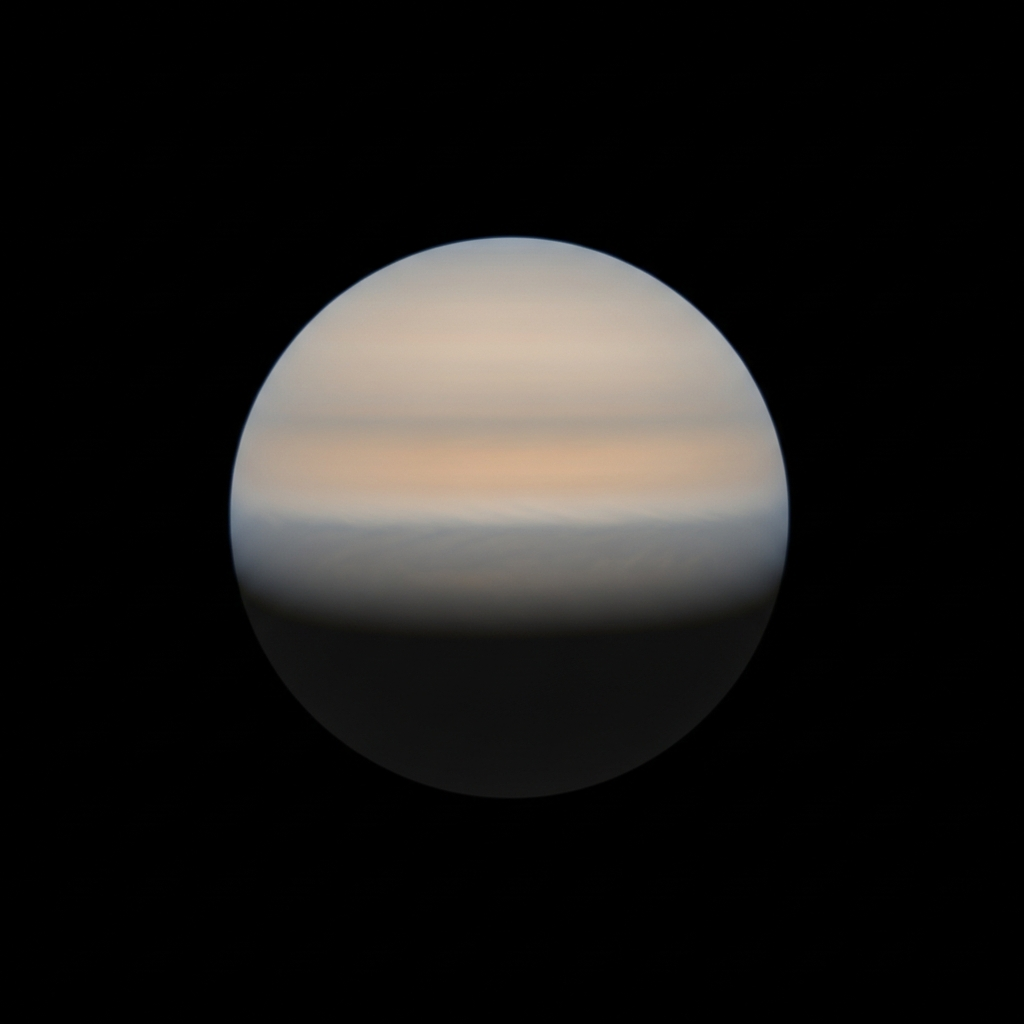
Brown dwarfs sit in a strange middle ground. They are too massive to be planets and too small to ignite as stars, glowing dimly with leftover heat from their formation. WISE 0855, at roughly 265 kelvins (-8 degrees Celsius, 17 degrees Fahrenheit), is colder than Earth's surface and sits at the very bottom of the category. At about twice Jupiter's mass and nearly the same size, it behaves in many ways like a free-floating giant planet.
The study found that its atmosphere is shaped by at least two processes at once. High-altitude water clouds grow thicker and thinner as the object rotates, and gases from deep inside are dredged upward by convection. The spectrograph also captured a rhythmic, wavelike signal in carbon monoxide and phosphine. Those gases fluctuate because heat from the interior churns them toward the surface, "the same way a pot of hot soup pushes warmer liquid up from the bottom," in the words of the university's account.
Co-author Mark Marley, director of the Lunar and Planetary Laboratory at the University of Arizona, compared the problem to looking through a screen door. "The photons go through the atmosphere and escape to space," he said. "We're learning about the world on either side of the screen, but we also have to understand the screen itself." Here, the screen keeps changing, because different patches with different cloud cover and temperature rotate into view.
Webb's medium-resolution spectrograph was sensitive enough to track those differences across individual molecular features, something no earlier observatory could do for an object this cold. The same physics, convection, clouds and what is called disequilibrium chemistry, governs Jupiter, which suggests it also applies to the giant exoplanets Webb is beginning to study in earnest.
"Even though brown dwarfs are not true planets, they exhibit planet-like behavior," Miles said. "There is a spectrum of behaviors, not a hard line between brown dwarfs and planets." She plans to log more Webb hours on WISE 0855 to pin down its rotation and the three-dimensional structure of its atmosphere. "We're seeing water clouds getting thicker and thinner, and deep gases rising and falling, and we can actually watch them change in real time," she said.