Webb Finds Galaxies Spewing Carbon and Oxygen Just 500 Million Years After the Big Bang
A University of Arizona-led team found heavy elements being blown out of three early galaxies at up to 250 kilometers per second, showing the young universe was already far less pristine than astronomers assumed.
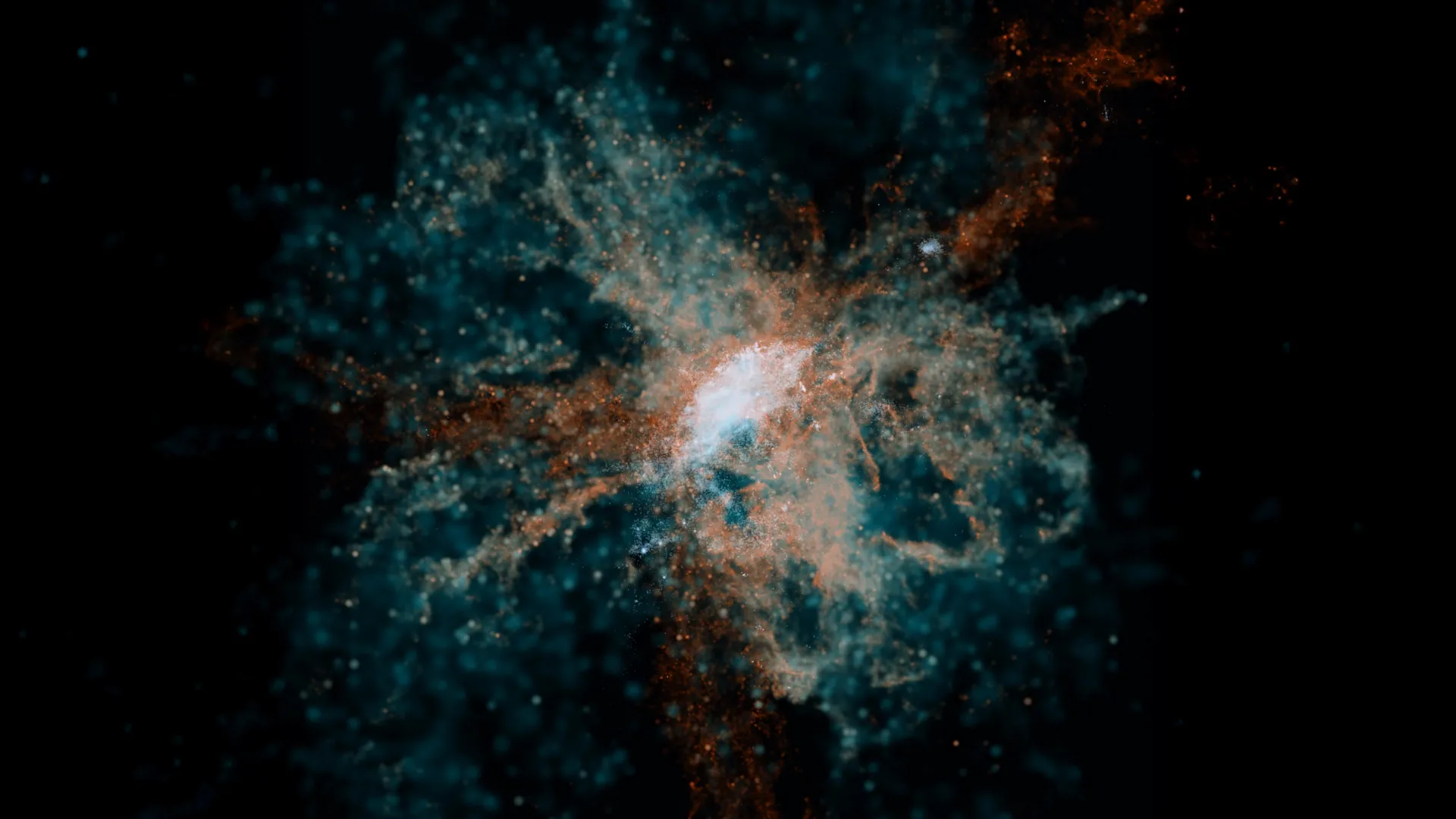
The James Webb Space Telescope has caught galaxies blowing carbon, oxygen and silicon out into space when the universe was only about 500 million years old, evidence that the cosmos was being enriched with heavy elements far earlier than most astronomers believed. The study, led by Yongda Zhu at the University of Arizona, was published in Nature Astronomy.
Astronomers long assumed that the gas surrounding the first galaxies was close to pristine, made almost entirely of hydrogen and helium left over from the Big Bang. Everything heavier is forged inside stars and has to be scattered by stellar winds and supernova explosions before it can seed new generations of stars and planets. The new data show that process was already underway within the first few hundred million years.
Zhu's team studied three galaxies at redshifts between about 7.2 and 9.3, meaning their light has traveled for more than 13 billion years. The most distant is seen as it was roughly 500 million years after the Big Bang. The astronomers used about 30 hours of Webb exposure time and examined the galaxies' spectra, the rainbow of light split by wavelength, for dark absorption lines.
Those lines are the fingerprints of specific atoms. The team identified neutral oxygen, singly ionized silicon and carbon, and more highly ionized silicon and carbon in gas around the galaxies. Crucially, the absorption was blueshifted, shifted toward shorter wavelengths, which means the gas is moving toward us relative to each galaxy. The ions showed velocities of 50 to 250 kilometers per second, consistent with galactic winds pushing metals outward.
"Think of these elements, which originated from the galaxies' stars, as food dye dropped into a cup of water," Zhu said, describing how the elements spread into the surrounding gas.
In astronomy, anything heavier than helium is called a metal. The finding shows that baryon cycling, the exchange of ordinary matter between galaxies and the space around them, started within the universe's first few hundred million years. Stars form from gas, die and return enriched material, which then feeds new stars. That loop is central to how galaxies grow.
The result adds to a growing list of Webb observations showing that early galaxies were more mature and more chemically complex than models predicted. Astronomers will now try to measure how far the metals travel and how much escapes into the wider intergalactic medium, a question that bears on when the ingredients for planets and life first became available.