Webb Spots a Possible Supernova Just Days After the Star Exploded
A transient called AT 2026abck, in a galaxy at redshift 5.017, was caught four to 10 days after its blast without help from a gravitational lens, astronomers report.

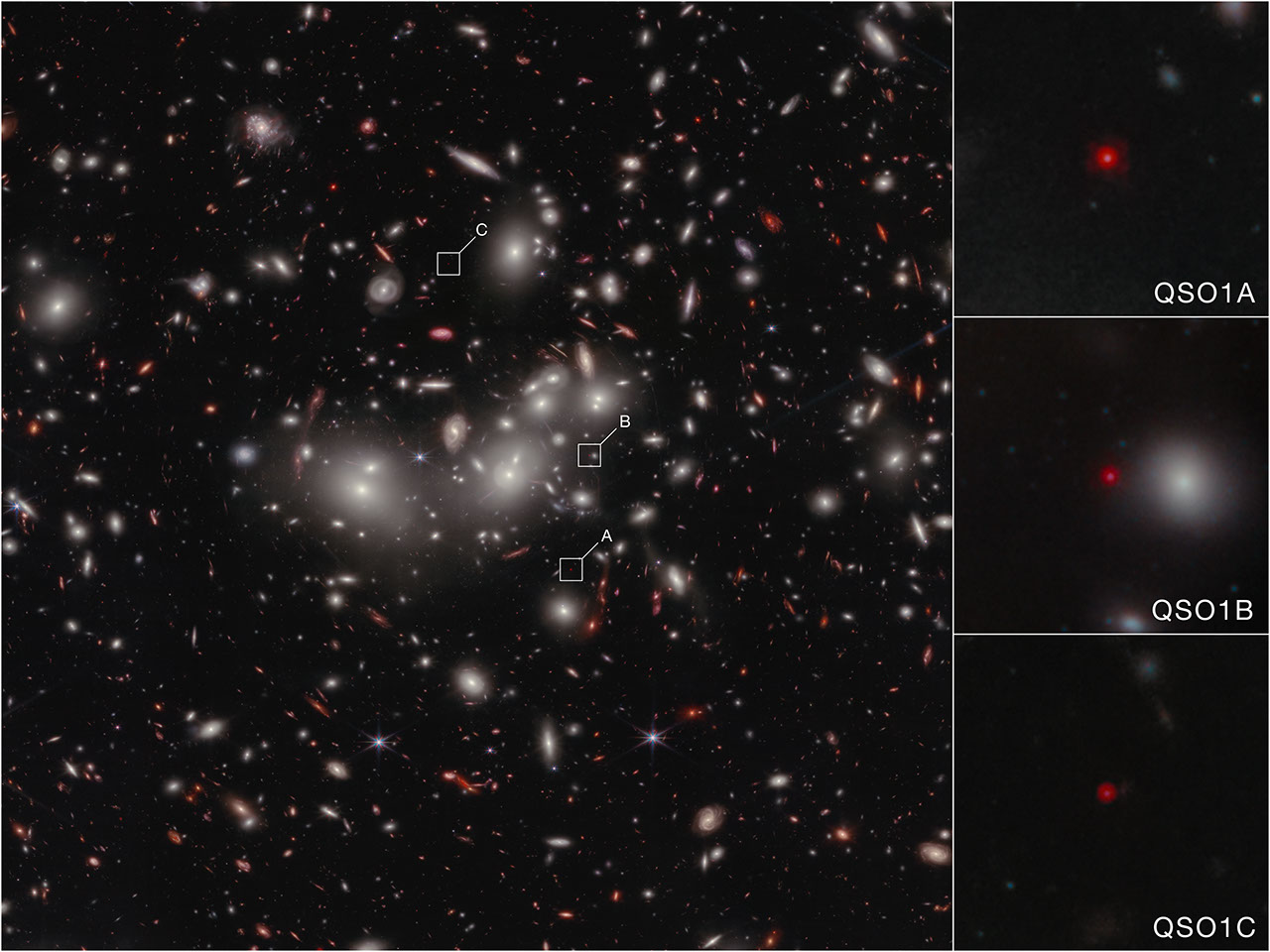
The James Webb Space Telescope has detected a possible supernova in the early universe just days after the star exploded. The object, called AT 2026abck, lies in a star-forming galaxy at a redshift of 5.017 and was found without the help of gravitational lensing. Webb observations suggest the event was caught only about four to 10 days after the explosion. The paper was posted to the arXiv preprint server on Sept. 29 and has not yet been peer reviewed.
Supernovae in the early universe give astronomers a direct look at how massive stars lived and died when galaxies were young, metal-poor and forming stars in bursts. Their rate also gives an independent measure of the cosmic star-formation history. But they are hard to observe, because their light is stretched to infrared wavelengths by the time it reaches Earth. Webb's infrared vision has made it possible to detect more than 200 potential supernova events in host galaxies out to a redshift of around 6.
Even so, most candidates beyond redshift 4, when the universe was about 1.5 billion years old, have been observed only once or a few times, and few have been caught within days of exploding. At redshifts greater than 5, only one supernova has been confirmed by its spectrum, and only because a galaxy cluster magnified it up to 30 times.
Astronomers led by Ming-Yang Zhuang of the University of Illinois Urbana-Champaign found the new transient in data from NEXUS, a Webb Treasury program that revisits the same patch of sky every two months. On May 28, 2026, the spot was empty. About 71 observed days later it had appeared at roughly magnitude 27.4, a brightening of more than 3.6 times in the F200W filter. Modeling gave a temperature of about 17,000 kelvin, a radius about 46 times the Earth–Sun distance and a luminosity of about 3 × 10^43 erg per second.
The object sits between two components of its host galaxy, roughly 3,600 and 4,200 light-years from the center. That argues against a star shredded by a black hole or a flare from an active galactic nucleus, which typically happen at a galaxy's center. Its ultraviolet-bright emission, high temperature and early brightness also do not fit a Type Ia explosion.
The best match is a Type II supernova, the core-collapse death of a massive star, but not a normal one. Among 34 well-observed nearby Type II supernovae, none had a temperature above about 15,000 kelvin after six days or reached this luminosity after four days. "AT 2026abck is hotter and more luminous than normal SNe II at comparable phases," the team writes. The brightness instead matches Type II supernovae surrounded by dense, confined circumstellar material, with the extra early power most plausibly coming from shock cooling of an extended envelope or interaction with that material.
The host galaxy holds about 6 billion solar masses of stars, has about 0.3 times the Sun's metal content and forms 14 to 21 solar masses of stars a year, typical for its era. It differs sharply from the host of SN Eos, the only spectroscopically confirmed supernova at this distance. There is no spectrum of the transient itself, so the analysis rests on brightness measurements in a few filters. The researchers say a definitive classification needs deep NIRSpec spectroscopy, and they cannot rule out a superluminous supernova caught on the rise. A Type II should fade quickly in ultraviolet, while a superluminous one would keep brightening, so prompt follow-up should settle the question.