NASA Marks Four Years of Webb With a Never-Before-Seen Infrared Portrait of a Galactic Collision
To celebrate the James Webb Space Telescope's fourth science anniversary, NASA unveiled a new view of Centaurus A, peering through the dust that had long hidden the galaxy's violent heart.
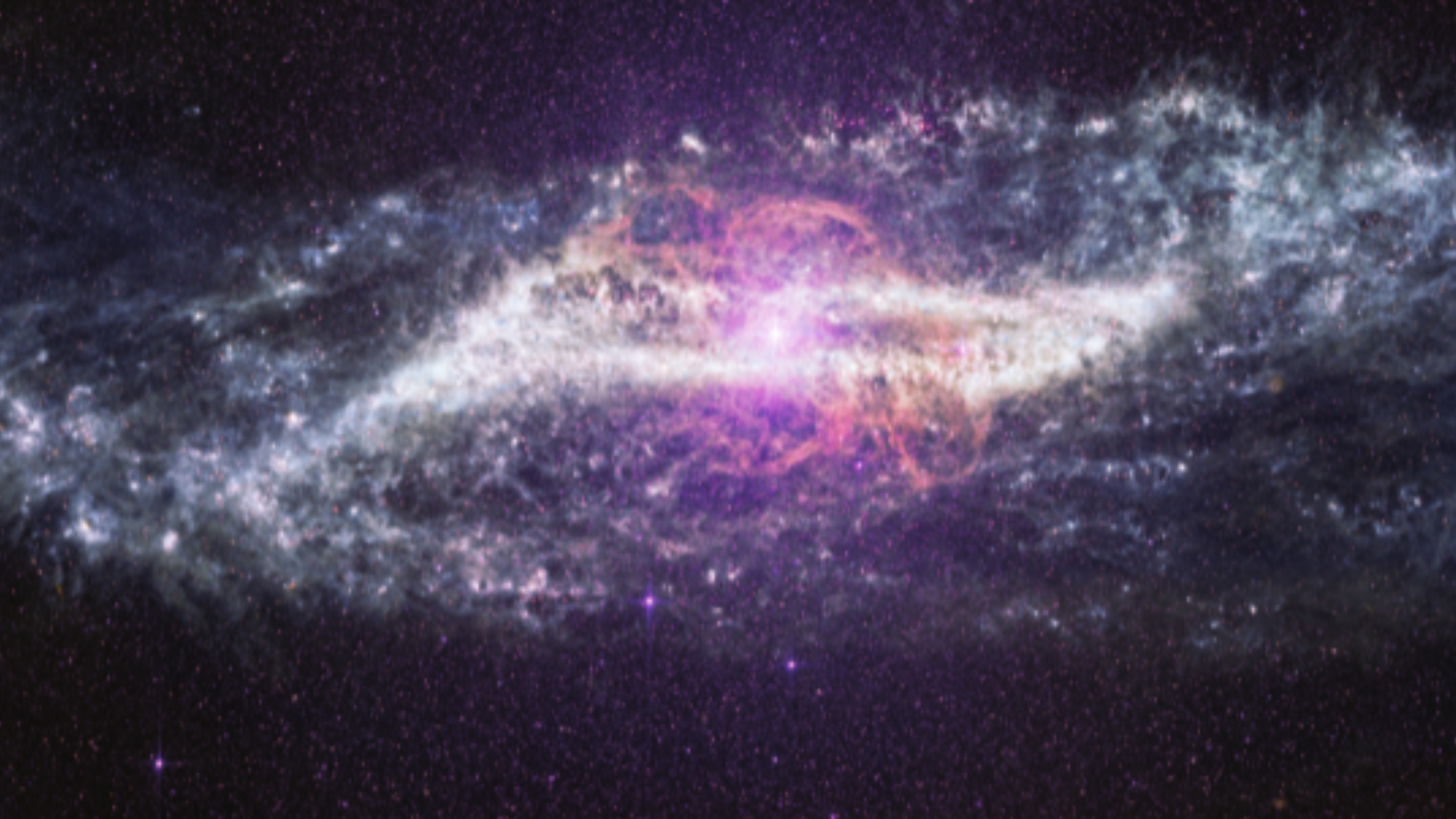
NASA celebrated four years of science from the James Webb Space Telescope this month with a striking new image of Centaurus A, one of the most dramatic galaxies in the nearby universe. The portrait, released to mark the anniversary of Webb's first public images in July 2022, uses the observatory's powerful infrared vision to cut through thick clouds of dust and reveal structure at the galaxy's core that earlier telescopes could not see.
Centaurus A, located roughly 12 million light-years from Earth, is a peculiar galaxy long thought to be the wreckage of a cosmic collision, a merger that left a broad, dark lane of gas and dust slashing across its center. That same dust has frustrated astronomers for generations, because it blocks the visible light that observatories like the Hubble Space Telescope depend on. Infrared light, however, slips through the dense sheets of gas and dust, allowing Webb to peer into regions that were effectively hidden.
The new image showcases exactly why NASA built Webb to see in the infrared. Where visible-light photos show a galaxy bisected by an impenetrable curtain of dark material, Webb reveals the glowing warm dust, star-forming regions and the turbulent environment around the supermassive black hole believed to lurk at the galaxy's heart. Centaurus A is a well-known source of powerful radio jets, and studying its center in infrared helps astronomers trace how such black holes shape the galaxies around them.
Anniversaries like this one underscore how modern astronomy works less like a single snapshot and more like an accumulating archive. "No single telescope tells the whole story," wrote Space.com's Robert Lea in the outlet's coverage of the release. "Discoveries build over time, and new observatories expand on the foundations laid by earlier missions." Webb's infrared view of Centaurus A layers directly onto decades of Hubble, radio and X-ray observations of the same object.
Since it began operations, Webb has transformed multiple fields of astronomy. It has detected some of the earliest galaxies ever observed, probed the atmospheres of distant exoplanets for signs of clouds and chemistry, and produced detailed maps of star birth and death across the cosmos. Each new image, mission scientists say, extends the telescope's reach a little further back in cosmic time.
For the public, the Centaurus A image is a reminder of what the roughly $10 billion observatory was designed to do: turn objects that appear as featureless smudges or dust-choked blurs into richly detailed scenes. Four years in, Webb remains healthy and heavily oversubscribed, with astronomers around the world competing for time on the most powerful space telescope ever launched.