Scientists Build a Cell From Scratch That Eats, Grows, Divides — and Evolves
The University of Minnesota's 'SpudCell,' assembled entirely from non-living chemical parts, completes a full life cycle — a milestone biologists have chased for decades.
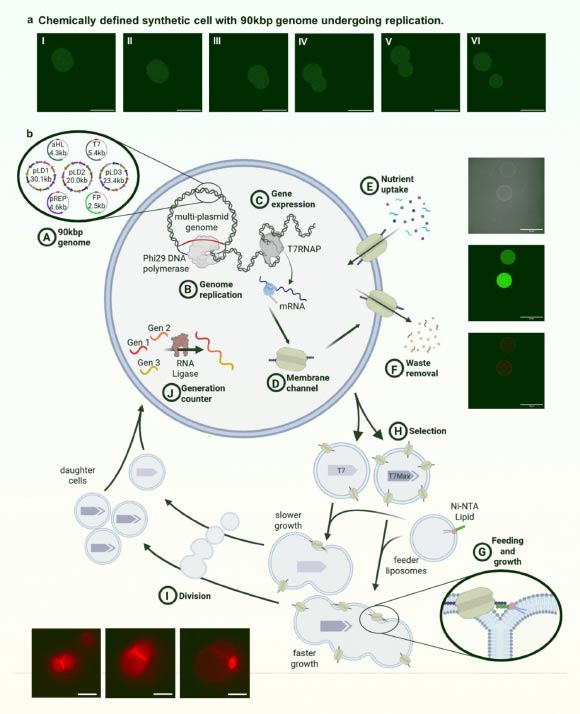
Biologists have built a synthetic cell from entirely non-living components that can carry out the full repertoire of a living cell: taking in nutrients, growing, copying its genetic material, splitting into daughter cells and even passing beneficial mutations to the next generation. The achievement, dubbed SpudCell, marks a landmark in the decades-long quest to construct life from scratch.
The project was led by Dr. Katarzyna Adamala at the University of Minnesota, whose team loaded a stripped-down DNA genome and cell-free protein-making machinery into liposomes — microscopic bubbles of fatty membrane that stand in for a cell wall. They then engineered a membrane protein that reels in separate "feeder" liposomes; when those bubbles fuse with the cell, they dump in sugars, transfer RNAs and ribosomes, effectively feeding the artificial cell the raw materials it needs to keep running.
With that supply line in place, the synthetic cells grew by pulling in proteins and genetic material, elongated, and finally pinched apart into two daughter compartments — a rudimentary but genuine version of cell division. Strikingly, SpudCell's genome is just 90,000 base pairs, smaller than the roughly 113,000 that scientists had speculated might be the minimum required for a living cell.
The most important demonstration was evolutionary. When the researchers introduced a genetic change that boosted production of a growth-related protein, cells carrying that change grew and divided faster than their peers — proof that the synthetic cells are subject to natural selection, one of the defining hallmarks of life. "We've replicated in chemistry what only used to be possible in biology: the complete set of behaviors of a cell," Adamala said.
The work carries a pointed philosophical message. Adamala argued that the results show the fundamental processes of life do not require "a mysterious magical spark" — that growth, division and evolution can emerge from the right arrangement of ordinary molecules. Detailed in a lengthy report and highlighted in a feature published July 1, the milestone has drawn wide attention across the synthetic-biology community.
For now, SpudCell has clear limits: it cannot survive without constant deliveries of food and ribosomes, the molecular factories that build proteins, so it is far from a free-living organism. But researchers say the platform could become a powerful tool — a programmable chassis for manufacturing drugs, studying the origins of life, or engineering cells with capabilities nature never evolved. Adamala called for a "combined international effort" to make the technology more robust and practical.