Humans and Great Apes Have Been Laughing to the Same Beat for 15 Million Years
A study of chimps, bonobos, gorillas, orangutans and people found that all of them giggle with the same underlying rhythm, hinting at the deep roots of human speech.
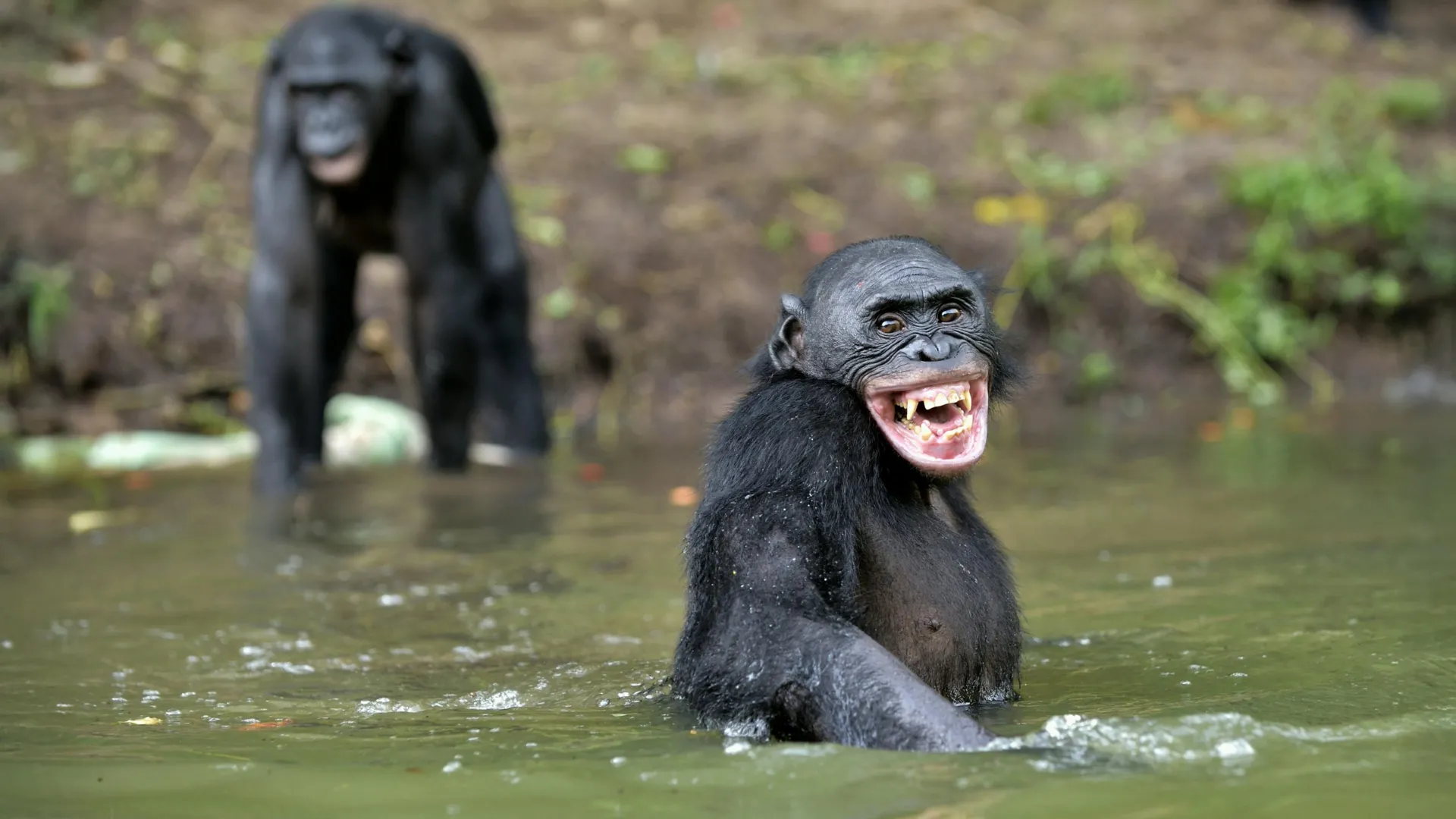
Human laughter, it turns out, marches to a beat we did not invent. A new study finds that people, chimpanzees, bonobos, gorillas and orangutans all produce laughter with the same fundamental rhythmic pattern, evidence that our style of laughing was already present in the common ancestor we shared with the great apes some 15 million years ago.
The research, published in the journal Communications Biology, was led by Chiara De Gregorio, a primatologist at the University of Warwick. Her team analyzed recordings of laughter from four orangutans, two gorillas, three bonobos, four chimpanzees and four humans, working through 140 separate laughter sequences. Across all five species they found the same signature: laughter made of evenly spaced sounds, with regular rhythmic intervals separating one burst from the next.
That shared metronome points back to a single origin. The consistency across such distantly related apes suggests the last common ancestor of humans and the other great apes, living in East or Central Africa roughly 15 million years ago, was already laughing in this rhythmic way. Rather than being a uniquely human quirk of expression, laughter appears to be an ancient piece of biological inheritance, conserved across millions of years of separate evolution.
Humans, however, have not simply copied and pasted the ancestral chuckle. The researchers found that human laughter is faster, more variable and far more sensitive to social context than the laughter of other apes, standing out for its rhythmic complexity and sheer flexibility. Where a chimpanzee's laugh is relatively fixed, ours can be tuned on the fly to a joke, a crowd or an awkward silence.
That flexibility may be the most important clue of all. The scientists argue that developing a more controllable, adaptable laugh could have been a crucial stepping stone toward human speech, because the fine vocal control needed to modulate laughter is one of the same building blocks required to form words. Rather than a sharp line dividing human vocal ability from that of other apes, the study frames it as a continuum, with human laughter sitting at the flexible, complex end of a spectrum shared across the hominid family.
In that view, every giggle is a faint echo of a 15-million-year-old sound, and also a hint of how our ancestors' voices grew supple enough to eventually talk. The finding adds to a growing body of research suggesting that many of the traits once thought to set humans apart are better understood as amplified versions of abilities our closest relatives already possess, refined over millions of years rather than invented from scratch.