Webb's Mysterious 'Little Red Dots' May Be the Birthplaces of the First Giant Black Holes
New simulations from the University of Portsmouth suggest the compact red specks are early galaxies where massive stars collapsed into black holes that stay wrapped in gas.

Astronomers say they may have solved one of the biggest puzzles the James Webb Space Telescope has turned up: what the hundreds of compact, bright, strangely red objects in the early universe actually are.
A new study, published in The Astrophysical Journal Letters, uses cosmological simulations to argue that these "little red dots" are most likely young galaxies hosting massive black holes, formed when enormous primordial stars collapsed. The black holes stay buried inside the huge gas disks that created them, which hides most of their activity from view. The lead author is Daniel Whalen of the University of Portsmouth's Institute of Cosmology and Gravitation.
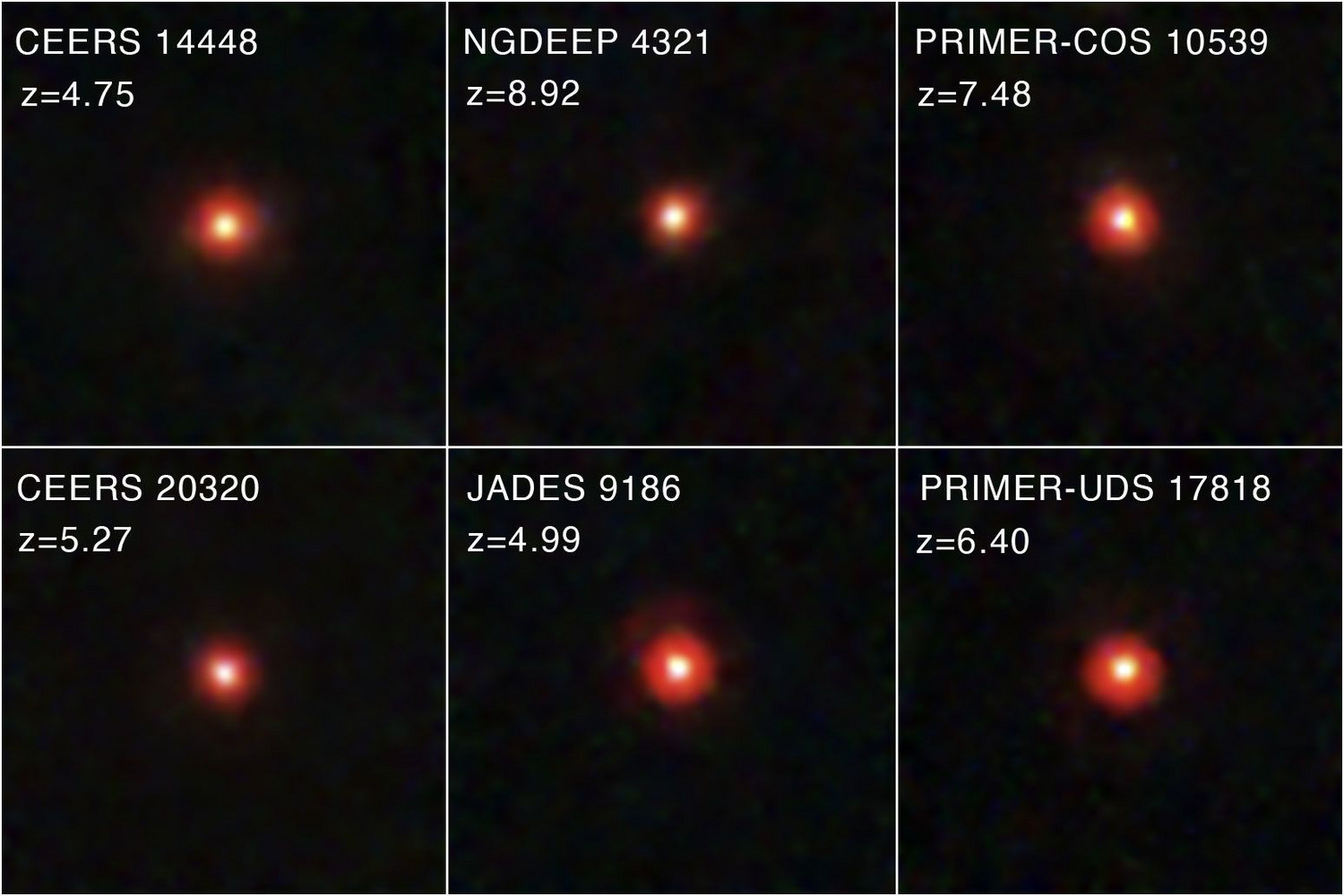
Since Webb began looking deeper into the cosmos than any telescope before it, researchers have counted hundreds of these objects. They are only a few hundred light-years across, yet as bright as far larger galaxies. Their light has an unusual V-shaped spectrum, and they show no detectable X-ray or radio emission, which has made them hard to explain with standard astrophysics. "LRDs have been one of the most surprising discoveries made by the James Webb Space Telescope," Whalen said.
In the simulations, the black holes have masses around 10 million times that of the sun. Dense gas around each black hole traps high-energy X-rays while letting some ultraviolet, visible and infrared light escape, which naturally reproduces the odd spectral shape Webb sees and explains the missing X-rays. A large neighboring cluster of stars in the same small galaxy supplies the blue half of the spectrum, accounting for another long-standing feature of the dots. The simulated systems also pack roughly 100 million stars into a region about 500 light-years across, which matches what astronomers observe in real little red dots.
Earlier proposals included compact collections of stars, heavily obscured black holes, supermassive stars and even hypothetical "black hole stars." According to the Portsmouth team, none of them could fully explain how the objects form, how common they are, how long they last and why their spectra look the way they do. The new model reproduces the properties of a wide variety of little red dots Webb has found, including some of the most distant and extreme examples.
The result bears on a deeper question. Some supermassive black holes already weighed millions or billions of suns less than a billion years after the Big Bang, which is hard to explain if they grew slowly from small seeds. Direct collapse, where a giant primordial star falls straight into a black hole, would give them a head start. "What makes this discovery so exciting is that we may be witnessing the birth of the first supermassive black holes," Whalen said. "For decades, simulations have predicted that these objects should exist, and now the James Webb Space Telescope may finally be allowing us to see them."
The finding is a simulation-based match to observations, not a direct detection of a collapsing star, so other explanations are not ruled out. The paper is titled "Little Red Dots are Direct-collapse Black Hole-forming Galaxies," with the DOI 10.3847/2041-8213/aeb37a. Further Webb observations of the dots' spectra and brightness over time should show whether the model holds up.