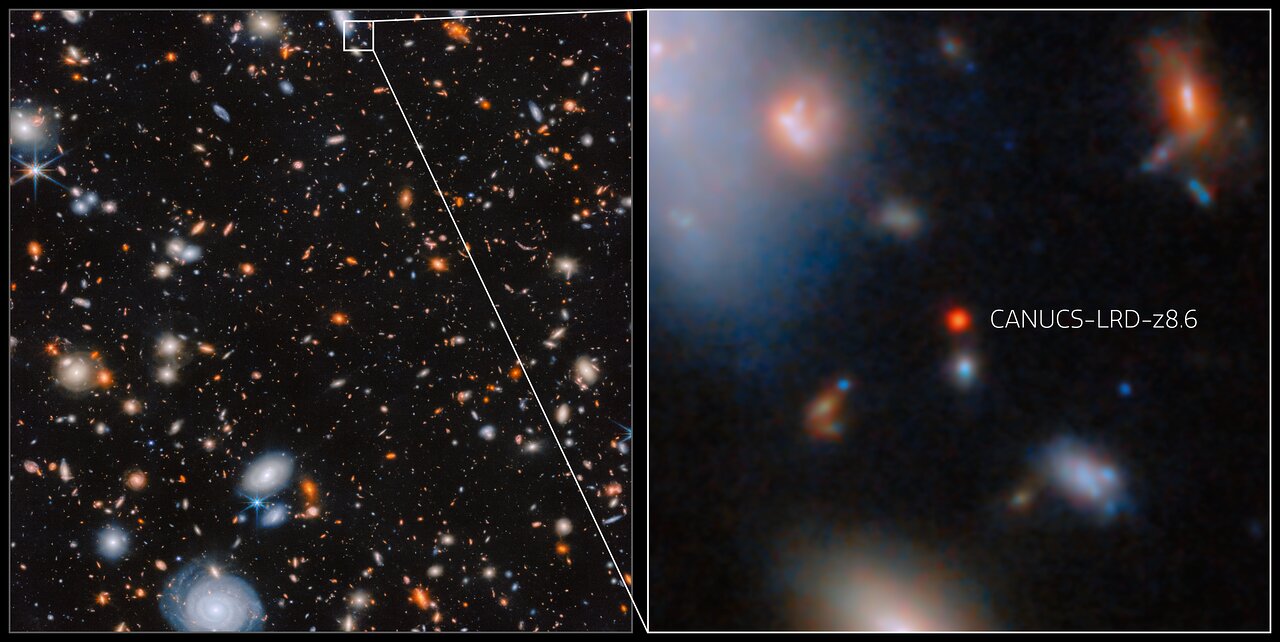
Euclid Telescope Finds 31 Ancient Quasars, Including Two That Break the Distance Record
The black-hole-powered beacons were already shining about 670 million years after the Big Bang, each as bright as roughly a trillion Suns.
The European Space Agency's Euclid telescope has found 31 very early quasars, including two that set new distance records, in what astronomers describe as a sudden jump in the number of known objects from the dawn of the universe.
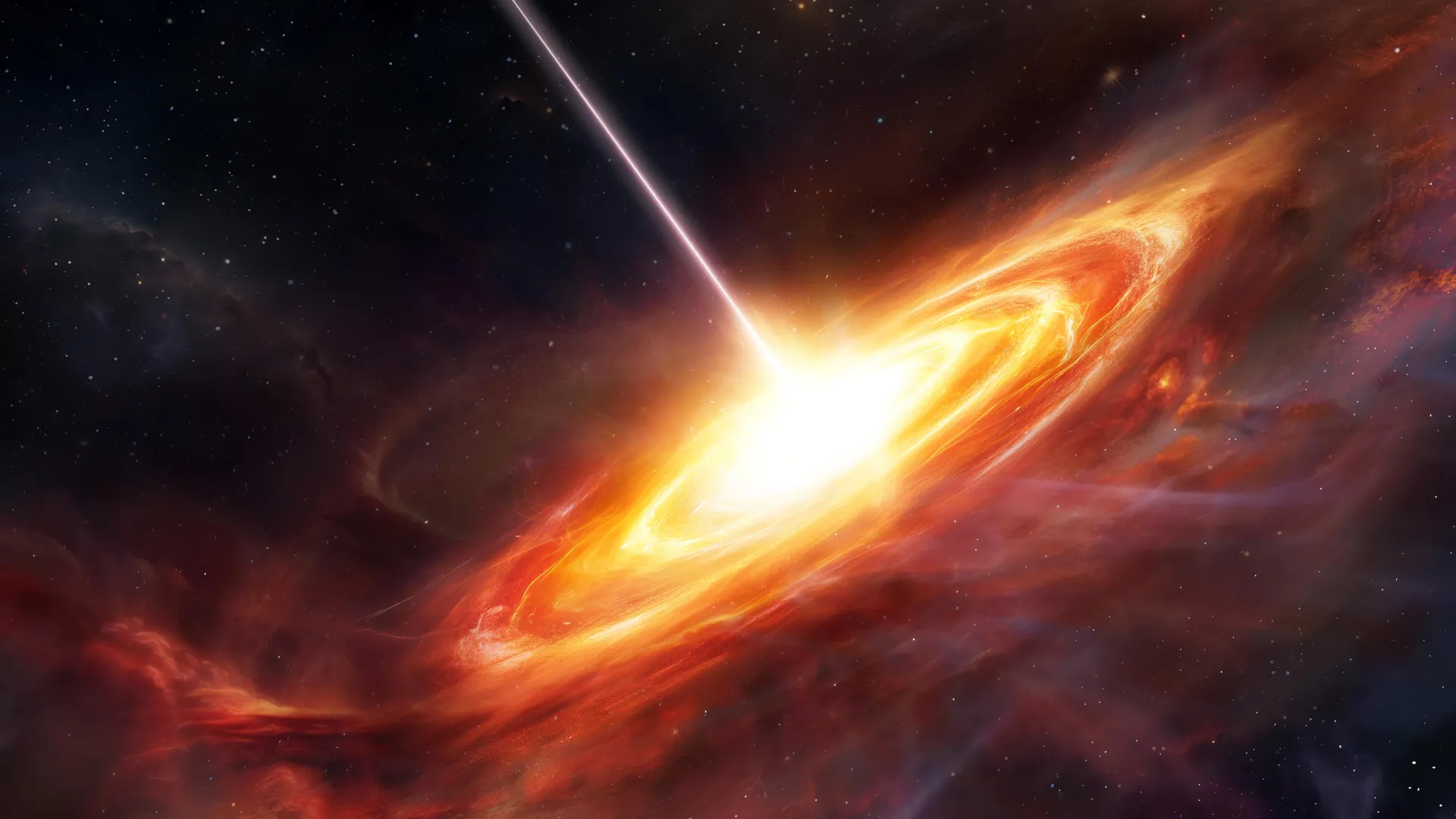
Quasars are the blazing cores of galaxies, powered by supermassive black holes that are gobbling up matter. They can outshine their host galaxies by hundreds to thousands of times. The two record-setters were already shining when the universe was about 670 million years old, roughly 5% of its present age, and are just over 13 billion light-years away. Each was as bright as about a trillion Suns.
The farthest, named EUCL J172902.75+641018.1, has a redshift of 7.77. The second, EUCL J125308.55+705432.3, sits at 7.69. The previous record, set by an object found in 2021, was 7.64. Redshift measures how far light has been stretched by the expansion of the universe, so a higher number means a more distant and earlier object.
All 31 were found in the Euclid Wide Survey, which will eventually cover more than one-third of the sky. Twelve of them have a redshift of 7 or greater, which places them within the first 770 million years of cosmic history. The pace is striking. Astronomers needed more than a decade to find roughly the first 10 quasars at redshift 7 or higher. Euclid passed that count in about one year.
Daming Yang of Leiden University in the Netherlands, lead author of the discovery paper, said: "Euclid is a true game-changer." Antonio La Marca, an ESA research fellow on the Euclid team, said the finding "more than doubles" the number of quasars known from this era. Silvia Belladitta and colleagues carried out a follow-up study of the second most ancient quasar and found it sits in a galaxy rich in gas and dust, where stars are forming rapidly.
Valeria Pettorino, ESA's Euclid Project Scientist, called ancient quasars "time machines" for studying the early universe. These objects date to the epoch of reionization, when the universe emerged from its so-called dark ages and radiation from the first stars and black holes stripped electrons from the surrounding hydrogen gas.
The result is a byproduct. Euclid, launched in 2023, was built mainly to study dark matter and dark energy by mapping the shapes and distances of billions of galaxies. Finding quasars at the edge of the observable universe was not its primary job.
The discovery raises a hard question that astronomers have wrestled with for years: how did black holes grow so massive so soon after the Big Bang? Every additional quasar from this era gives theorists another data point to test their models of black hole growth. With Euclid's survey still in its early stages and covering only part of its planned area, the count is likely to keep climbing.